
Welcome back, fellow connoisseurs of digital delinquency. Last time, we waded through the sprawling open worlds of indie GTA-likes that tried to do everything. It was fun. It was chaotic. But let’s be honest: sometimes you don’t want a 60-hour crime simulator with a side of fishing and a mortgage on a fake condo. Sometimes, you just want to rob a place, count your money, and not have to worry about your character’s hydration meter.
That’s where the “One-Mechanic” indie crime game comes in. These are the scrappy developers who looked at the monolithic juggernaut of Grand Theft Auto and said, “What if we just… took one part of that?” No bloated maps. No endless tutorials. Just a laser-focused loop of criminal enterprise. It’s the difference between an all-you-can-eat buffet and a perfectly cooked steak. And in 2026, with GTA VI looming over our wallets and our free time like a particularly expensive storm cloud, a tighter, more focused experience is exactly what the doctor ordered.
So, put down the 200-hour checklist and let’s look at the indie titles that understood the assignment: strip away the fat, keep the crime.
The Heist Pillar: Snatch Squad
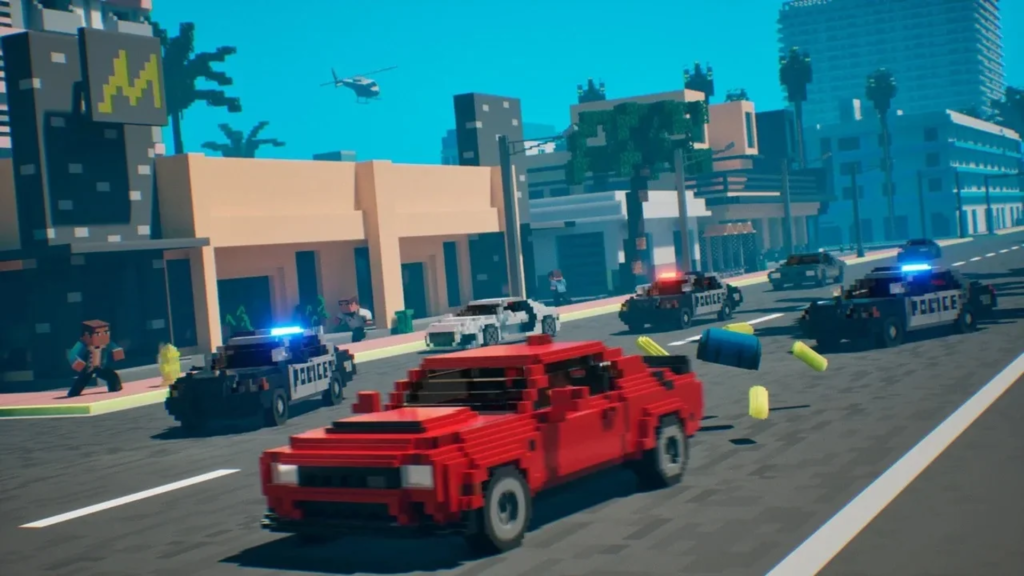
Let’s start with the most literal interpretation of “stripping GTA down.” Snatch Squad is a voxel-based co-op crime sim that describes itself—with the kind of blunt honesty usually reserved for a drunk friend at a bar—as “Payday in an open world like GTA.” Now, before you roll your eyes at the blocky aesthetic, hear me out. This isn’t about looking pretty. It’s about clarity.
In a traditional GTA heist, half the time you’re fighting the camera or wondering why your carefully planned stealth route got ruined because an NPC sneezed on a security camera. Snatch Squad focuses entirely on the heist and the laundering. You plan, you execute, you escape, and then—crucially—you wash the dirty money through legitimate businesses to build your empire. That’s it. That’s the loop.
It’s a game that understands the most satisfying part of a crime game isn’t the driving (controversial, I know), but the getting away with it. The voxel style means the city, inspired by a neon-soaked Miami, is readable and functional rather than a photorealistic maze of identical alleyways. You’re not here to admire the ray-traced puddles. You’re here to coordinate a four-man crew, manage roles, and outsmart the cops without needing a second monitor just for a map. It is, essentially, the heist fantasy without the open-world friction.
The Chaos Pillar: Hotline Miami
If Snatch Squad is about the planning, Hotline Miami is about the mess. This is GTA’s “going on a rampage” impulse distilled into something far more terrifying: a top-down puzzle game where you and every enemy die in one hit. There’s no driving, no property management, no sprawling city to get lost in. Just you, a mask, and a building full of people who need to be removed from the premises with extreme prejudice.
Why does this work as a “stripped” GTA? Because it takes the most visceral, immediate part of the crime fantasy—the violence—and removes every single buffer between you and the consequences. In GTA, you can tank a few bullets and call it a day. In Hotline Miami, a single mistake means you’re restarting the floor. It’s the chaos pillar refined into a razor-sharp, neon-drenched loop of “try, die, try again” that respects your time by wasting it in the most satisfying way possible.
The Crime Management Pillar: Pixurbia
If Snatch Squad is about the adrenaline of the job, Pixurbia is about the quiet, sociopathic joy of the ledger. This is a 2D top-down crime sandbox that isn’t trying to be an action game. It’s a crime simulator in the most literal sense. You want to rob a store? Go for it. But you can also run a legitimate business, gamble your savings away at a casino, or invest your ill-gotten gains in the bank.
It’s the game for the person who played GTA V and spent more time managing the properties as Michael than actually doing missions. Pixurbia strips away the third dimension and the cinematic camera angles to deliver pure, uncut systems. You can steal cars, sure, but you can also just work as a taxi driver if you’re feeling risk-averse that day. It is the ultimate “I’ll get to the crime later, I’m busy checking my investment portfolio” experience.
The Crime Management Pillar (Again, Because It’s a Deep Well): Schedule I
Look, if we’re talking about stripping GTA down to its business-management bones, we have to mention Schedule I. This is the indie hit that took the “drug empire” side activity from GTA and made it the entire game. You’re not running from cops in a stolen supercar; you’re managing supply chains, distribution, and expansion in a grungy low-fi sandbox. It’s Breaking Bad by way of a spreadsheet, and it has the review numbers to prove that people are absolutely here for it. It’s the “crime management” pillar with the volume turned all the way up and the action dial turned all the way down. For some of us, that’s paradise.
The Chaos Pillar (Retro Edition): Shakedown: Hawaii
If you want your chaos with a side of hostile takeover, Shakedown: Hawaii is your poison. This top-down, pixel-art satire from the mind behind Retro City Rampage puts you in the shoes of a CEO who decides the best way to fix his finances is through property damage, insurance fraud, and shaking down local businesses. It’s GTA if the protagonist was a geriatric capitalist with a grudge and a business plan.
The “one mechanic” here is acquisition through destruction. You’re not stealing cars for fun; you’re demolishing buildings to drive down property values so you can buy them cheap. It’s chaos with a purpose, wrapped in a 16-bit aesthetic that makes the whole thing feel like a deranged episode of a business seminar. It respects your time by making every act of vandalism a strategic move, and honestly, that’s a level of efficiency we can all aspire to.
Why the “One-Mechanic” Approach is the Future (or at Least, a Saner Present)
Look, I love a massive open world as much as the next person with a dangerously high tolerance for repetitive side quests. But the gaming landscape of 2026 is different. We’re tired. We have backlogs that could outlive us. The appeal of a game like Snatch Squad or Pixurbia isn’t just that they’re cheaper (though, bless them, they usually are). It’s that they offer density over scale.
These indie devs aren’t trying to build a city where you can enter every building. They’re building a system you can master in an afternoon. They strip away the “life sim” fluff and get right to the “crime sim” meat. It’s an acknowledgment that the most memorable parts of a GTA game aren’t the long drives to the mission marker, but the moments where a plan comes together (or spectacularly falls apart).
So, if you’re burnt out on the endless sprawl of modern AAA gaming and you just want to launder some fake money in peace, maybe it’s time to embrace the one-mechanic wonder. Your backlog (and your free time) will thank you.
What’s your favorite “stripped down” indie gem? Let us know in the comments—or don’t. We’re not the boss of you. (Unless you’re playing a crime sim, in which case, we absolutely are.)