
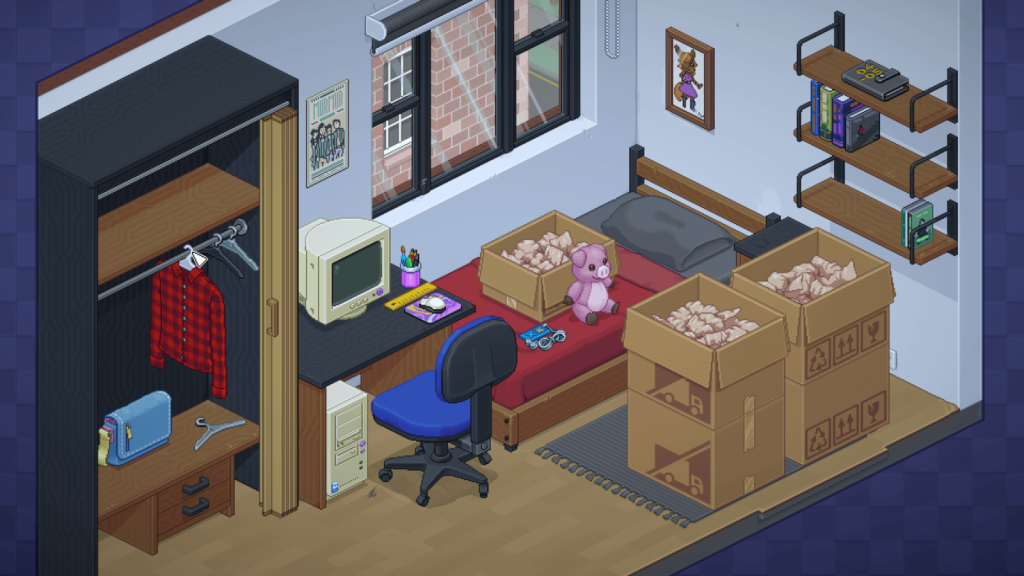
Hello everyone and welcome back to another blog post. Let’s be honest: most games are about saving something—a princess, a galaxy, your self-esteem after a bad haircut in a character creator. Unpacking is different. It’s a game about placing a toothbrush. And then being told, with a gentle, unyielding bloop sound, that you are wrong. This deceptively simple indie gem is a wordless, decade-spanning story about growing up, moving on, and learning that some people have very strong opinions about where kitchen sponges should live.
In a world where video games often feel like second jobs with more lasers, Unpacking offers a radical alternative: a few hours of quiet, methodical organization with a side of profound existential dread. It’s the digital equivalent of finding an old photo album and realizing your past self had questionable taste in decorative towels.
The Zen of Being Told You’re Wrong
The gameplay loop is meditative simplicity itself. A room appears, boxes tumble in, and you start dragging items out. A teddy bear on the bed. A book on the shelf. A diploma on the wall. The “puzzle” is learning the game’s secret, unspoken rules of domestic geography. Can the frying pan hang on the wall rack? Bloop. Apparently not. Try a lower hook. Ahh. The satisfying thunk of a correct placement is a tiny victory over chaos.
This is where the magic—and the gentle comedy—happens. The game isn’t just about putting things away; it’s about putting them in their rightful, culturally-approved place. It turns out we all share a deep, subconscious rulebook. Toilet paper goes on the holder, not the back of the toilet. Mugs face handle-out on the shelf. That weird ornamental geode you got at a roadside attraction? It goes… actually, where does that go? The game forces you to confront your own domestic biases. Who decided the cutlery tray was the only valid home for a soup spoon? Unpacking suggests a higher, stricter power did.
The Story in the Stuff: A Life in Four Moves
Without a single line of dialogue or text box, Unpacking tells a complete, tender, and relatable story. You follow an unseen protagonist from childhood bedroom to college dorm, first apartment, shared home, and beyond. The narrative unfolds entirely through her possessions.
You witness her journey not through cutscenes, but through artistic evolution (childhood drawings give way to university sketchpads and a professional graphic tablet). You infer her relationships (the cautious merging of two sets of bathroom products is a more tense negotiation than any political thriller). You feel her triumphs and setbacks by the quality of her living space and the personal items she makes room for.
It’s environmental storytelling at its most pure. Finding a beloved stuffed animal carefully placed in a new adult apartment hits harder than any tragic monologue. Realizing you can’t display a career award because your partner’s sports trophies take up all the shelf space… well, that’s a whole different kind of cinematic drama. The game is a masterclass in “show, don’t tell,” making you an active archaeologist of a digital life, dusting off each item for clues.
The Catharsis of a Perfectly Organized Virtual Drawer
So why is this so compelling? In our perpetually messy, notifications-buzzing, real-world lives, Unpacking offers a controlled space for completion and order. You can achieve a state of perfect, harmonious organization in 45 minutes—a feeling utterly elusive in reality, where a tidy room is just a paused state on its way back to entropy.
There’s a deep satisfaction in the finality of it. When the last book is shelved and the last pot is hung, the game simply… ends. The house is quiet. The job is done. It’s a small, perfect catharsis we rarely get elsewhere. It’s also, let’s be honest, a fantastic way to procrastinate from organizing your actual home. Why deal with your chaotic junk drawer when you can achieve zen by perfectly lining up someone else’s virtual socks?
The Verdict: Should You Buy This Digital Moving Simulator?
If your ideal game involves headshots and loot boxes, move along. Unpacking is for the rest of us: the contemplative, the curious, the mildly anxious who find comfort in a well-ordered pantry.
It’s a short, beautiful, and emotionally resonant experience that will make you laugh, sigh, and look at your own belongings with a newfound suspicion. It asks silent questions about what we keep, what we leave behind, and how we build a home out of a collection of things.
Just be warned: after playing, you may feel a sudden, unstoppable urge to reorganize your entire kitchen. And you’ll finally understand that, yes, there is only one correct place for the spatula. Anywhere else is simply chaos.