
Hello everyone and welcome back to another blog post. The management simulation genre is a place where we can live out our wildest corporate fantasies without the crippling fear of a real-life audit or having to fire someone named Chad who still uses a flip phone. For years, the genre was dominated by the same formulas: build a theme park, run a hospital, or try to keep your colonists from eating each other.
But the indie scene has decided that “management” can mean a whole lot more. It can mean managing a fantasy shop, managing the anxiety of a post-apocalyptic colony, or managing to build a factory without succumbing to the soul-crushing boredom of reality.
I’ve scoured the digital storefronts, ignored my actual responsibilities, and played dozens of hours of the best simulation titles to bring you the definitive list. These are the games that actually respect your intelligence—or at least, they’re entertaining enough to make you forget you’re basically doing unpaid accounting homework.
So, grab your ledger, polish your clipboard, and prepare to optimize your leisure time. Here are the Top 12 Management Simulator Indie Games that won’t put you to sleep.
1. Quarantine Zone: The Last Check — “Papers, Please” with Extra Body Fluids
Let’s kick things off with a game that asks the important question: “How many ethical violations can you commit before the zombies break down your walls?” Quarantine Zone: The Last Check drops you into the role of a checkpoint commander at humanity’s last stand against a zombie outbreak. This isn’t your casual “build a farm” simulator. This is a hardcore inspection sim where balancing the needs of the living against the risk of the infected requires a degree in medicine and a therapist.
Released in January 2026 by Brigada Games and published by Devolver Digital, this gem has you inspecting survivors for signs of infection using everything from UV flashlights to thermal scanners . The mechanics are so intricate that you’ll find yourself scrutinizing digital rashes and listening to lung sounds, much to the concern of your coworkers who think you’re developing some kind of medical fetish. If you’ve ever thought, “I wish Papers, Please was slightly less optimistic and had more body cavities to check,” this is your new digital soulmate.
The best part? Survivors will try to hide grenades in their butt. Repeatedly. Don’t try this at home. It’s dangerous and, I have to imagine, quite uncomfortable.
2. Prison Architect — “Hotel California: The Management Sim”
Welcome to the game that lets you live out every authoritarian fantasy you’ve ever had, legally and from the comfort of your own home. Prison Architect asks the simple question: “What if you ran a prison, but like, really ran it into the ground?”
You start with a plot of dirt and a dream—a dream of incarceration, rehabilitation, and hopefully, not too many riots. You’ll design cell blocks, hire guards, and manage the daily chaos of keeping murderers, thieves, and that one guy who stole a loaf of bread all in the same room without them forming a gang and shanking each other.
The beauty of Prison Architect is that it doesn’t judge you. Want to build a humane, reform-focused facility with libraries and counseling? Go ahead, you saint. Want to build a nightmarish panopticon where prisoners are packed like sardines and the only “rehabilitation” is forced labor in the license plate factory? Also an option. The game simply watches, occasionally throws a gang war at you, and asks, “How’s that working out for you, warden?”
It’s a masterpiece of systems design disguised as a moral playground. Just remember: if your prisoners start tunneling out using spoons, that’s a “them” problem, not a “you” problem. Probably.
3. Two Point Museum — “Finally, a Place to Display All Those Fossils You Definitely Dug Up Legally”
The third timeslot is apparently the charm for Two Point Studios, because Two Point Museum isn’t just a reskin of Hospital or Campus—it’s the evolutionary pinnacle of the “wacky British management sim” genre. Released in March 2025, this game asks the important question: “What if running a museum was exactly as chaotic as running a hospital, but with more ghosts and man-eating plants?”.
The core loop is deceptively simple. You build a museum. You hire staff: Experts to find stuff, Janitors to clean stuff, and Assistants to sell tickets and look vaguely disappointed . Then you send your Experts on expeditions to dig up, fish out, or exorcise new exhibits . A crate arrives! You open it! It’s a dinosaur skeleton! Or a frozen caveman! Or a ghost that will immediately possess your gift shop if you don’t build it a proper haunted display case .
Here’s where the simulation depth kicks you in the shins. Exhibits need maintenance. They need “Buzz,” which is generated by decorations, thematic consistency, and not letting the caveman thaw out and terrorize the visitors. You have to manage staff happiness, research upgrades, and deal with dilemmas on expeditions that read like a Choose Your Own Adventure book written by someone with a grudge against archaeologists. Send your expert into a spooky tomb? Sure, but he might come back with a curse instead of a sarcophagus.
With five distinct museum themes—from the prehistoric Memento Mile to the genuinely unsettling haunted Wailon Lodge—and a campaign that actually rewards you for revisiting and improving your old museums, this isn’t just a management sim. It’s a beautiful, chaotic, and surprisingly deep argument that curatorship is, in fact, a contact sport . Just don’t ask where the exhibits came from. They were… acquired. Ethically. Probably.
4. Football Manager 2026 — “Spreadsheet: The Game (Affectionate)”
Let’s be honest: you probably already have 3,000 hours in this franchise and don’t need me to tell you about it. But for the uninitiated, Football Manager is less a video game and more a lifestyle choice that your family will eventually hold an intervention for.
Now in its 20th year under the Sports Interactive banner, FM26 is the same beautiful disaster it’s always been—just shinier. You are the manager. You handle transfers, training, tactics, press conferences, and the delicate art of telling a 19-year-old wonderkid that no, he cannot have a new contract just because he scored one goal.
The game’s USP is its absurd database: roughly 47 million real players across 800,000 clubs, scouted by 1,600 obsessive volunteers who probably know more about Brazilian third-division left-backs than their own families. It’s so accurate that real clubs actually use it. The Philippines national team once recruited a player because an FM player emailed them about his eligibility. A 21-year-old kid got a real job as a club’s sporting director based entirely on his FM experience. Belgian manager Will Still literally became a professional coach because he stayed up until 4 AM playing this game as a teenager.
The 2026 edition finally drags the match engine into the present decade, redesigned the UI (which will confuse you for approximately 15 hours), and added women’s football for the first time. But deep down, it’s the same game it’s always been: a dopamine minefield where you spend four hours negotiating a contract, lose 3-0 to a team managed by a potato, and immediately start a new save because “this time will be different.”
It will not be different. See you in 2027.
5. Planet Zoo — “Building a Zoo is Easy. Building a Toilet is Hard.”
Remember Zoo Tycoon? You’d plop down a cage, drop in a lion, and call it a day. Planet Zoo is what happens when that game goes to grad school, gets a PhD in animal husbandry, and develops an existential crisis about conservation.
Released in 2019 by the beautiful masochists at Frontier Developments (the same folks who brought you Planet Coaster and the existential dread of Jurassic World Evolution), this game lets you build the zoo of your dreams . But here’s the catch: your dreams involve spreadsheets. So many spreadsheets.
The animals are, genuinely, the most realistic you’ll ever see in a video game. They have unique genetics. They have personalities. They form social bonds. They will absolutely refuse to breed because you placed their food bowl six inches too far to the left. A wolf pack actually behaves like a wolf pack. African plains animals can cohabitate peacefully. Predators will hunt other animals, but mercifully, they won’t eat your guests—Frontier learned that lesson from the Jurassic Park franchise.
6. Potion Craft: Alchemist Simulator — “Let Him Cook”
Potion Craft swaps spreadsheets for bubbling cauldrons. You run a potion shop in a fantasy world, but the heroes are too busy saving the realm to read the instructions. You have to manage ingredient sourcing (ethically dubious), customer relationships (heroes are terrible tippers), and inventory space.
The game shines in its tactile, physical interface. You’re actually grinding ingredients and stirring cauldrons. But don’t let the cozy vibes fool you. If you accidentally sell a “Fire Resistance” potion mislabeled as “Mana Regeneration,” that knight isn’t just coming back for a refund; he’s coming back with a torch and a grievance. It’s Recettear meets Breaking Bad, and it is just as stressful as that sounds.
7. Pixel Cafe — “Diner Dash Had an Existential Crisis, and Honestly? Good for Her.”
Remember Diner Dash? You’d zip around, seat customers, take orders, and everything was simple and beige. Pixel Cafe is what happens when that gameplay grows up, moves to Eastern Europe, and starts having complicated feelings about its childhood.
Released in late 2023 by Polish studio Baltoro Games, this game is a genre hybrid that shouldn’t work but absolutely does: it’s half frantic time-management sim, half melancholic visual novel about family, generational trauma, and the lingering shadow of the Soviet Union’s collapse. Yes, you read that correctly. Your coffee shop simulator has themes.
You play as Pixel, a young woman who’s moved back to her late grandmother’s home in the city of Karstok, hoping to make something of herself. She’s not your typical wide-eyed protagonist. She’s mouthy. She’s distrustful. She’s carrying baggage that would require an extra fee at the airport. And she works in diners. Lots of diners. Ten of them, each with different menus, different bosses, and different flavors of chaos.
Critics generally agree it’s a charmer. The Metacritic user score sits at a solid 8.2, with praise for its constant addition of new mechanics and its “story atypical for this medium”. Complaints exist—some find the controls clunky, the dialogue occasionally clumsy, and the difficulty curve a bit bonkers (early game is brutal until you upgrade, late game apparently gets easier). But at around 10-12 hours of content and a price tag under $15, it’s a steal.
It’s Diner Dash for people who now have emotions and a 401(k). Highly recommended. Just maybe keep tissues nearby. Grandma’s Coffee hits different when you’re not expecting it.
8. Airline Manager — Budget Airlines, Budget Safety
Ever looked at a budget airline and thought, “How do they make money while treating us like cattle?”. You are the CEO of a “low-cost, low-responsibility” airline. You choose the routes, the prices, and just how many maintenance checks you can skip to boost that stock price.
The dark humor is the main draw (even if unintentional). You can cut costs by removing the peanuts, or you can really cut costs by delaying maintenance. It’s a tightrope walk between bankruptcy and a federal investigation, and it’s hilarious right up until your “Pilot Wellness Program” results in a plane landing in the wrong country.
9. Oddsparks: An Automation Adventure — “Pikmin Got a Union Job and a 401(k)”
Ever played Pikmin and thought, “This is great, but I wish I could make these little guys work in an assembly line until they pass out from exhaustion?” Congratulations, Oddsparks heard you.
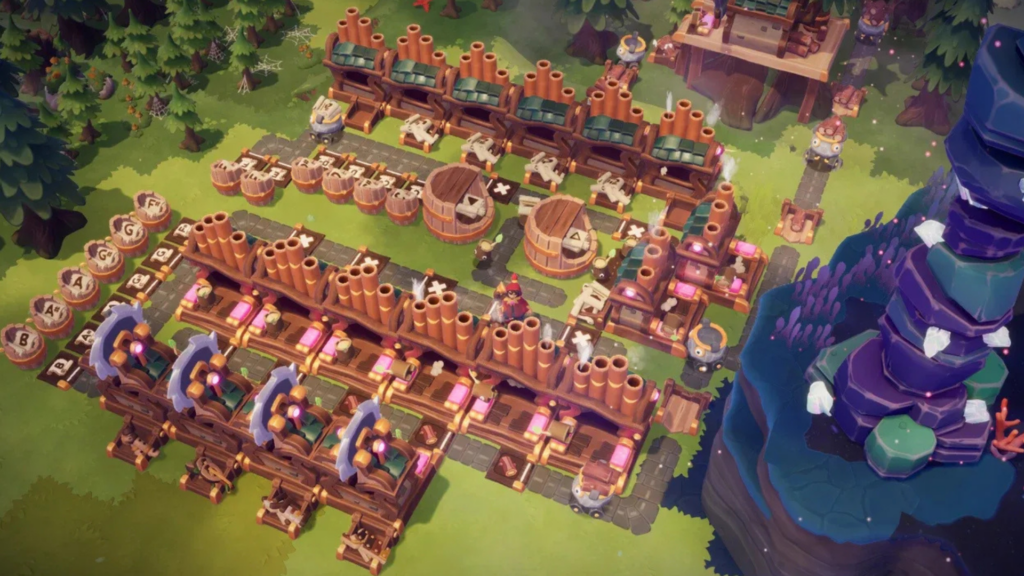
Released in full during May 2025 by Massive Miniteam, this game replaces conveyor belts with adorable golem-like creatures called Sparks. You throw them at machines, they carry stuff, they follow paths, and they occasionally get eaten by giant bugs. It’s Factorio meets Pikmin, but cozier and with more wood paneling.
The twist? No conveyor belts. Your Sparks are the conveyor belts, scurrying along paths you design while following a simple “keep right” rule that sounds charming until you realize you’ve created the world’s cutest traffic jam. Eventually you get trains, ziplines, and logic gates because apparently running a woodland factory requires a computer science degree.
Five biomes, co-op for up to four friends, and a village full of quest-giving townsfolk who definitely have opinions about your production efficiency. The AI can be a bit special—sometimes your Sparks will ignore the thing you asked them to harvest and instead punch a bush three miles away. But honestly? That just adds character.
Plus, and this is crucial: you can pet the Sparks. Game of the year, frankly.
10. Oxygen Not Included — “It’s Fine. We’re Fine. Everything is on Fire.”
Rounding out the list is Oxygen Not Included, Klei Entertainment’s masterpiece of space colony management. You are the only competent crew member on a ship full of dupes with the IQ of a damp sponge. You have to assign tasks, fix life support, and stop Gary from peeing in the water supply.
This game is a physics simulation first and a game second. You will learn more about gas pressure, heat transfer, and plumbing than you ever wanted to know. And just when you think you’ve stabilized everything, your entire colony dies because you forgot to filter the carbon dioxide. Again. It’s a masterpiece, and it hates you personally.
11. Satisfactory — “Factorio in 3D, or: How I Learned to Stop Worrying and Love the Conveyor Belt Spaghetti”
You knew this was coming. You felt it in your factory-optimized bones. Satisfactory isn’t just a bonus entry; it’s the elephant in the room that everyone’s already playing while pretending to work .
Developed by Coffee Stain Studios—yes, the same beautiful chaos gremlins who brought you Goat Simulator—this game drops you on an alien planet as a “Pioneer” for the vaguely sinister FICSIT Incorporated . Your job? Exploit the planet’s resources, build increasingly complex factories, and launch stuff into space. That’s it. That’s the plot. And honestly? That’s all you need .
What makes Satisfactory the undisputed king of the genre is the first-person perspective. Instead of watching your factory from a god’s-eye view, you’re in it. You’re walking through the spaghetti mess of conveyor belts you swore you’d organize “later.” You’re riding a factory cart through a tunnel you built at 3 AM. You’re standing on a cliff at sunset, admiring the absolute abomination of industry you’ve carved into the once-pristine wilderness.
The only downside? Performance. This game will absolutely cook your PC. Even on high-end rigs, late-game factories can cause frame drops and weirdness . But honestly? When you’re standing in the middle of a fully automated mega-factory that produces 50 different components simultaneously, you won’t care if your graphics card is screaming for mercy.
It’s not a management sim. It’s a lifestyle. And it is, despite the name, significantly more than satisfactory.
12. Hellmart — “Stock the Shelves, Survive the Night, Question Your Life Choices”
Who said management simulators can’t be scary? Hellmart is here to correct that assumption with extreme prejudice .
Released on January 28, 2026 by Bulgarian studio GAZE IN GAMES, this genre-bending horror-sim hybrid asks the simple question: “What if your shift at the local supermarket was also a fight for your literal soul?”. The game exploded thanks to a demo that racked up over 150,000 wishlists and a “Very Positive” rating, plus endorsements from basically every horror YouTuber with a pulse.
Here’s the gist: You’re the lone clerk at a 24-hour convenience store in the far North. During the day, it’s a perfectly normal supermarket simulator. Stock shelves. Scan items. Clean up after the drunk guy who vomits in the wine aisle. Hit your sales targets. Don’t be rude to customers, even if they’re smiling in a way that makes your skin crawl.
Then the sun goes down.
At night, the game becomes something else entirely. Strange figures knock on the locked doors, begging to be let in. Some are genuine survivors. Some are… not. They’re entities that can mimic any customer, and your survival depends entirely on your ability to read dialogue, spot patterns, and decide who gets shelter and who gets left to whatever’s lurking in the fog. Let the wrong one in, and suddenly you’re being hunted through aisles of cereal by something that really, really wants to know if you have a rewards card.
Now Go Manage Something
And there you have it. The Top 12 Management Simulator Indie Games that prove, once and for all, that spreadsheets can indeed be fun—provided they’re attached to something involving zombies, prisons, or extremely aggressive geese.
We’ve inspected survivors for contraband, built prisons that would make Geneva Convention observers weep, curated museums haunted by the very exhibits on display, and sent adorable Sparks to their inevitable doom in the name of “automation efficiency.” We’ve done everything except, you know, manage our actual responsibilities.
That’s the beauty of this genre. It lets us feel competent. In Quarantine Zone, you’re the only thing standing between humanity and extinction. In Football Manager, you’re the tactical genius who finally figured out the 4-4-2. In Oxygen Not Included, you’re… well, you’re the person who forgot to filter the carbon dioxide again, but at least you’re trying.
The indie scene continues to prove that management sims don’t have to be dry, corporate exercises in number-crunching. They can be funny. They can be emotional. They can be about your grandmother’s coffee recipe or a road trip with a convict in the backseat. They just have to make the spreadsheet feel like it matters.
So go forth. Purchase these games. Ignore your family. Lose track of time. Wake up at 3 AM in a cold sweat because you forgot to assign a janitor to the gift shop.
And remember: in every management sim, the real resource you’re managing is your own sanity.
Spend it wisely. Or don’t. I’m not your supervisor.