
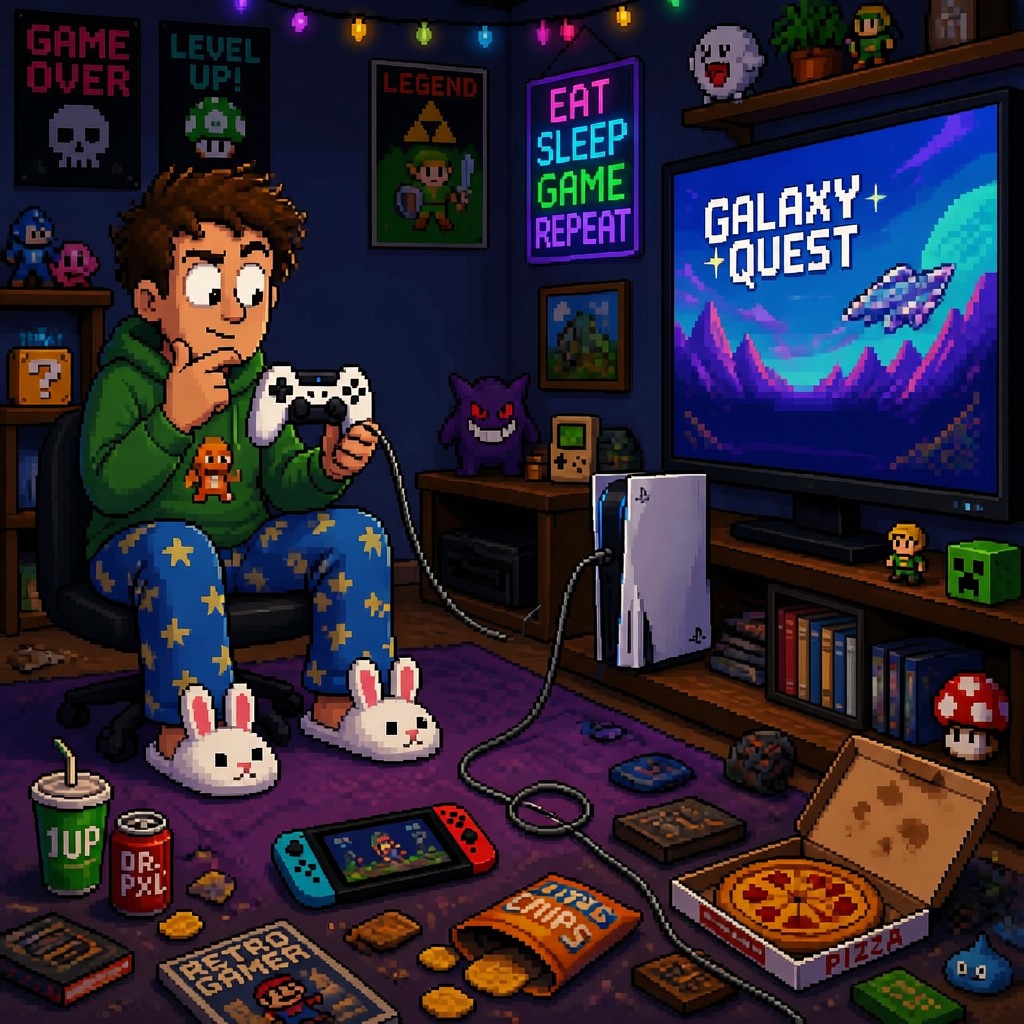
Welcome, weary traveler, to the only Top 10 Indie Games for Non-Gamers list on the internet that isn’t written for the sweaty-palmed individual who uses “K/D ratio” in casual conversation.
You are a “non-gamer.” You think a “roguelike” is something that happens to your internal organs after eating sketchy street food. You believe “metroidvania” is a new type of prescription drug. I am here to tell you, with the authority of someone who has spent way too many hours staring at a screen, that these games are not for “gamers.” They are for people.
What Even is a “Non-Gamer” Game?
Forget the stereotypes. A “non-gamer” isn’t someone who doesn’t play video games. It’s usually someone who doesn’t like being frustrated. They don’t want a game to be a second job. They don’t want a controller with more buttons than a NASA control panel. They want fun, story, and maybe some cute animals.
The List: 10 Games to Ruin Your Productivity (in a Good Way)
Here is the definitive, completely objective, and definitely not-biased list of indie games for the uninitiated.
1. Stardew Valley
The “I’ll Just Play for 15 Minutes” Lie
You know who loves Stardew Valley? My grandmother. Seriously. This game is the digital equivalent of a weighted blanket. You inherit a farm. You plant crops. You talk to villagers. You wonder why you ever thought city life was a good idea.
There is no “Game Over” screen. If you fail, you just wake up the next day with slightly less energy and a newfound appreciation for coffee. It’s a game about escapism, not competition.
If this doesn’t charm you, you are a robot. And even robots might like it because of the efficient farming mechanics.
2. Journey
The “Is This a Game or an Art Film?” Game
You are a robed figure. You walk through a desert. You slide down sand dunes. You fly with a scarf. That’s it. There are no enemies to kill, no levels to grind, no “git gud” nonsense. It’s a “short” game (about 2 hours) that feels like a spiritual experience.
The controls are simple. The point is to experience the emotional journey. Plus, the multiplayer is weirdly passive: you meet other players anonymously who only communicate by “chirping.” It’s the most wholesome multiplayer experience in existence. Because you can’t insult them over voice chat.
3. Untitled Goose Game
The “Nuisance Simulator”
Honk. That is the primary control. You are a horrible, terrible, no-good goose whose sole purpose in life is to ruin the day of a small English village. You steal a gardener’s hat. You trap a boy in a phone booth. You honk at people until they drop their groceries.
It’s hilarious. The puzzles require thought, but not “sweat on your forehead” thought. It celebrates chaos in a way that appeals to everyone who has ever wanted to be a menace to society without legal repercussions.
4. A Short Hike
The “Hiking Simulator” But Actually Good
You are a bird named Claire. You are on an island to climb a mountain. There are no bears trying to eat you, no survival meters, and no “over-encumbered” warnings. You just… hike. And chat. And maybe go fishing.
This is the “Palworld” of relaxation. Unlike the survival aspects of other games, A Short Hike has a “vibe” that is perpetually set to “Chill.” It’s a 2-hour joyride that is aggressively wholesome.
5. Unpacking
The “OCD Simulator”
You unpack boxes. You put things in rooms. You see a life unfold through the objects someone owns. A childhood bedroom. A dorm room. A shared apartment. It’s a puzzle game where the puzzle is “where does the frying pan go?”
It’s relatable. We all have to move at some point. It tells a story without a single word of dialogue, relying on the emotional weight of a well-placed plushie. It’s a brain massage.
6. Spiritfarer
The “Cry Your Eyes Out” Management Game
You are the new ferrymaster of the dead. You build a boat, grow crops, cook food, and help spirits move on to the afterlife. It sounds morbid. It is, actually, but it’s wholesome morbid.
It is a management game that doesn’t punish you for taking your time. The art is gorgeous. The music is beautiful. And the story will make you feel feelings you thought you buried deep down.
7. Firewatch
The “Walking Simulator with a Talking Lady”
You are a man named Henry who takes a job as a fire lookout in the Wyoming wilderness. Your only contact is your supervisor, Delilah, on a walkie-talkie. You walk around the forest. You talk to Delilah. You discover mysteries.
It’s basically an interactive movie. The dialogue is the main gameplay mechanic. If you like good writing and voice acting, this is your jam. No reaction times required.
8. Pencil Stories
The “Hand-Drawn Mailman”
A cute, hand-drawn game about a little letter named Letty who delivers mail to forest animals by solving riddles. The art is adorable, the controls are simple, and the vibe is “midnight postal service.”
It’s simple. It’s sweet. It’s a great starter game for anyone who finds a standard controller intimidating. It is the literal opposite of gun-toting chaos, proving that indie games come in all flavors of wholesomeness.
9. Balatro
The “Poker, But Addictive” Trap
You play poker hands. But there are “joker” cards that have weird effects. The numbers go up. Way up. You lose track of time.
Most people know how poker hands work. If you don’t, it teaches you in seconds. It’s a roguelike, but don’t let that scare you. In this context, “roguelike” just means “you can play it forever.”
10. Celeste
The “You Can Do It” Mountain
Wait, Celeste? The hard platformer? Yes. But here is the secret: it has a god-tier “Assist Mode.” You can slow down the game. You can give yourself invincibility. You can skip levels.
It is a game that says, “Hey, if this is too hard, it’s okay. Just enjoy the story.” The story is about anxiety and self-doubt, and it hits hard. It’s a message that says “you are enough,” even if you fall off the mountain 5,000 times. Assist mode is not cheating; it is caring.
A Quick Note on “Difficulty”
One thing we noticed while torturing our non-gamer friends with these games is that “difficulty” is subjective. For a seasoned player, Celeste is a challenge. For a newcomer, Stardew Valley might be stressful because “what if I plant the wrong crop?”
Here’s the secret: almost every modern indie game has options. Difficulty sliders. Assist modes. Accessibility settings. You are not “less of a gamer” for using them. You are a smart person who values their time and sanity.
If a game makes you feel bad, stop playing it. There are thousands of others. This list is a starting point, not a binding contract.
Conclusion: Stop “Gamering,” Start Playing
Video games aren’t just for the 14-year-old who drinks Mountain Dew and yells at a headset. They are for the grandma who wants to garden, the stressed-out office worker who wants to walk a dog, and the person who just really wants to be a disruptive goose.
So go forth. Play a game. You don’t have to be “good” at it. You just have to enjoy it.
And if you don’t enjoy it? Well, you can always go back to watching cute creatures wield assault rifles somewhere else. The choice is yours.