
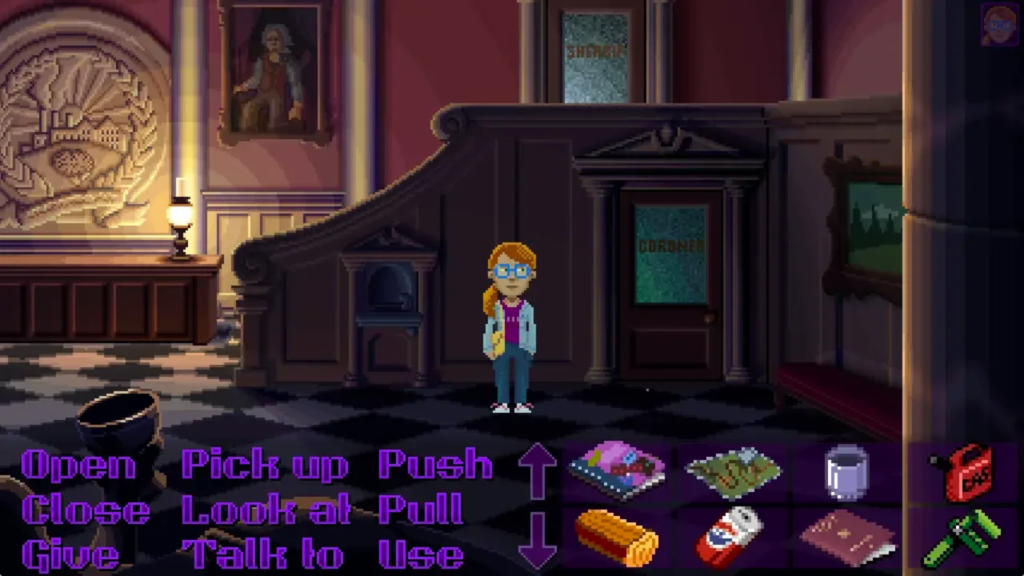
Let me guess: you’ve been burned by “retro-inspired” games before. You know the type—pixel art slapped on a hollow roguelike, sold to you as a “nostalgic experience,” and then you spend forty hours grinding for a hat that gives +2 charisma. Congratulations, you played a spreadsheet with a CRT filter.
Thimbleweed Park is not that.
It’s a genuine point-and-click adventure game, the kind where you walk around, pick up absurd objects, and combine them in ways that make sense only to the developer’s fever dreams. You play as five different characters—two federal agents, a ghost, a clown who can’t stop swearing, and an aspiring game developer—all investigating a murder in a town that peaked sometime before the Reagan administration and hasn’t quite accepted it.
The game was released in 2017 by Terrible Toybox, and it’s still sitting at “Very Positive” on Steam with over 3,200 reviews. For a niche genre that most publishers treat like a radioactive turd, that’s genuinely impressive.
The Good: What Thimbleweed Park Gets Right
The Puzzles Actually Make Sense (Mostly)
Here’s a revolutionary idea for adventure game developers: puzzles should be solvable through logic, not through brute-force object-combination roulette. Thimbleweed Park understands this most of the time.
One player on Metacritic put it well: the puzzles are “all well thought and logical; not too easy and not super frustrating. And you always have something to do or something to check, so getting stumped is rare.” That’s high praise for a genre where “moon logic” is practically a badge of honor.
The game also has a hint system that doesn’t treat you like a toddler. It gives you nudges without spoiling the solution, which is a delicate balance that most games completely botch. A full playthrough in Hard Mode usually takes people around 10 hours or more, which is a solid chunk of game for the price.
The Tone: Twin Peaks Meets Monkey Island, With a Side of Existential Dread
The game wears its influences proudly. A dead body under a bridge, a haunted hotel, a burnt-out pillow factory—it’s all very Twin Peaks, if Twin Peaks had a better sense of humor and fewer lingering shots of cherry pie. One reviewer described it as “the creepiness of Twin Peaks with the humor of Monkey Island,” which is about as accurate a one-line summary as you’ll find.
The voice acting is genuinely good. The art is gorgeous in that specific 1987 way that triggers something primal in anyone who grew up with a CRT monitor and a floppy disk drive. And the writing has real teeth—it’s funny without being desperate, weird without being random.
It’s a Genuine Tribute, Not a Cash-Grab
The people who made this game are the people who made the games you loved. Ron Gilbert and Gary Winnick didn’t license the Maniac Mansion IP and hand it to a studio that makes mobile puzzle games. They built this themselves. As one Steam reviewer put it: “This game is just spectacular. Some of my earliest gaming memories were playing adventure games my dad bought me… This game has some serious nostalgia.”
That authenticity matters. You can feel it in every interaction.
The Bad: Where Thimbleweed Park Stumbles
The Ending Is a Middle Finger Wrapped in a Plot Twist
Let’s talk about the ending. I won’t spoil it, but I will tell you that it’s the most divisive thing about the game.
One user review calls it “an almost literal deus ex machina type ending which robs the player of any sense of accomplishment or decent wrap up for the characters.” Another says the story “falls slightly short of what it could have been” due to “poor pacing and mismatched plot elements.” A Steam review (translated from Chinese) bluntly calls the story “a super big failure” with “an extremely hasty ending.”
Here’s the thing: Thimbleweed Park is deeply meta. It’s a game about adventure games, about the people who make them, about the people who play them. The ending is part of that commentary. Whether it works for you depends entirely on how much patience you have for a game that’s constantly winking at you.
For some players, it’s brilliant. For others, it’s a narrative betrayal. There is no middle ground.
The Pacing Is Uneven, and Some Characters Get Shortchanged
The game has five playable characters, which sounds generous until you realize that spreading the narrative across five protagonists means none of them get the depth they deserve. One reviewer noted that “the multiple characters could have been what made this game great but it ends up diluting the overall experience because there simply isn’t enough narrative or game to go around.”
The first two-thirds of the game is mostly puzzle-solving with occasional plot developments. Then the final third tries to wrap up five character arcs, a murder mystery, a town-wide conspiracy, and an existential meta-commentary on the nature of adventure games. It’s ambitious. It’s also too much for the time allotted.
The Difficulty Curve Has a Cliff
The puzzles are logical for most of the game, but there’s a notorious difficulty spike involving a tube design that one reviewer describes as having “absolutely no clue” to guide you. The hint system helps, but if you’re playing without it (because you’re a masochist), you’ll spend a lot of time wandering around wondering what the developers were thinking.
Should You Buy Thimbleweed Park in 2026?
If you loved Monkey Island, Day of the Tentacle, or Maniac Mansion—or if you’ve ever described a game as “a point-and-click adventure” without irony—yes. Buy it. It’s $10, it’s on every platform you own, and it’s one of the best examples of the genre in the last decade.
If you’ve never played a point-and-click adventure and don’t know why anyone would want to combine a rubber chicken with a pulley—maybe start with Monkey Island first. Thimbleweed Park assumes you know the language. It’s not hostile to newcomers, but it’s not here to teach you the alphabet either.
And if you’re the kind of person who needs every narrative thread neatly tied off with a bow and a satisfying epilogue? You’re going to hate the ending. You’ve been warned.
Frequently Asked Questions
Is Thimbleweed Park good for beginners to adventure games?
It’s manageable, but it assumes familiarity with the genre’s conventions. If you’ve never played a point-and-click before, start with Monkey Island or Day of the Tentacle to learn the rhythm, then come back.
How long does Thimbleweed Park take to beat?
Around 10–12 hours on Hard Mode, less on Casual. The hint system can shave off time if you get stuck, and you probably will at least once.
Is the ending really that bad?
It’s polarizing. Some players find it clever and thematically consistent; others find it frustrating and unsatisfying. If you hate meta-commentary in your storytelling, adjust your expectations accordingly.
Which platforms is Thimbleweed Park available on?
PC, Mac, Linux, PlayStation 4, Xbox One, Nintendo Switch, iOS, and Android. It runs on basically anything with a screen and a pulse.
Do I need to play Maniac Mansion first?
No. The game stands alone. But you’ll appreciate the references more if you have.
Final Verdict
Thimbleweed Park is a flawed gem. It’s got the wit, the charm, and the puzzle design of the LucasArts golden age, wrapped in a package that occasionally trips over its own ambition. The ending will divide you. The pacing will test you. But the good parts are so good that they’re worth the frustration.
It’s a game made by people who love adventure games, for people who love adventure games. If that’s you, you already know you’re going to buy it. If it’s not, now you know what you’re missing.