
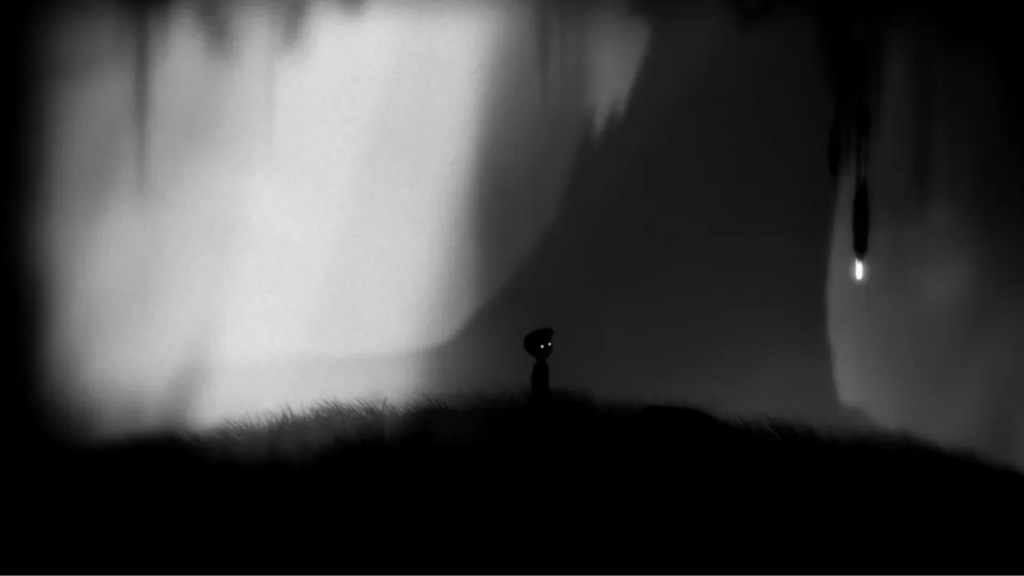
Hello everyone and welcome back to another blog post. So, you’ve just booted up a 16-year-old game. A game that’s in black and white, stars a kid who can’t talk, and features a tutorial that’s basically “just try not to get decapitated.” Welcome to Limbo. And no, before you ask, this isn’t a guide on how to do that silly dance under a stick. We’re talking about the good Limbo—the one that defined an entire genre of indie games.
The “Trial and Death” Method: Failing Forward Since 2010
Let’s get one thing straight: Limbo hates you. Oh, it’s not obvious about it at first. It lures you in with its artsy, monochrome visuals and a haunting ambiance that screams “I am a profound piece of interactive art.” But give it five minutes, and you’ll be watching a giant spider stab a small boy with its pointy legs. Fun, right?
This is what Playdead, the developers, so lovingly called the “trial and death” approach. Modern games often hold your hand, give you a nice little pop-up tutorial, and ensure you feel like a superhero. Limbo actively wants you to fail. It’s a puzzle game where the core mechanic is “how many horrifying ways can this child die before I figure out the solution?”
But to be honest? That’s the beauty of it. The deaths aren’t just there to be punishing; they’re the tutorial. The game teaches you through visceral, gut-wrenching failure. Bear traps snap shut, and you learn to look at the ground. A giant spider skewers you, and you learn that running isn’t always the right answer. By 2026, this “learn-by-dying” loop is practically a standard in indie platformers, but playing Limbo now proves it still has the best, most morbidly effective version of it.
The Silent, Shadowy Child Who Launched a Thousand Indie Games
Speaking of influence, it’s almost comical how many “masterpieces” owe their entire existence to this game.
Look at Inside—Playdead’s own spiritual successor—which is essentially Limbo 2: Slightly More Color, More Weird. It’s an incredible game, but to see it is to see the refinement of everything Limbo started. Then, of course, there’s the Little Nightmares series. Does that game feature a tiny, vulnerable child in a horrific world with no dialogue? Of course it does, because Limbo cleared that path and made it a viable genre.
Even the more optimistic cousin, Ori and the Blind Forest, uses that same DNA of precise platforming and wordless storytelling. It just swapped out the crushing dread for a bit of color and heartfelt emotion. It’s a testament to Limbo’s design that its formula works whether you’re telling a story of absolute despair or a story of hope.
2026 Takeaway: Brevity is the Soul of (Game Design) Wit
In an era where games are often bloated with 100-hour open worlds, skill trees, and crafting systems that require a PhD to understand, Limbo’s greatest strength in 2026 is its restraint. The game is about three hours long.
That’s it. No filler. No pointless collect-a-thons. No tedious side quests. Just a razor-sharp, tightly-paced nightmare that respects your time. Each screen is meticulously crafted to introduce a new puzzle or twist on an old one. It’s a stark, sarcastic rebellion against the “content is king” mindset that plagues modern gaming. Limbo proves that a short, perfect experience is infinitely more valuable than a long, mediocre one.
The Enduring Mystery: Are We Dead or Just Very Confused?
And then, of course, there’s the ending. Fifteen years later, and we’re still debating what the heck it all means.
Is the boy dead? Is the sister dead? Did they die in a tragic treehouse accident or a car crash? Are they both in purgatory? Is the final scene with his sister a happy reunion or a trick of a malevolent, hopeless afterlife?
The beauty of Limbo is that its story is the ultimate Rorschach test. The game refuses to give you a neat, tidy explanation. Some fans argue the sister is unaware she is dead, and the ending is a moment of horrific realization. Others believe the boy is trapped in an endless cycle of suffering, like Sisyphus pushing his rock.
Here’s my take: the game is a masterclass in narrative ambiguity. It forces you to engage, to theorize, to fill in the blanks with your own fears and interpretations. And in 2026, when games often explain every single plot point with an audio log or a cutscene, that kind of mature, “figure it out yourself” storytelling feels more refreshing—and more terrifying—than ever.
Look, you know me. I’m a cynic. But even I can’t deny that Limbo is a masterpiece. It’s a game that is brutal, beautiful, and brief. So, do yourself a favor and play it—if only to remember a time when a game could say so much by saying absolutely nothing at all.