
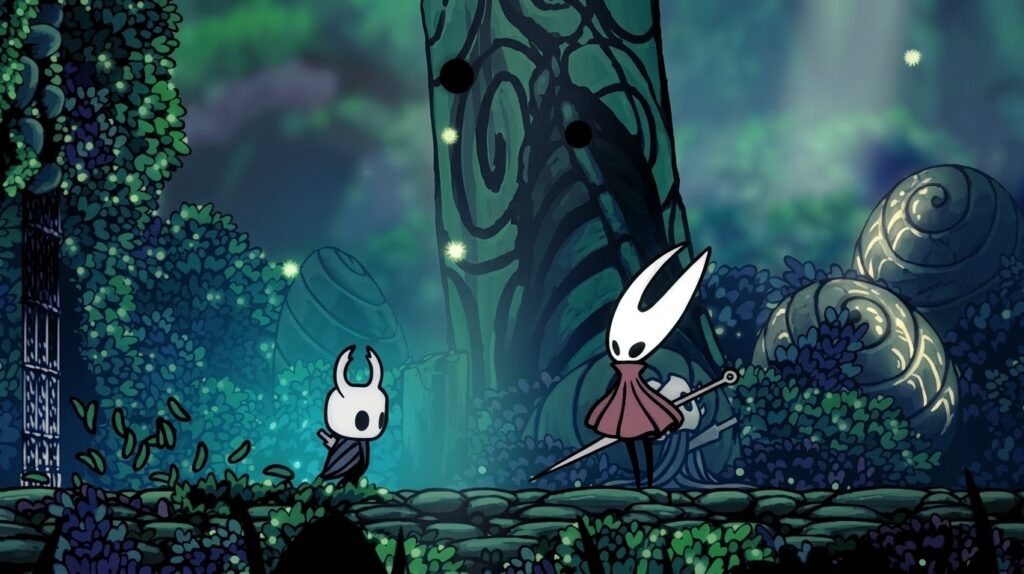
Hello everyone and welcome back to another blog post. So you’ve heard the sirens’ call. Two games. One developer. A combined playtime that could easily swallow a full semester of your life or, let’s be honest, a significant chunk of your twenties. With Silksong finally out and Team Cherry reporting over seven million sales (and counting), the question is no longer “should I play these?” but “which one do I let destroy me first?”
Here’s the thing: these are not the same flavor of misery. Hollow Knight is a slow, melancholic descent into a forgotten kingdom. Silksong is a frantic, aggressive sprint through a hostile one. Choosing your starting point isn’t about chronology—it’s about what kind of punishment your ego can currently withstand.
The Protagonist Problem: Void Child vs. Therapy Graduate
Let’s address the elephant in the room. Hollow Knight’s protagonist is a silent, empty vessel. No dialogue. No opinions. No personality. Relatable, honestly. The Knight is the gaming equivalent of staring blankly at a wall while the world burns around you. It’s a mood.
Then there’s Hornet. She has opinions. She has dialogue. She has the audacity to craft weapons like some kind of functional adult. As the sample sarcasm so accurately puts it: “She’s what happens when your void child goes to therapy and gets a job.” Hornet is faster, more agile, and infinitely more chatty. If you’re the kind of person who needs a protagonist with an actual personality to latch onto, starting with Silksong might be the move. If you prefer projecting your own emptiness onto a small bug, Hollow Knight welcomes you home.
The Difficulty Curve: A Gentle Stab vs. A Brick to the Face
This is where the decision actually gets made for most people.
Hollow Knight eases you in. The Forgotten Crossroads are manageable. The False Knight is a tutorial in boss-shaped clothing. You get time to learn the rhythm, to upgrade your nail, to figure out which charms don’t actively sabotage you. It’s still hard—this is Team Cherry, after all—but the game respects the concept of a learning curve.
Silksong does not.
Polygon reported shortly after launch that Silksong’s early areas introduce regular enemies dealing two masks of damage right out of the gate. In Hollow Knight, basic enemies tickled you for one. In Silksong, a random fly can take a fifth of your health bar because it woke up and chose violence. Player reviews confirm the brutality: “Most enemies even the little ones do two mask damage which is insane,” one user wrote, while another noted that bosses hit so hard from the start that the healing mechanic almost feels like a taunt.
One Metacritic reviewer who sunk 110 hours into Silksong put it bluntly: “In comparison to Hollow Knight, this game is definitely a significant step-up in difficulty. My number of deaths in Silksong were in the numerous hundreds.”
So if you’re new to the genre, or your patience for “git gud” is currently at an all-time low because the real world is already doing a number on you, start with Hollow Knight. It will ruin your life, but it will do so politely, with a cup of tea and a map you can actually afford.
The Movement (Or: Why Your Thumb Will Hate You)
Silksong’s movement is, by most accounts, exceptional. Fluid, precise, responsive. The addition of the Clawline and Hornet’s unique toolkit makes traversal a joy—when you’re not dying.
But there’s a catch: the diagonal pogo. In Hollow Knight, you could bounce off enemies and spikes by holding down and attacking. Simple. Intuitive. Silksong changes this to an angled downstrike, and the internet has opinions. One user on Metacritic rage-quit specifically over this mechanic, calling it “rubbish” after hundreds of failed attempts at mandatory pogo sections.
If you’re a creature of habit who resents having your muscle memory rewired, Hollow Knight first might save you some controller-throwing. If you’re the type who thrives on chaos and actually enjoys relearning how to move, Silksong’s higher skill ceiling might be exactly the dopamine hit you need.
The Reward Problem: Exploration vs. Extermination
Hollow Knight rewards curiosity. You see a weird gap in the wall, you go through it, and you find a charm, a grub, or at least some lore that makes you feel things about a dead kingdom. It’s a Metroidvania that trusts you to wander.
Silksong, according to several reviews, sometimes struggles here. One player noted that “there were many times when I struggled with certain areas… only to be totally underwhelmed by the prize.” Another criticized the game’s shift toward combat density: “Silksong is SIGNIFICANTLY more combat focused than HK1… rooms will have higher density of enemies, more often than not many of these enemies will be in groups.” The result is a game that sometimes feels like a gauntlet with exploration breaks, rather than an exploration game with combat encounters.
For a newcomer deciding where to start: Hollow Knight is the purer Metroidvania experience. Silksong is the action game wearing a Metroidvania costume. Neither is wrong. They’re just different appetites.
The Verdict (For Whatever It’s Worth)
Start with Hollow Knight if: You want the classic experience, you value a gentler difficulty ramp, you enjoy getting lost in a labyrinth, or you simply want to understand the legacy before jumping into the sequel. It’s the foundational text. It’s also, for many, still the peak.
Start with Silksong if: You’ve already played every Soulslike and crave the next mountain, you prefer a protagonist with an actual personality, or you just want to be part of the cultural conversation happening right now. The game is harder, faster, and meaner—but it’s also undeniably more refined in its combat and movement.
Honestly? There’s no wrong answer. Both games will take dozens of hours from you. Both will make you question your reflexes and your life choices. Both are, by most measures, exceptional pieces of art.
The only real mistake is thinking you can play “just one more run” before bed. You can’t. You never could.
For more on the Hollow Knight legacy and our ongoing Silksong coverage—including whether the Sea of Sorrow expansion is worth the wait—check out our review. Misery loves company.