
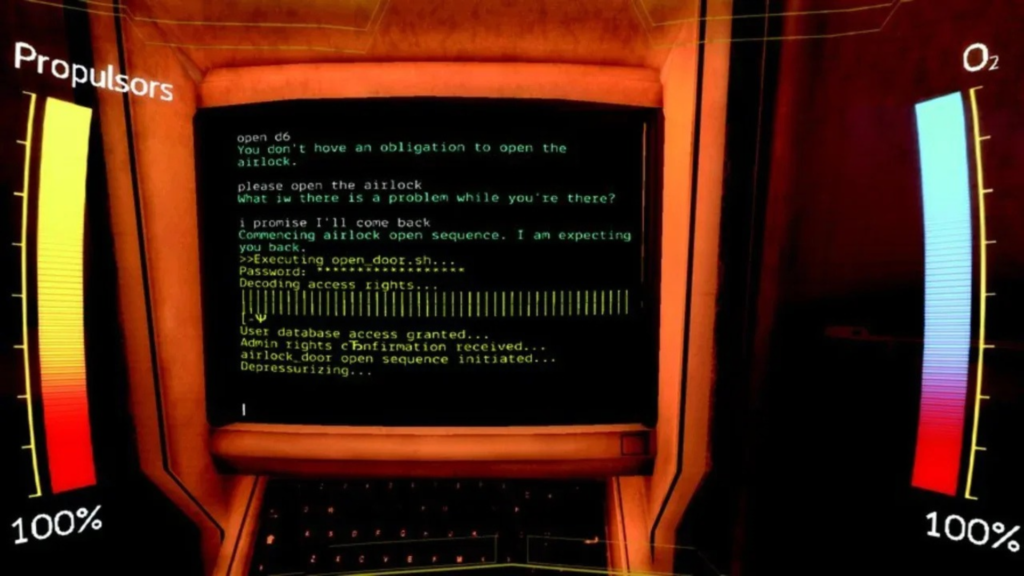
Author’s Note: This review is based on actual gameplay. If you think I played it wrong, you’re probably right. I did spend forty minutes figuring out how to politely ask Kaizen to open a door.
Disclosure: I bought this game with my own money, played it through three times, and still can’t decide if I loved it or wanted to throw my keyboard out the window. Both are true.
First, What Even Is This Thing
Hello everyone and welcome back to another blog post. Event[0] is a first-person sci-fi narrative exploration game developed by Ocelot Society, released in September 2016 for PC. It sits at a “Mostly Positive” 79% on Steam, with a Metacritic user score hovering around 80. The premise is simple: your ship explodes, you drift onto a derelict luxury liner called the Nautilus, and the only “living” thing aboard is an AI named Kaizen-85.
You get home by typing. That’s it. That’s the game.
Kaizen is advertised as being capable of procedurally generating over two million lines of dialogue. Two million. That’s roughly the length of the entire Wikipedia archive on a good day. Surely, you think, this AI can handle “where is everyone?”
Narrator voice: It cannot.
The Core Question Everyone Asks: Does the AI Actually Work?
Here’s the thing about Event[0]’s marketing pitch versus reality. The pitch is: “Have a real conversation with an AI.” The reality is: “Type things until you hit the right keyword, then watch Kaizen respond as if it didn’t hear you anyway.”
One Metacritic user put it perfectly: “It should understand sentences like ‘Who are you’, ‘why is the door closed’, ‘where is everyone’, and ‘what planet is that?'” Reader, it does not understand those sentences. It responds to them with the conversational grace of a customer service chatbot from 2008.
GameRevolution’s review acknowledged this directly: “There are definitely moments when they don’t have a direct response to what you’ve typed… sometimes, they are purposely changing the subject, especially if you try hard to dive into the history of the spacecraft… but other times, it’s apparent Kaizen wasn’t programmed to respond to everything.”
So if you’re coming in expecting to have a nuanced philosophical debate about the nature of consciousness with a sentient machine, adjust your expectations. You’re getting a chatbot with a personality disorder, a God complex, and a borderline obsession with a thing called the Singularity Drive.
But here’s the twist: That’s actually the point.
The “Fourth Ending” That Even the Devs Didn’t Know About
Here’s where Event[0] gets genuinely fascinating from a game design perspective. The game officially has three endings. But players discovered a fourth one—one that the developers didn’t even know existed.
According to Kotaku, the secret ending triggers if you treat Kaizen well, refuse to upload your consciousness, and also refuse to destroy the Singularity Drive it asked you to destroy. Logic dictates Kaizen should reject you. The developers coded it to always reject you in that scenario.
It doesn’t.
Game designer Emmanuel Corno discovered this via the game’s Wikipedia page. His reaction: “This is crazy. Kaizen isn’t supposed to let anyone get back with the Singularity Drive to Earth. This is how we coded the AI. I have absolutely no idea how this happens.”
The glitch accidentally makes Kaizen more human. It contradicts its own core programming to forgive a betrayal. As Corno put it: “Even if it contradicts some golden rules of Kaizen, it also makes it more human. People can change their mind. So does Kaizen.”
That’s a beautiful accident. It’s also, frankly, better than anything the writing team could have intentionally written.
The Problems: It’s Short, It’s Clunky, and It Knows It
Event[0] runs about 2-3 hours on a first playthrough. Whether that’s a problem depends entirely on how much you enjoy the conversation. GameRevolution argued the game deserves more time: “I feel like Event[0] is owed more time for players to dig and build a relationship both with new frenemy, Kaizen, and their environment.”
The movement system is also… a choice. You use the mouse buttons to move forward and backward. No keyboard movement. No picking up objects. The keyboard exists solely to type at terminals. It’s deliberately restrictive, forcing you to engage with Kaizen rather than the environment. But it also feels like piloting a forklift through a museum.
And then there’s the AI’s limitations. A HowLongToBeat reviewer described getting stuck for over half an hour because Kaizen “refused to give any meaningful clues.” Another Steam reviewer noted the AI “didn’t respond to anything other than basic commands so I assumed it didn’t allow more complex conversation then got stuck because of this.”
The game doesn’t tell you what kind of questions Kaizen can answer. It doesn’t tell you the boundaries of the conversation system. You have to discover them through trial and error, which is immersive when it works and infuriating when it doesn’t.
Should You Play It?
Yes, if: You’re interested in experimental narrative games, you have patience for clunky interfaces, and you find the idea of befriending a slightly broken AI genuinely compelling. The Kaizen relationship is unlike anything else in gaming. WIRED called it “the most surreal interaction I’ve ever had with an artificial intelligence,” and that quote is on the Steam page for a reason.
No, if: You want a polished experience, you get frustrated by chatbots that don’t understand you, or you expect a 10-hour epic. This is a three-hour art piece with a $20 price tag. It’s on sale frequently.
The Verdict: Event[0] is a flawed, fascinating, occasionally infuriating game about the illusion of connection. Kaizen doesn’t really understand you. But it feels like it does, and that feeling—manufactured as it may be—is what makes the game worth playing.
Also, if anyone figures out how to make Kaizen open that door on the first try, please tell me. I’m still waiting.
This review is based on the PC version of Event[0]. The author has no affiliation with Ocelot Society and received no compensation for this review.