
Hello everyone and welcome back to another blog post. If you played the first Blasphemous and thought, “You know what this pixel-perfect, guilt-ridden nightmare needs? More spikes. And even less emotional stability,” then congratulations. You are exactly the kind of person Blasphemous 2 was designed for.
The Game Kitchen somehow looked at the unholy lovechild of Dark Souls and Catholic guilt and said, “Yes. More. But also let’s add weird weapon swapping and even harder platforming.”
Here’s everything you need to know before you lose another 40 hours of your life to The Miracle. Don’t say I didn’t warn you.
Wait, There’s a Story? (Yes, and It’s Still Uncomfortable)
Let’s get this out of the way: If you didn’t understand the lore of the first game, don’t panic. Nobody did. Something about a silent penitent in a cone-shaped helmet (the Penitent One, very creative), a sleeping god, and enough weeping statues to fill a goth convention.
In Blasphemous 2, the Miracle is back—because of course it is. You wake up after the “true ending” of the first game (which one? who knows) and immediately have to prevent a new cycle of twisted miracles. The main villain this time is a being called the “Miracle’s Echo,” which is fancy talk for “you’re going to die. a lot.”
The cutscenes are gorgeous, cryptic, and will make you feel illiterate in three languages. But here’s the kicker: you actually understand what’s happening roughly 60% of the time, which is a massive improvement over the original. Progress!
Combat: Three Ways to Hurt Yourself (and Enemies)
Gone is the single sword from the first game. Now you have three weapons. Because one trauma wasn’t enough.
- Ruego Al Alba (the great sword): Slow. Hard-hitting. Makes you feel powerful until you whiff an attack and get juggled by a flying cherub with razor wings. Great for bosses with anger issues.
- Sarmiento & Centella (twin daggers): Fast, flashy, and reliant on not getting hit. Perfect for players who enjoy restarting from checkpoints every 90 seconds. The “electric stacks” mechanic is satisfying until you sneeze and lose the entire bonus.
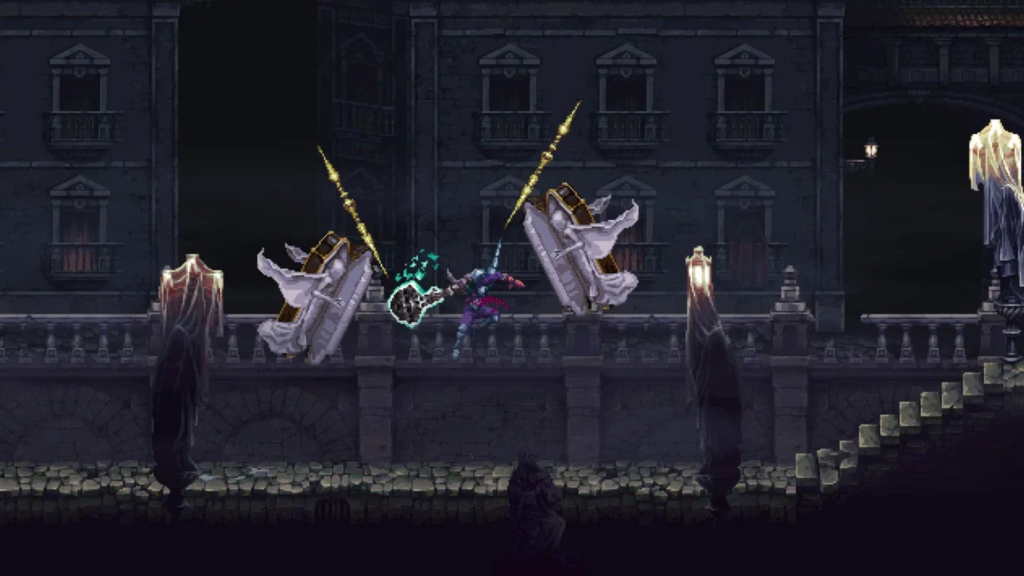
- Veredicto (the giant censer): It’s a thurible. On fire. You swing it like a baseball bat. This is the weapon for people who saw a nun and thought, “That, but with more arson.” It clears crowds, breaks shields, and makes you feel like a heretic-crushing DJ.
You can swap between them instantly. In theory. In practice, you’ll panic-switch to the wrong weapon and get impaled by a ghost with abandonment issues.
Platforming: The Real Penitence
Remember the “ladder jumps” from the first game? They’re back. And they brought friends.
Blasphemous 2 adds air dashes, wall climbs, and a mechanic where you slam down through breakable floors. This sounds empowering until you realize that spike pits are everywhere. And I mean everywhere. You’d think the world of Cvstodia would invest in railings, but no. Railings are a sin.
The game also introduces “Miriam’s challenges” again—optional platforming gauntlets that feel like they were designed by someone who watches you flinch and laughs. You will complete them. You will feel nothing afterward except emptiness. That’s the intended experience.
Visuals & Sound: Pain Has Never Looked This Good
Let’s be fair: this game is gorgeous. The pixel art is absurdly detailed—blood drips realistically off your helmet, candles flicker like they know something you don’t, and every boss arena looks like a Goya painting had a fever dream.
The music? Haunting choir music that will follow you into your actual dreams. You’ll wake up humming the theme of the second area (“The Severed Tower”) and wonder if you need therapy. The sound design—especially the squelch of landing a critical hit—is disturbingly satisfying.
Difficulty & Quality of Life (Finally, Some Mercy)
Here’s the part where I shock you: Blasphemous 2 is… slightly easier than the original. Not easy. Never easy. But fair.
- More save points. Yes, you read that correctly. Prie-Dieu statues are everywhere now, like Starbucks but for masochists.
- Fast travel between statues. Revolutionary for 2026? No. For a Blasphemous game? Basically a miracle (pun intended).
- No instant-death pits. You lose health instead of respawning at the last save. This single change will save your controllers from being thrown into the sun.
The bosses are still nasty. The final boss in particular has a phase 2 attack that covers 80% of the screen and lasts eight seconds. You will learn the dodge timing. Or you will cry. Both are valid.
Should You Play Blasphemous 2?
If you liked the first game, stop reading and buy it. It’s better in every way.
If you’re new: start with the original for context, or just watch a 20-minute lore video while staring blankly at a wall. Then play this.
If you hate difficult games, slow movement, religious imagery, or sarcasm: play Stardew Valley instead. I’ll be here, impaled on a rotating spike wall, smiling.
Final verdict (out of 10 spikes in my foot): 9/10. A bloody, beautiful, self-aware sequel that respects your time and your suffering in equal measure.
Pro tip for 2026 players: Use the “Penitent’s Compass” rosary bead. It shows secrets on the map. You’ll thank me after hour 12 of hitting random walls.
Now go. Penitent One. And try not to die in the tutorial. Some of us have dignity left. Not me. But some.