
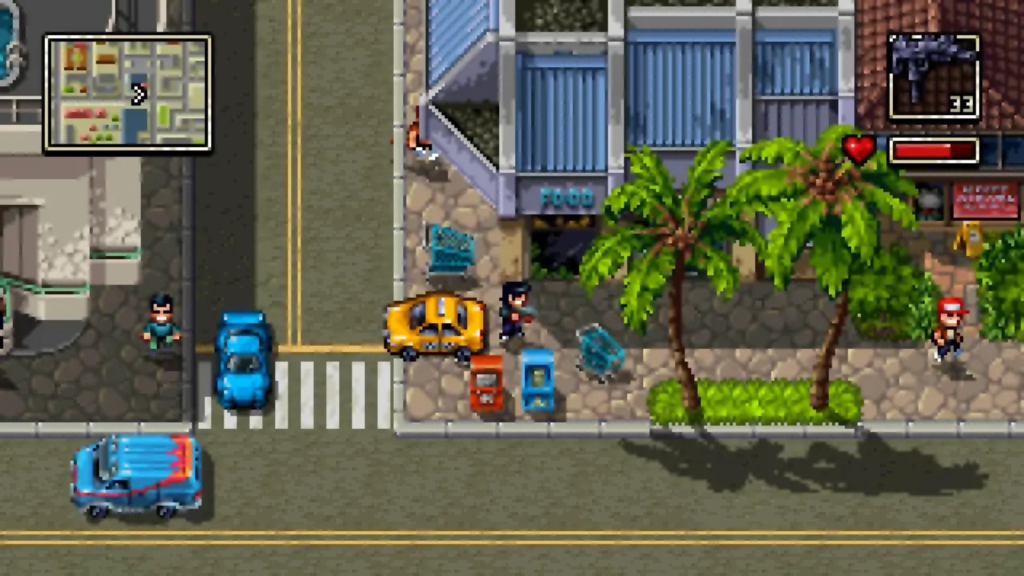
Hello everyone and welcome back to another blog post. If you’re still sleeping on Shakedown: Hawaii because it looks like a game your dad would’ve rented from Blockbuster in 1992, congratulations—you’ve officially outed yourself as someone who judges books by their pixel count. This is a game where you play an aging CEO who builds a “legitimate” business empire through acquisitions, intimidation, property sabotage, and enough white-collar crime to make a hedge fund manager blush. It’s absurd, it’s charming, and it’s occasionally repetitive enough to make you question your life choices. But hey, so is scrolling social media, and at least this game lets you bulldoze a competitor’s building.
What Actually Is This Game?
Shakedown: Hawaii comes from Vblank Entertainment, the Canadian studio behind Retro City Rampage, and it released in May 2019 across PC, Switch, PS4, PS Vita, and even the 3DS—yes, this thing actually came out on a handheld that Nintendo discontinued years ago. Steam user reviews sit at “Very Positive” with an 89% approval rating, while Metacritic critic scores average around 75%. Some outlets called it a must-play on Switch; others complained it was too short and too repetitive. Both camps are right. Welcome to video game discourse.
The premise is painfully relatable: your CEO’s company is on the verge of bankruptcy because online shopping killed his retail stores, ride-sharing apps destroyed his taxi business, and streaming services… well, VHS rental stores haven’t been a thing for decades. So what’s a washed-up D-list celebrity CEO to do? Obviously, put on a disguise and shake down shops for protection money, sabotage competitors’ delivery trucks, and “re-zone” land—which absolutely means bulldozing buildings. The game satirizes mega-corporations, white-collar crime, and business practices so egregious you can’t even be mad. You just have to admire the sheer audacity.
How It Actually Plays
The core loop is simple: you drive around a top-down open world, talk to people, destroy things, and occasionally place buildings to expand your empire. You can buy real estate in a fluctuating market, complete arcade challenges, tackle side quests, and switch between three playable characters—including the CEO’s unemployed son Scooter, who joins a gang and does tasks for their leader. There are over 200 accessible buildings, a destructible environment, and a 150MB install size that would’ve fit on a floppy disk if you tried hard enough. That’s more content than most modern games offer at launch, and it runs on a toaster.
But here’s the thing: the mission design doesn’t evolve much. One Polish reviewer noted the gameplay boils down to “go talk to someone or go destroy something, then occasionally place buildings,” and it starts to drag after about two hours despite taking only eight hours to finish. That’s not a hot take. That’s just what the aggregate reviews say. The satire is sharp, but the gameplay loop is shallow. If you love 16-bit aesthetics and top-down GTA-style chaos, you’ll probably enjoy it. If you’re expecting deep narrative or varied mission design, you’ll be disappointed. Both reactions are valid. That’s called nuance, and it’s rarer than a functioning fax machine in 2026.
The Good, The Bad, And The Pixelated
The Good: The humor lands more often than it misses. The game skewers corporate greed, absurd business practices, and 1980s pop culture with the precision of a well-aimed rocket launcher. The pixel art is gorgeous, the soundtrack slaps, and the sheer amount of optional content—arcade challenges, side quests, real estate speculation—means you can ignore the main story for hours and still feel productive. It’s also genuinely impressive that this thing runs on a 3DS.
The Bad: The repetition. After the novelty wears off, you’re doing the same carjacking, combat, and shootout routines you’d expect from any open-world crime game. The story doesn’t offer enough variety to justify the eight-hour runtime, and the mission structure starts to feel like a checklist. One reviewer called it “full of potential but overshadowed by monotony,” and that’s a fair assessment. The game’s creator designed it as a parody of “the most absurd business practices,” and the satire is sharp—but satire alone doesn’t make a gameplay loop feel fresh after hour five.
Should You Play It?
Yes, if you can find it cheap and you appreciate pixel art and corporate satire. No, if you’re expecting Grand Theft Auto levels of narrative depth or mission variety. It’s a competent, charming, occasionally repetitive eight-hour experience that made me laugh at least three times and frustrated me at least twice. That’s a better ratio than most things I review.
The game’s biggest strength is its commitment to the bit. It doesn’t just parody corporate greed—it makes you complicit in it. You’re not a hero. You’re a washed-up CEO using every dirty trick in the book to stay relevant, and the game never lets you forget that. It’s funny because it’s true, and it’s true because we’ve all worked for someone like this. Or been someone like this. Or at least bought something from someone like this and felt vaguely guilty about it.
So yeah. Play Shakedown: Hawaii. Bulldoze a building. Shake down a shop. Buy some real estate. Laugh at the absurdity of it all. Then go back to your actual job and wonder why your boss hasn’t tried any of this yet. Give it time. The year is young.