
Hello everyone and welcome back to another blog post. Let’s be honest: indie game sequels are a terrifying proposition. The first game is often a scrappy, heartfelt gem made on passion and instant noodles. The pressure to follow that up? Crippling. Yet, every so often, a bold team doesn’t just create a decent sequel—they blow the doors off the original and make you wonder how you ever lived without it.
After painstaking research (which mostly involved yelling “HOW IS THIS SO GOOD?!” at my screen), I present the Top 10 Indie Sequels that didn’t just meet expectations—they took those expectations, folded them into a paper airplane, and flew them into the sun.
The Golden Rule of Sequeldom
Before we dive in, a moment of silence for the fallen. As industry watchers note, 2025 alone saw many sequels to successful indie games end up commercially overshadowed by their originals. It turns out that lightning, especially the indie kind, is notoriously hard to bottle twice.
The secret sauce? According to developers, it’s not about cynical calculation. In other words, you can’t just remake your hit. You have to evolve it. The titles below didn’t just hear that advice—they took it as a personal challenge.
10. Portal 2
“We Took a Perfect 3-Hour Puzzle and Built an Entire Universe of Jokes Around It.”
Let’s settle the debate: the original Portal was a razor-sharp, minimalist puzzle game bundled in The Orange Box. Its sequel, Portal 2, is what happens when you give that brilliant concept a budget, a world, and a script funnier than 99% of comedies. It took the perfectly-tuned portal mechanic and wrapped it in a hilarious, heartbreaking, and mind-bending narrative with one of gaming’s greatest villain duos (GLADOS and Wheatley). It expanded the scope from sterile test chambers to the decaying bowels of Aperture Science without ever losing the original’s perfect core. It’s the gold standard for how to turn a brilliant experiment into a timeless classic.
9. Ender Magnolia: Bloom in the Mist
“We Didn’t Reinvent the Wheel, We Just Made It Perfectly Round.”
While everyone else was trying to reinvent the Metroidvania, Ender Magnolia was in the back, calmly polishing a single, beautiful apple to a mirror shine. It took the excellent foundation of Ender Lilies and refined every aspect: the combat is crisper, the exploration more rewarding, the melancholy more… melancholic. It’s the sequel that proves you don’t need a gimmick. You just need to be really, really good at your job. A shockingly novel concept in an industry obsessed with “innovation.”
8. Amnesia: The Bunker
“Forget Cosmic Lore, Here’s One Guy, a Generator, and a Very Persistent ‘Friend.'”
Frictional Games finally remembered what made them terrifying. The Bunker is a hardcore survival-horror loop set in a claustrophobic WWI bunker with a single, relentless monster. Everything is limited—light, resources, time—and key elements are randomized each playthrough. It traded the grandiose storytelling of its immediate predecessor for pure, systemic dread. In doing so, it became the most terrifying and replayable entry since the original Dark Descent, proving that sometimes, less story and more sheer panic is exactly what the doctor ordered you to flee from.
7. Ion Fury
The Predecessor: Bombshell (2016) – An isometric action game that was, to put it politely, one of the worst-reviewed titles of its year.
The Superior Sequel: Ion Fury (2019) – A prequel, technically.
When your first game bombs (pun intended), what do you do? If you’re 3D Realms and Voidpoint, you pivot the entire franchise to the genre it should have been in the first place: a Build Engine-era retro FPS. Ion Fury was a glorious, CRT-filtered middle finger to modern shooter conventions, dripping with pixelated gore and clever, interconnected level design. It didn’t just outshine its predecessor; it retroactively gave the franchise a reason to exist. Talk about a plot twist.
6. Yooka-Laylee and the Impossible Lair
“Our 3D Platformer Was Fine. So We Made a Perfect 2D One Instead.”
The first Yooka-Laylee was a crowdfunded love letter to 90s 3D platformers that, for many, felt like receiving a VHS of your favorite childhood movie—charming, but the tracking was off. For the sequel, Playtonic didn’t try to fix the 3D formula. They performed a shocking genre-ectomy and delivered a spectacular 2D platformer that felt more like Donkey Kong Country than their own first game. It was an admission of “We heard you, and you were right. Here’s something actually fun.” The audacity to completely change lanes and then speed past the competition is still breathtaking.
5. Hades II
The Predecessor: Hades (2020) – A game that won a zillion awards and was deemed by many to be roguish perfection.
The Impossible Task: Make a sequel that doesn’t feel like a victory lap.
Somehow, Supergiant Games did it. While Hades was a vertical ascent from the Underworld, Hades II gives you a choice: ascend to Olympus or descend into the depths of Tartarus. These are two entirely different campaigns with unique biomes, bosses, and storylines. It solved the roguelike problem of repetitive grinding by offering a whole other world to conquer when you hit a wall. It took an already impeccable combat system and made the “build-crafting” even deeper.
4. Citizen Sleeper 2: Starward Vector
The Predecessor: Citizen Sleeper (2022) – A critically adored, narrative-driven RPG about survival and connection on a space station.
The Superior Sequel: Citizen Sleeper 2: Starward Vector (2025).
Gareth Damian Martin’s first game was a tightly focused, station-bound story. The sequel throws open the airlocks, trading a single location for a Firefly-esque journey across a star system. You gather a motley crew, manage your ship, and explore planets, all while the series’ signature dice-based mechanics and profound writing delve deeper into questions of autonomy and found family. It demonstrated a “deep understanding of what made the first game click” and then boldly built a bigger, more ambitious universe around that core.
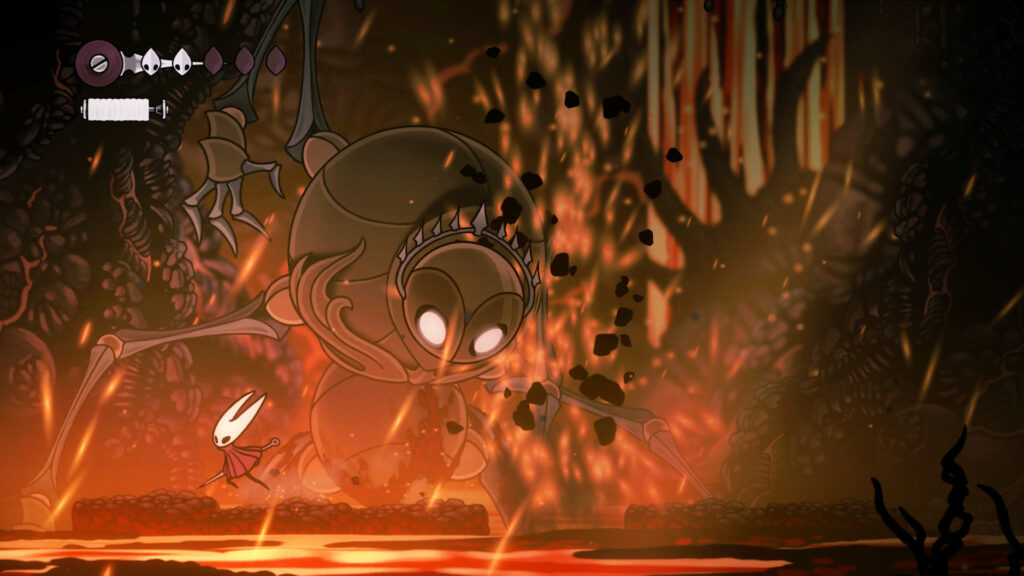
3. Hollow Knight: Silksong
The Predecessor: Hollow Knight (2017) – A masterpiece of the Metroidvania genre, renowned for its challenging combat, stunning world, and oppressive atmosphere.
The Eight-Year Wait: Hollow Knight: Silksong (2025).
After nearly a decade of anticipation that reached mythical proportions, Silksong had one job: don’t collapse under its own weight. It didn’t. It soared. Critics found that it “exceeded those expectations” by taking the original’s impeccable foundation and enhancing virtually every aspect. The movement as Hornet is faster and more acrobatic, the new kingdom of Pharloom is even more breathtaking to explore, and the boss fights are somehow more inventive and punishing. It proved that Team Cherry’s first act was no fluke; they are master world-builders, and Silksong is their magnum opus.
2. Monster Train 2
“You Liked Our Deck-Builder? Here’s a PhD in Strategic Suffering.”
The first Monster Train was a genius fusion of deck-building and tower defense that proudly stood next to Slay the Spire. The sequel looked at that high bar and said, “Cool. Watch me jump over it while juggling.” It didn’t just add new clans; it redesigned the core mechanics to be deeper, wilder, and more brain-meltingly complex. It’s a sequel that respects your intelligence by assuming you’ve already mastered the first game and are now ready for your mind to be folded into a pretzel. Glorious, masochistic fun.
1. Risk of Rain 2
“What If We Just Added… A Whole Other Dimension?”
The original Risk of Rain was a gritty, pixelated 2D survival sim about collecting so many buffs your character becomes a flashing, universe-ending god. The sequel asked a simple, genius, and completely unhinged question: “But what if it was in 3D?” This wasn’t a tweak. This was taking the family recipe and strapping it to a rocket. The chaos, the scale, the sheer joy of watching a dozen screen-filling laser beams erupt from your little survivor—it’s everything the first game dreamed of being. A masterclass in dimensional promotion.
The Aftermath: What Makes a Sequel Shine?
So, what’s the common thread? These Top 10 Indie Sequels didn’t play it safe. They identified the core fantasy of the original and expanded upon it in a bold new direction—whether that meant shifting genres (Impossible Lair), doubling the scope (Hades II), or modernizing a classic.
The indie landscape is more competitive than ever, with revenues growing faster than AA and AAA sectors. In this “golden age,” as some call it, standing out requires that boldness. These ten sequels are the ultimate proof that the best follow-up isn’t a copy—it’s a response, an evolution, and, when done right, a new standard.
What’s your favorite indie sequel that topped the original? Did we blaspheme by leaving one off the list? Let the (friendly, inspired) debate begin.
Amazing
Thank you for reading!
I like it 👏🏻
Thank you for reading!