
Hello everyone and welcome back to another blog post. Let’s get something straight. In an era where “retro-inspired” can mean anything from a muted color palette to a character who occasionally says “rad,” we’re here to talk about the real deal. These aren’t games that just look old; they’re games that feel old. We’re talking authentic 8-bit and 16-bit aesthetics that don’t just mimic the past but seem to have been teleported directly from it, cartridge dust and all. If your idea of a good time involves deciphering pixelated dialogue and mastering mechanics that offer exactly zero hand-holding, you’ve come to the right (and slightly glitchy) place.
Forget the walking simulators and the cinematic experiences that pass for retro these days. We’re diving into the pixelated deep end with Top 10 Indie Retro-Style Games that understand limitation isn’t a barrier—it’s the entire point.
1. AdventureQuest 8-Bit: Dungeons & Doomknights
The game that started as a physical NES cart because digital wasn’t authentically inconvenient enough.
Why It’s Retro Gold: This isn’t just a love letter to 8-bit action-RPGs; it’s a ransom note written in pixel art. Born from the popular web-based AdventureQuest Worlds, this game was first released as a literal, playable NES cartridge, a move so beautifully unnecessary it borders on performance art. It mashes together Zelda-like exploration with “Metroidvania” progression, all wrapped in a layer of mid-2000s internet humor so thick you can practically hear the dial-up tone.
Finally, a game that understands the true core of retro gaming: the paralyzing fear that your save file will corrupt if you look at it wrong. It packs more nostalgic references per square pixel than a YouTube compilation, proving that while graphics have evolved, our desire to see memes from 2005 rendered in 56 colors has not.
2. Shovel Knight: Treasure Trove
The game that proved you could polish a pixel until it blinded an entire generation.
Why It’s Retro Gold: Yacht Club Games didn’t just make a retro-style game; they bottled the essence of 8-bit NES classics like Mega Man and DuckTales and sold it back to us at a premium. Every jump, every enemy pattern, every chiptune track is a masterclass in purposeful design. The “Treasure Trove” compilation is the gift that keeps on giving, adding entire new campaigns that feel like lost cartridges from a parallel universe.
Shovel Knight is so well crafted it makes the actual NES games it’s inspired by look a little… sloppy. It’s the gaming equivalent of using modern engineering to build a perfect Model T that never breaks down—it’s brilliant, but it lacks the authentic terror of your transportation spontaneously combusting.
3. The Legend of Steel Empire (Remastered)
For when you need your steampunk served with a side of CRT scanlines.
Why It’s Retro Gold: This is the ultimate test of retro authenticity: it’s a remaster of a real Sega Genesis/Mega Drive shoot-’em-up from 1992. The 2021 remaster gives you a crisp HD mode, but the purist’s choice is the “Original” filter that perfectly replicates the blurry, shimmering pixels of a 16-bit display. Choosing between a nimble fighter or a slow, tanky zeppelin isn’t just a gameplay decision; it’s a philosophical stance on how you want to navigate a sky full of diesel-powered nonsense.
This game understands that the true enemy in any retro experience isn’t the end boss—it’s hardware limitations. The “Original” visual mode is a historical reenactment of what it was like to play on a TV that weighed more than your sofa. It’s nostalgia for a time when “graphical fidelity” meant being able to tell which pixel was your ship.
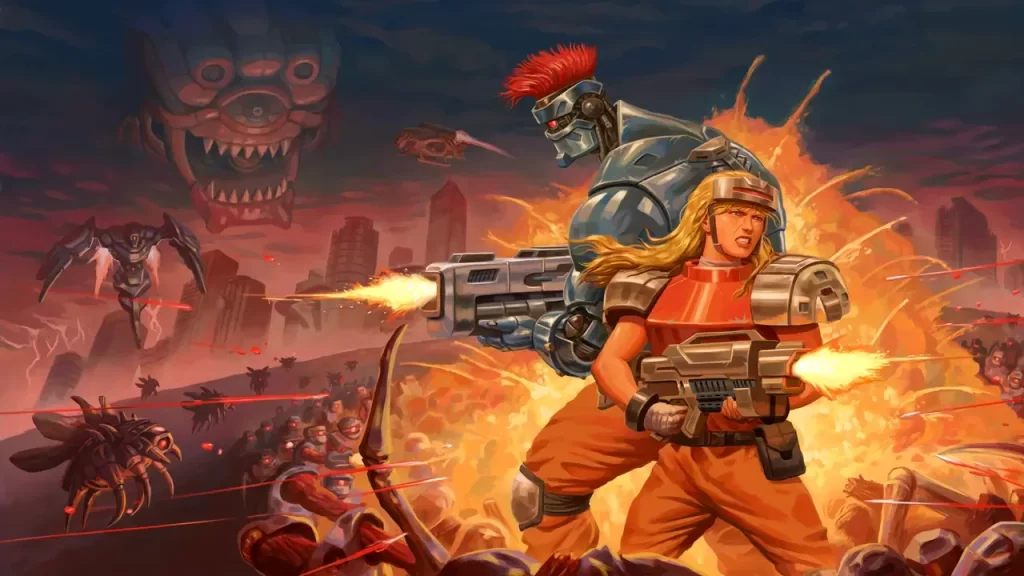
4. Blazing Chrome
Because “What if Contra but, like, way harder?” was a question that desperately needed answering.
Why It’s Retro Gold: This is a run-and-gun that stares directly into the soul of the arcade classic Contra III and says, “I can do that, but I will remove any mercy you may have mistakenly assumed was included.” The pixel art is gorgeously detailed, the action is relentlessly chaotic, and the co-op mode exists so you can blame your failures on a real human instead of the game’s perfectly tuned, brutal design.
Blazing Chrome is the friend who constantly reminds you that games used to be “challenging,” which is a polite way of saying “designed to extract quarters from children.” It’s a magnificent tribute to an era where continuing cost 50 cents and your dignity.
5. Saga of the Moon Priestess
For those who miss the days when a game manual was required reading, not a decorative pamphlet.
Why It’s Retro Gold: This top-down action-adventure is a direct conduit to the Game Boy Color era of Zelda. It nails the exploration, the simple but satisfying combat, and the charmingly basic sprite work. It’s a comfort food game that understands sometimes you don’t want a five-course meal; you want a perfectly made pixelated sandwich.
This game is so dedicated to the classic formula that it includes the occasional moment of cryptic, “where-do-I-go-next?” design. It’s a gentle reminder that the golden age of gaming was also, occasionally, the beige age of wandering aimlessly until you accidentally bomb the right wall.
6. Celeste (Assist Mode Off)
A precision-platformer that uses adorable 16-bit aesthetics to lure you into a beautiful trap.
Why It’s Retro Gold: While its story and accessibility features are decidedly modern, Celeste’s gameplay soul is pure 8-bit. At its core, it’s a game about perfecting pixel-perfect jumps and overcoming seemingly impossible challenges, much like the Super Mario Bros. “Lost Levels” of yore. The charming character sprites are a Trojan horse for some of the most demanding and rewarding platforming ever designed.
Celeste is the game that proves your therapist was right: the real mountain you’re climbing is your own self-doubt. Also, that dying 2,000 times to a screen of sentient, floating neon blocks is a valid form of emotional catharsis. The retro aesthetic is basically a stress ball for your eyes while the game abuses your thumbs.
7. The Messenger
A game that starts as a loving Ninja Gaiden tribute and then meta-textually explodes in the second act.
Why It’s Retro Gold: It begins as a flawless 8-bit action-platformer, complete with tight controls, witty dialogue from a shopkeeper, and a banging chiptune soundtrack. Then, at the halfway point, it pulls the ultimate retro trick: it evolves into a 16-bit “Metroidvania.” It’s not just playing with nostalgia; it’s actively documenting gaming’s own technological evolution in real-time.
The shopkeeper in this game is the most authentically retro element of all—an NPC who won’t shut up, dispensing sarcastic commentary that you cannot skip. He is the spiritual successor to every unhelpful guide character from the 80s, finally given the platform he never deserved.
8. Huntdown
The dystopian future, as envisioned by a VHS tape left in the sun.
Why It’s Retro Gold: This co-op action game is a blistering homage to the side-scrolling arcade brawlers and sci-fi movies of the 80s. Its 16-bit pixel art is drenched in neon and grit, featuring sprawling cyberpunk cityscapes and bosses with more personality than most AAA protagonists. The soundtrack is a synth-wave masterpiece that sounds like it was rescued from a forgotten arcade cabinet.
In a world of open-world games with 100-hour campaigns, Huntdown is a refreshing reminder that sometimes all you need is a big gun, a bigger enemy, and a one-liner so cheesy it should be served with crackers. It’s the video game equivalent of an action movie you rented because the box art was cool.
9. Cyber Shadow
The answer to “What if Ninja Gaiden was developed by a sentient, malevolent AI that hates you?”
Why It’s Retro Gold: Developed by a single creator, this is a no-compromise, nail-hard action-platformer. Every screen is a meticulously crafted puzzle of spikes, enemies, and timing. It captures the raw, unforgiving spirit of NES-era action games with a sleek cyber-ninja aesthetic. It’s a game that respects your skills by assuming you have them from the very first level.
Cyber Shadow is the game you play to prove something, mostly to yourself. It’s a brutal exam where the only study guide is your own repeated failure. The satisfaction of finally beating a stage is directly proportional to the number of controllers you considered throwing.
10. Timespinner
A Metroidvania that uses time travel as both a gameplay mechanic and a poignant narrative device.
Why It’s Retro Gold: Timespinner is a masterful homage to the golden age of 16-bit “Metroidvania” games, specifically channeling the aesthetic and atmosphere of the beloved Castlevania: Symphony of the Night. It nails the core formula: a vast, interconnected castle to explore, a steady drip-feed of new movement and combat abilities, and a rich inventory of weapons and familiars. However, its modern twist is the central time-manipulation mechanic, allowing you to freeze enemies or create time echoes of yourself, which adds a fresh strategic layer to the classic exploration loop.
This game understands that the key to a great retro experience isn’t just nostalgia; it’s also the satisfying crunch of finding a new ability that finally lets you access that one stupid room you’ve been staring at for three hours. The time-freeze mechanic is there not just for clever puzzles, but so you can finally get a good, long look at the beautifully animated sprites of the monsters that have been murdering you.
Why The “Fake Retro” Look Fails (And Why These Games Succeed)
Let’s be blunt: slapping a pixel-art sprite on a 3D model with modern lighting isn’t retro. It’s aesthetic cosplay. The games that truly resonate understand that the retro style was a creative response to technical shackles. Limited color palettes forced inventive art. Limited memory demanded concise, evocative storytelling. Limited processing power meant every gameplay mechanic had to be ironclad.
These Top 10 Indie Retro-Style Games (and upcoming contenders) succeed because they embrace the constraint. They aren’t just using pixels; they’re thinking within the box of an 8-bit or 16-bit console’s imaginary motherboard. The humor, the challenge, the structure—it all coheres into an experience that feels excavated, not fabricated.
The Future of the Past in 2026
So where does retro go from here? As we move deeper into the 2020s, the most exciting trend isn’t just replication, but archaeology and reinterpretation. Developers are now making games for hardware that’s older than they are, treating the NES or Sega Genesis as a living platform. They’re not just making a “retro-style” game; they’re making a “new-old” game.
The future belongs to titles that use the established language of 8 and 16 bits to tell new stories, experiment with form (like The Messenger’s genre shift), or deliver pure, uncut gameplay. It’s a niche, sure, but it’s a niche built on a bedrock of genuine passion—a passion for the time when a game had to be brilliant to be remembered, because you only got five of them a year.
The ultimate irony? In trying to perfectly recreate the limitations of the past, today’s best retro developers have created some of the most timeless games of the present. They’ve built a time machine that only goes one way: to a pixelated past that, it turns out, has an infinite future. If you want to check some of these titles out, check out the Steam store here, or gog.com here.