
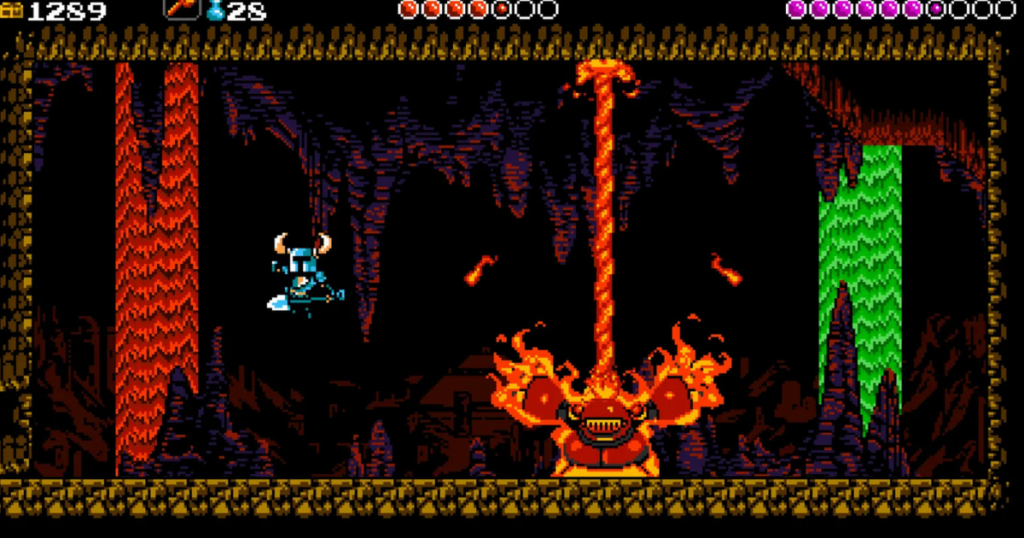
Hello everyone and welcome back to another blog post. At first glance, Shovel Knight looks like a game that escaped from a dusty NES cartridge and refused to evolve—pixel art, chiptune music, and a hero whose weapon of choice is literally a shovel. And yet, somehow, this gloriously retro-looking game manages to do the unthinkable: it’s actually fantastic. Beneath the pixels and dirt-based combat lies a game that knows exactly what it’s doing, winks at the past, and then casually outplays a lot of modern games with ten times the budget and zero percent of the charm.
The Genius Isn’t the Shovel. It’s the Dirt.
Anyone can tell you the core loop: you dig, you bounce, you collect gems. Big deal. The magic—the real, devious magic—is in the dirt, the levels, the very spaces between the pixels.
New players think they’re playing a game about hitting things with a shovel. Veterans know they’re playing a game about physics and rhythm. The pogo bounce isn’t just an attack; it’s your primary mode of transportation, your puzzle-solving tool, and your security blanket. The weight, the arc, the clink sound effect when you strike an enemy—it’s so perfect it makes other platformers feel like you’re controlling a soap bar in a tub.
And the checkpoints. Oh, the beautiful, sadistic checkpoints. The game presents you with a risk-reward calculation so simple and cruel it should be taught in economics classes: smash the floating checkpoint orb for a big pile of gold, but if you die after that, you’re sent back to the start of the stage. It turns every level into a high-stakes heist where you are both the mastermind and the fall guy.
An Expansion Pack That Showed Up the Entire Industry
The Treasure Trove isn’t DLC; it’s a quietly arrogant manifesto from Yacht Club Games. It’s them saying, “You think that first campaign was good? Watch this.” Each expansion isn’t just a new character skin; it’s a full-blown genre shift that re-contextualizes the entire map.
- Plague of Shadows is a chaotic science experiment where you play as an alchemist who can’t walk in a straight line. You’re not platforming; you’re conducting explosive, self-immolating research. It shouldn’t work. It’s glorious.
- Specter of Torment is the cool one. It turns the methodical digging of Shovel Knight into a flowing, dash-slash-wall-run ballet. It’s not just better than the original for many—it makes the original feel slow. The audacity.
- King of Cards adds a whole dang card game (Joustus) that’s legitimately more compelling than most standalone puzzle games, then wraps it in a campaign with more stages than the base game. It’s an absurd level of content that makes other studios’ “deluxe editions” look like a sad bundle of concept art.
Most companies sell you a horse, then sell you the saddle, then the reins, then the horse armor. Yacht Club sold you a horse, then came back a year later and gave you a unicorn, a dragon, and a fully-functional chariot for free before deciding to charge new customers for the whole stable.
The 8-Bit Ruse That Hid a Symphony
Calling Shovel Knight an “8-bit game” is like calling a Stradivarius “some wood with strings.” It uses the aesthetic as a launching pad, not a limitation.
Jake Kaufman’s soundtrack doesn’t mimic chiptune music; it fulfills the fantasy of it. The tracks have a depth and complexity the actual NES could never produce. The track for the Stranded Ship stage doesn’t just accompany the level—it is the level: lonely, rolling, and haunting. You don’t just hear it; you feel the salt spray.
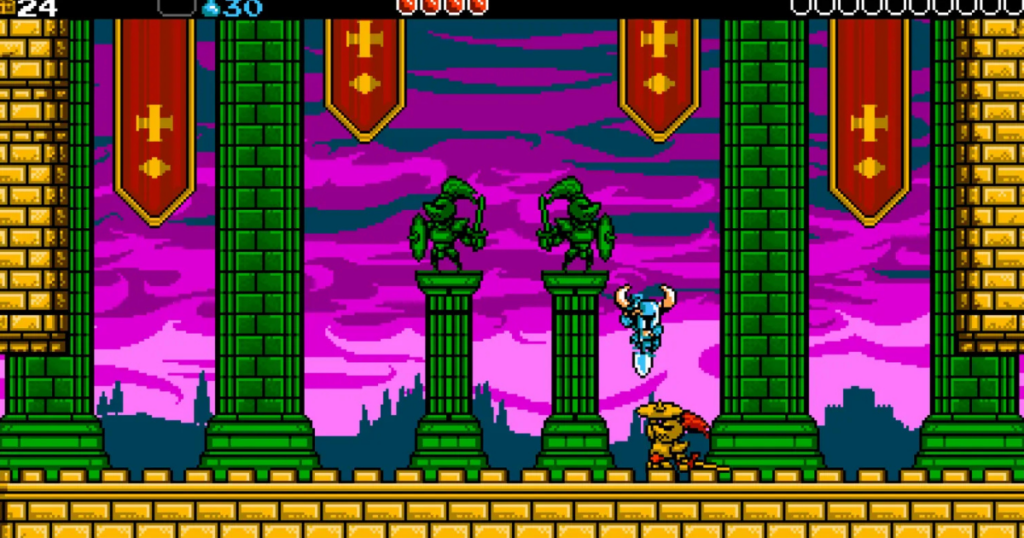
The sprite work is where the love leaks out of every pixel. Every enemy has a silly, exaggerated animation cycle. The Troupple King sloshes majestically. The Shield Knight’s armor glints in a way that’s impossible on an actual CRT TV. They didn’t recreate the past; they built the past we remember, which is always better than the one that existed.
The Final Verdict (From Someone Who Can’t Stop Playing)
So, is Shovel Knight: Treasure Trove worth buying in the year 2025?
Let’s put it this way: in a landscape where games are routinely shipped as $70 beta tests with roadmaps for “future content,” Treasure Trove is a complete, polished, self-contained universe for a fraction of the price. It’s a game that respects three things modern publishers seem to have forgotten: your time, your intelligence, and your wallet.
You will like this game if: You appreciate mechanics so tight you could set a watch to them. You find joy in a perfectly executed sequence. You believe “Nintendo-hard” is a term of endearment.
You will not like this game if: You require cinematic, movie-like experiences. Your patience for trial-and-error is measured in nanoseconds. You think pixels are for Instagram, not art.
In the end, Shovel Knight succeeded not because it looked backward, but because it understood the timeless principles of what makes a game feel good: weight, feedback, risk, and reward. It’s a lesson so many have missed while chasing graphics and scale. It’s not a retro game. It’s a fundamental one.
Now, if you’ll excuse me, I have a date with a certain card-playing monarch. The completion percentage isn’t going to max itself out, and my 148th hour isn’t going to log itself. A shovel’s work is never done. If you want to learn more about the devs, check their website here.