
Hello everyone and welcome back to another blog post. When a game announces itself as coming from the creative minds behind Journey and ABZÛ (check out our review here), it sets expectations somewhere in the stratosphere. Sword of the Sea, the latest from developers Giant Squid, makes this bold claim proudly. But does it actually manage to surf its way to greatness, or does it wipe out on the shores of its own ambition? Let’s dive in.
A Legacy of Art and Music (Or, “We Made Journey, Remember?”)
Let’s get the obvious out of the way first: Sword of the Sea is breathtaking to behold and listen to. Creative director Matt Nava and composer Austin Wintory are reuniting for another symphony of sight and sound, and their signature styles are stamped all over this game like a developer’s watermark.
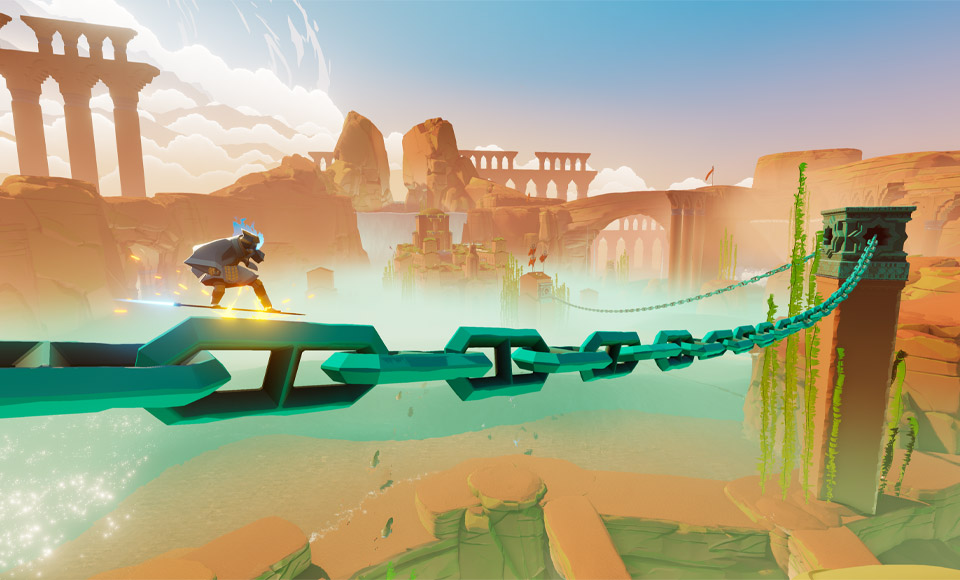
The art direction transforms what could be another boring desert landscape into a shifting, flowing sea of sand that’s somehow both desolate and alive . The visual transformation as you restore water to these areas is where the game truly shines, with vibrant aquatic life bursting forth in breathtaking shoals that paint the world with color . It’s like watching a black-and-white photograph slowly develop into a technicolor dream.
Wintory’s score, as always, is a character in itself. The music accentuates quiet moments and swells into incredible vocal pieces that often carry more emotional weight than the plot itself . There were moments I stopped playing entirely just to listen—which says something, given the game’s already short runtime.
The Core Experience: Movement and “Flow”
Here’s where Sword of the Sea either soars or stumbles, depending on what you’re looking for. The much-touted hoversword movement—a combination of snowboard, skateboard, and surfboard—is an absolute triumph of feel and fluidity .
The Good:
- The movement system is intuitive and deeply satisfying from the moment you start carving through dunes .
- Building momentum and catching air off crests feels natural and rewarding .
- The controls are responsive enough to make traversal feel seamless and enjoyable .
The “But…”:
- The trick system is surprisingly superficial . You can perform flips, spins, and grabs, but they have little impact on actual gameplay beyond style points .
- It’s less like the technical depth of Tony Hawk’s Pro Skater and more like… well, having a really cool-looking double jump .
The game excels at creating what fans of Giant Squid’s previous work will recognize as that signature “flow state.” When you’re zipping across the landscape, chaining movements together, and taking in the stunning vistas, it achieves a meditative quality that’s genuinely special . It just rarely challenges you to push that movement system to its limits.
Pro Tip: If you play on PC, use a DualSense controller. The haptic feedback makes a noticeable difference, letting you feel the texture of different terrains beneath your board .
A Short, Spectacular Journey
Let’s talk about the elephant in the room: Sword of the Sea is brief. We’re talking 3-4 hours for a standard playthrough, even with some exploration . For a $30 price tag, that’s going to be a legitimate dealbreaker for some.
The critical reception has been largely positive, with the game earning very positive reviews on Steam and strong critic scores . But the length remains a point of contention:
“I completed the main game in 3.8 hours and I wasn’t by any means rushing… For my part, at least, I’m glad the game isn’t any longer because I don’t think the simplistic puzzle design would’ve sustained it.”
The game does offer some replayability through New Game+, speedrun incentives, and trick challenges scattered throughout the world . But these are essentially variations on the same content rather than substantial additions.
More Than Beauty: Engaging with the World
Beautiful visuals are great, but a game needs more than a pretty face to hold your attention. Sword of the Sea’s gameplay loop revolves around exploring areas, solving environmental puzzles, and revitalizing the landscape by restoring water.
The puzzle design, however, is where the game shows its limitations. Most challenges boil down to finding and activating three of something—a familiar trope in adventure games that grows repetitive over time . While the environmental storytelling hints at deeper lore about a lost civilization, the narrative itself is light and leaves many questions unanswered .
There are delightful moments of variety—like riding dolphins and whales through the skies—though these sections sometimes feel underbaked in their execution and can overstay their welcome . They’re spectacular the first time but mechanically shallow.
For Whom is This Journey?
So, who should actually buy Sword of the Sea? Let’s break it down:
You’ll Probably Love This Game If:
- You’re a fan of Journey, ABZÛ, or The Pathless and want more of that experience
- You value artistic expression and atmosphere over complex gameplay mechanics
- You appreciate shorter, focused experiences that don’t overstay their welcome
- You’re looking for a meditative, almost therapeutic gaming experience
You Might Want to Skip This Game If:
- Your $30 needs to buy you more than 4 hours of entertainment
- You prefer substantial narrative depth and complex character development
- You’re seeking a deep trick-based system like Tony Hawk or SSX
- You need challenging puzzles to stay engaged with an adventure game
The Verdict: Is This the Next Great Atmospheric Adventure?
Sword of the Sea is a flawed masterpiece—or perhaps a masterpiece of specific elements that doesn’t quite coalesce into a perfect whole. It delivers one of the most satisfying movement systems in recent memory, wrapped in a stunning audiovisual package that will linger in your memory long after the credits roll.
At the same time, its short length, simplistic puzzles, and underdeveloped trick system prevent it from reaching the legendary status of games like Journey. It comes closer than most, but still falls just short.
The bottom line: Sword of the Sea is less the next great atmospheric adventure and more a beautiful evolution of the genre—one that demonstrates both how far these experiences have come and how much further they still have to go. If you approach it as a meditative experience rather than a deep game, you’ll find something special here. Just don’t expect it to change your life.
Now if you’ll excuse me, I have some dunes to surf. Someone has to set the high score on those ancient skateparks.
Disclaimer: This review is based on the PC version of Sword of the Sea. The game is also available on PS5, where it’s part of the PlayStation Plus Game Catalog at launch