
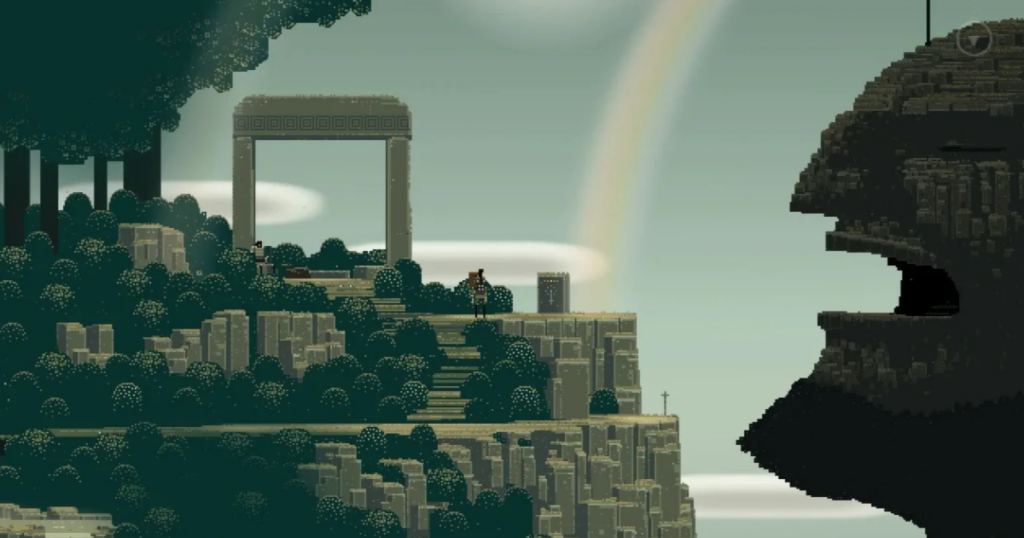
Hello everyone and welcome back to another blog post. Look, I get it. In 2026, we’re drowning in procedurally generated, live-service, AI-assisted, dopamine-drip-feed “experiences.” You’re probably asking, “Why should I care about a pointy-clicky pixel-art game from the ancient, pre-pandemic year of 2011?” Because, in its brief, four-session runtime, Superbrothers: Sword & Sworcery EP accomplished something most modern games still fumble: it was effortlessly, authentically, and permanently cool.
The Core Thesis: A Prog Rock Album You Could Touch
The creators themselves called it “a bit like a record you can hang out in”. This wasn’t just marketing fluff; it was the entire design philosophy. You play as The Scythian, a warrior on a “woeful errand” to retrieve a magical book, and the game unfolds like a vinyl LP, divided into distinct “sessions” introduced by a mysterious narrator called The Archetype.
The Vibe is the Gameplay: Movement is a languid tap-to-walk. Puzzles involve listening to the environment and strumming “sworcery” songs on scenery like a harp. Combat, when it happens, requires you to physically rotate your iPad (or click the mouse) to wield your sword—a gimmick that somehow never feels cheap, only ritualistic. This isn’t a game about challenge; it’s about participation in a mood.
The “Negative Progression” Gambit: In a genius subversion of RPG tropes, The Scythian grows weaker with each major triumph. Heroism has a tangible, fatal cost. A 2026 game would sell you a “Soul Revive” microtransaction. Here, it’s the tragic, beautiful point of the whole story.
Deconstructing the 2011 “Hipster” Masterpiece with 2026 Eyes
Let’s address the pixelated mammoth in the room. Yes, Superbrothers: Sword & Sworcery EP was the poster child for a certain brand of early-2010s “hipster” indie. It had a wry, meta-narrative voice, integrated with then-novel Twitter, and oozed a self-aware, lo-fi aesthetic. Time has been kind, revealing this not as pretension, but as a perfectly preserved time capsule of sincere digital art.
The Audacious Moon Mechanic: The game synced with real-world moon phases. Certain secrets were locked behind waiting for an actual full moon (though a late-game “moon grotto” let you cheat). In 2011, this felt magical. In 2026, a game demanding access to my system clock would trigger a five-alarm privacy panic. The audacity is breathtaking.
A Unified Sensory Experience: The 8-bit pixel art, often dismissed as simple, is a masterclass in restrained palettes and purposeful animation. The soundtrack by Jim Guthrie is the emotional core, a “landmark prog rock concept album” you get to inhabit. Every element—art, sound, pacing, even the typography (ITC Conduit, for the font nerds)—serves the same cohesive, melancholic-whimsical vibe.
The 2026 Verdict: Is It Still Worth Your Time?
Absolutely, but with caveats as sharp as The Scythian’s sword.
Play it if: You treat games as curated experiences. You value atmosphere, sound, and story over complex mechanics. You have a high tolerance for deliberate pacing, meta-humor, and the courage to play a game that sincerely tells you to take a break between sessions.
Skip it if: You demand tight combat loops, deep skill trees, or a power fantasy. If the phrase “laid-back exploration & mysterious musical problem-solving” sounds like a screensaver, not a game, this isn’t for you.
Where to Play This Relic (That’s Still in Print)
The game is more accessible than ever, having escaped its iOS origins. You can find it on:
- Nintendo Switch (The most recommended modern port, blending touch and controller play).
- Steam (For PC/Mac/Linux, with the excellent soundtrack included).
- Legacy iOS and Android versions exist but may feel dated.
In the cacophonous arena of modern gaming, Superbrothers: Sword & Sworcery EP remains the cool, quiet friend leaning against the wall. It doesn’t need to yell. Its power is in the haunting crescendo of a Guthrie track, the perfect crunch of pixels under a digital moon, and a story that understands true heroism ends in a quiet, sacrificial blaze. For a cure to 2026’s soul-sickness, The Archetype’s experimental treatment is still waiting. Just don’t expect a battle pass for it.