
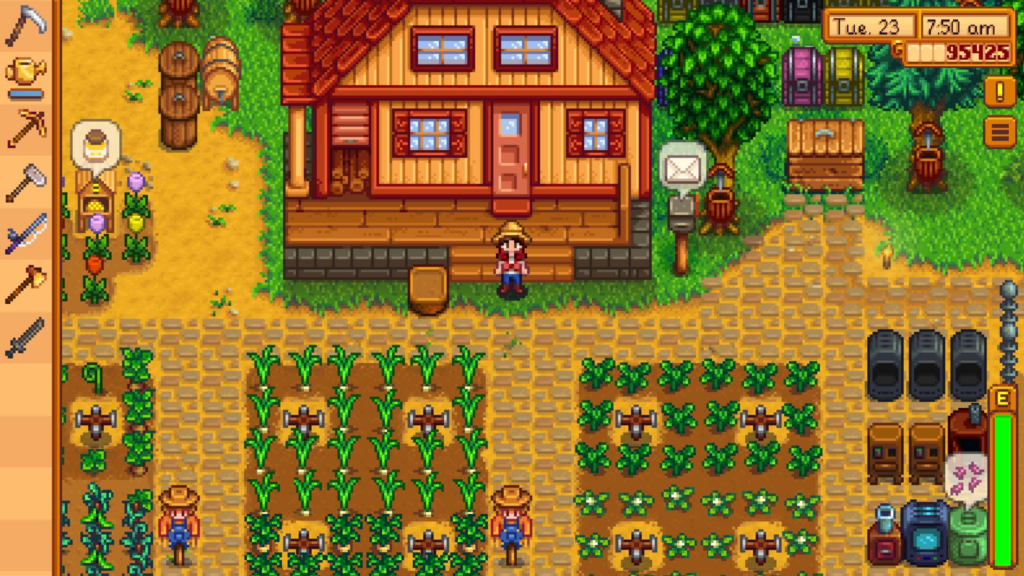
2026 Update: Still Farming, Still Questioning My Life Choices
Originally published in 2024. Updated Stardew Valley Deep Dive in 2026 because apparently I’m still not done writing about pixel parsnips.
Hello everyone and welcome back to another blog post. It’s 2026. You’ve had at least three friends vanish into this game for months at a time, only to re-emerge confused about why the sun is still a thing and why real-world grass doesn’t drop fiber. You’ve seen the memes. You’ve heard the “it’s relaxing, bro” pitch from people who then proceed to explain their elaborate ancient fruit wine empire with the intensity of a Wall Street trader.
So let’s skip the polite introductions. Stardew Valley isn’t just a farming simulator. It’s a lifestyle replacement. A gentle trap. A game that asks “what if you gave up everything and moved to a small town?” and then slowly reveals that small towns are weird, actually.
I’ve put another 200 hours into it recently, just to be sure my initial opinion still holds. It does. Send help.
The First Day Trap: How ConcernedApe Steals Your Life
Here’s the thing about Eric Barone (ConcernedApe)—the man built this entire universe by himself, which is either the most impressive indie development story of all time or deeply concerning evidence that one person should not have this much control over a virtual economy. Possibly both.
The game opens with you, a burnt-out corporate drone, inheriting your grandfather’s farm. It’s a power fantasy for anyone who’s ever sat in traffic thinking “what if I just… didn’t?”
And then the trap springs.
You clear a few weeds. Plant some parsnips. Water them. And somewhere around day three, something in your brain chemistry shifts permanently. Suddenly you’re calculating crop yields in your head at work. You’re googling “best Stardew Valley spring crops” at 2 AM. You’re explaining to your confused partner that you can’t attend their birthday dinner because it’s the Egg Festival and you need those strawberry seeds.
This is not relaxation. This is a gentle form of madness, and it’s beautiful.
The Farming Industrial Complex: From Subsistence to Monopoly
Let’s talk about the actual farming, because the game really wants you to think that’s the point.
Initially, it’s charming. You’ve got your little plot. Your parsnips. Maybe a chicken named something horrible (I respect your decision to name yours “Eggmund,” by the way). You’re living the simple life, just like Grandpa wanted.
Then you discover kegs.
Suddenly “simple life” becomes “aggressive expansion into artisanal goods.” Your farm transforms from a quaint homestead into a medieval factory floor. Ancient fruit everywhere. Kegs in every available space. The greenhouse looks like a wine cellar had a baby with a botanical garden. Grandpa wanted you to reconnect with nature; instead you’ve created a paleo-agrarian monopoly that would make Nestlé nervous.
And the game encourages this. There’s no ethical consumption under late-stage capitalism, but there is a clock telling you your starfruit wine is ready for harvest, and honestly? That’s close enough to happiness.
Pelican Town: A Sociological Case Study in Gift-Giving Manipulation
The relationship system in Stardew Valley is, when you think about it for more than three seconds, absolutely unhinged. ConcernedApe meticulously crafted a vibrant and immersive world. The meticulously designed pixel art style, coupled with the game’s enchanting soundtrack, creates a truly captivating atmosphere. Stardew Valley’s world is alive with subtle details – the changing seasons, the unique personalities of each villager, and the dynamic weather system all contribute to a sense of immersion that few games can match.
You arrive in this town as a complete stranger. And your strategy for integration is: walk up to people and shove objects at them until they love you.
“I’ve never met you before,” says Leah, a woman you’ve known for approximately twelve seconds, “but wow, a salad? Actually, you seem great. Let’s be friends.”
This escalates. You learn everyone’s favorite things like a stalker with a spreadsheet. You carry a rabbit’s foot specifically because a wizard told you it would prevent your multiple girlfriends from discovering each other. You give Haley a coconut and she blushes.
The heart events are genuinely sweet, I’ll give the game that. Behind the manipulation is real writing, real character development. Shane’s story in particular hits like a truck, assuming that truck is made of depression and blue chicken metaphors. But let’s not pretend the mechanics aren’t deeply weird. You’re basically a small-town sugar daddy whose currency is mayonnaise.
Also: you can get married. Have kids. Turn your kids into doves at a witch’s hut. What other life sim lets you unbirth your children via dark magic, Emily? Answer me.
When the Charm Wears Thin: The Perfectionism Trap
Here’s where I have to be honest with you. Stardew Valley’s first year is magic. Pure, uncomplicated, discovering-the-world magic.
Year two is still great. You’re expanding. You’re mining. You’ve probably proposed to someone (again, no judgment on your choice of the emo teenager).
But somewhere in year three, if you’re the type of person who needs to complete things, the game shifts. The mysterious “perfection” tracker appears. The clock is everywhere. You realize you need to cook every recipe, catch every fish, and somehow befriend the guy who lives in a tent and makes his own clothing.
The mines become routine. The skull caverns remain frustrating. The walnut hunt on Ginger Island stops being exploration and starts being archaeology with a side of violent rage every time you can’t find that one last golden walnut behind a bush you’ve checked fourteen times.
This is where modern players, especially those coming from more guided games, might bounce off. Stardew assumes you have the patience of a monk and the organizational skills of a librarian. It does not hold your hand. It does not care that you’ve looked for that stupid fossil for three hours. The jungle will yield its secrets when it damn well pleases.
The Modding Community: When Vanilla Isn’t Enough
We need to talk about mods, because in 2026, “vanilla Stardew” is almost a choice.
The modding community for this game is unhinged in the best way. Want expanded maps? There’s a mod. Want anime characters? Several, actually. Want to turn your farm into a dark academia aesthetic complete with proper lighting and shadow effects? Someone built that specifically because you asked.
The “Stardew Valley Expanded” mod alone doubles the game’s content. New characters, new areas, new lore that somehow fits seamlessly with the original. It’s less a mod and more a full-blown expansion pack that ConcernedApe was gracious enough to let the community build for him.
The danger, of course, is the modding rabbit hole. You’ll spend 40 hours curating your perfect mod list and 4 hours actually playing. Your game now has 500 new crops, a fully voiced cast, and graphical improvements that make the original look like a Game Boy cartridge. You have no idea what’s vanilla anymore. You are free, but at what cost?
The 2026 Verdict: Does It Hold Up?
Here’s the thing about games that try to copy Stardew Valley—and there have been so many in the last decade.
Some are good! Coral Island is pretty. Fields of Mistria has that 90s anime energy. Sun Haven said “what if fantasy, but also farming?” and honestly, valid.
None of them have it.
That indefinable thing Stardew does—the warmth, the mystery, the sense that every corner of this world was placed there by someone who cared about it—that’s harder to replicate than people realize. The pixel art isn’t retro affectation; it’s meticulous. The music isn’t background noise; it’s lodged permanently in your brain. The secrets aren’t just collectibles; they’re reasons to keep exploring long after you should have stopped.
Stardew Valley in 2026 is like a well-loved novel you keep on your shelf. You know the story. You know how it ends. But every time you pick it up, you find something you missed. A line of dialogue you skimmed. A room you never noticed. A secret you somehow ignored for eight years.
That’s not nostalgia. That’s just good design.
Your Three Valid Ways to Play in 2026
You have options, and none of them are wrong:
The Completionist Path: You will not rest until perfection is achieved. Every achievement, every heart, every walnut. You have a spreadsheet. You have a second monitor with the wiki permanently open. Your family misses you, but the farm doesn’t. This is your life now.
The Chill Path: You’re here to farm. Maybe some chickens. You ignore the mines beyond what’s necessary. You’re vaguely aware there’s a community center but honestly, Joja membership seems easier. You play for 20 minutes before bed and it genuinely relaxes you. You have achieved what the game intended. Congratulations.
The Modded Path: You have 147 mods installed. Your game has 200 hours of additional content, a fully voiced cast, and crops that look like they’re from a Ghibli film. You’re not sure what ConcernedApe originally made anymore, but you’re having a great time. The line between “vanilla” and “community creation” has blurred beyond recognition. This is chaos. This is beautiful.
Final Thoughts From Someone Who’s Played Too Much
Stardew Valley endures because it understood something most “relaxing” games don’t.
True relaxation isn’t about having nothing to do. It’s about having things to do that actually feel worth doing. Every crop planted is progress. Every relationship built is connection. Every secret found is proof that the world rewards curiosity.
In 2026, when every game wants your attention, your money, and your data, Stardew Valley just wants you to plant some parsnips and maybe talk to the weird guy in the woods. It asks nothing you can’t give and gives everything you didn’t know you needed.
Even if you do end up turning your children into doves. We don’t talk about that. I hope you liked our Stardew Valley Deep Dive and if you want to learn more, check the game’s website here.