
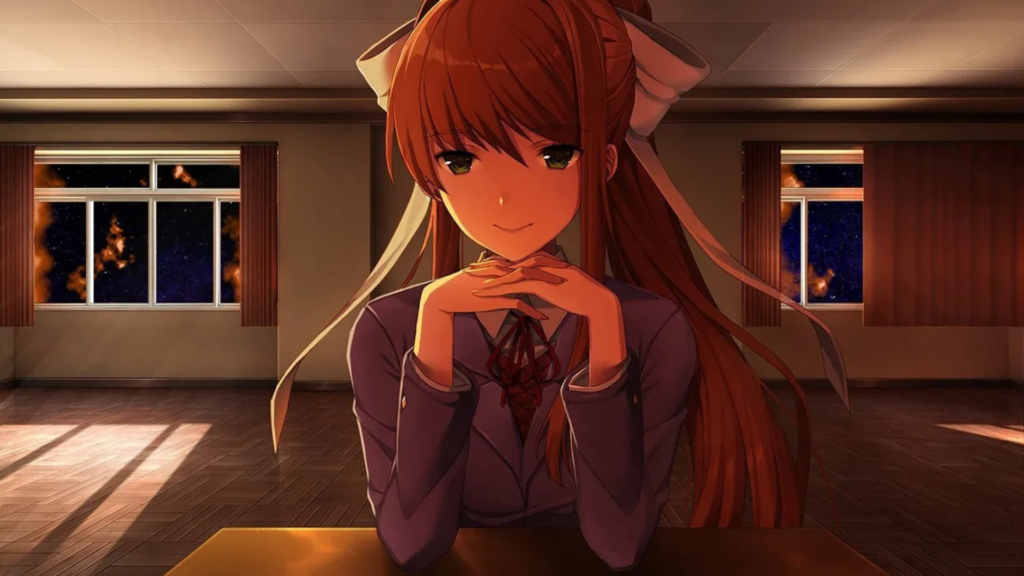
Hello everyone and welcome back to another blog post. Spring is almost here. The flowers are budding, the birds are singing, and apparently, a whole new batch of gamers is about to walk into a classroom and have their souls quietly vacuumed out through their eyeballs.
If you, like me, have been scrolling through the Google Play Store or Steam lately, you might have noticed a familiar face popping up with a fresh coat of paint. Doki Doki Literature Club! (DDLC) is back in the conversation. Thanks to the recent official mobile port by Serenity Forge—which users are praising for being “surprisingly easy to navigate” and a “great port” —a whole new generation of wide-eyed idealists is about to learn that not all club activities involve snacks and poetry.
And honestly? In the content-saturated, AI-generated world of 2026, we need to talk about why this “cute game” remains the gold standard for psychological horror. Grab a cupcake. You might need it.
The Ultimate Bait-and-Switch (Or: How I Learned to Stop Worrying and Love the PTSD)
Let’s set the scene. You boot up the game. You are greeted by Monika. She’s adorable. She’s bubbly. She welcomes you to the Literature Club, where every day is full of “chit-chat and fun activities” . You meet your childhood friend Sayori (the human embodiment of a sunbeam), Yuri (the shy bookworm who definitely doesn’t have a knife collection), and Natsuki (the tsundere who writes poems about cupcakes).
It is, on the surface, the most saccharine, trope-filled anime dating sim since the invention of blushing sprites. If you played this in 2017—or in the 2026 mobile version—you likely felt a sense of comfortable boredom. “Oh great,” you thought, “another game where I have to choose which cartoon girl to hold hands with.”
This is where the game’s genius lies. It commits to the bit. It forces you to play through the mundane. As Yahtzee Croshaw from Zero Punctuation brilliantly noted back in the day, you have to wade through the “flustered reactions to sexual arousal” and the “tacky romance game” tropes to get to the meat . It uses the boring parts as a smokescreen.
Spoiler alert for the three people who haven’t played this since 2017, I guess.
And then, Sayori hangs herself.
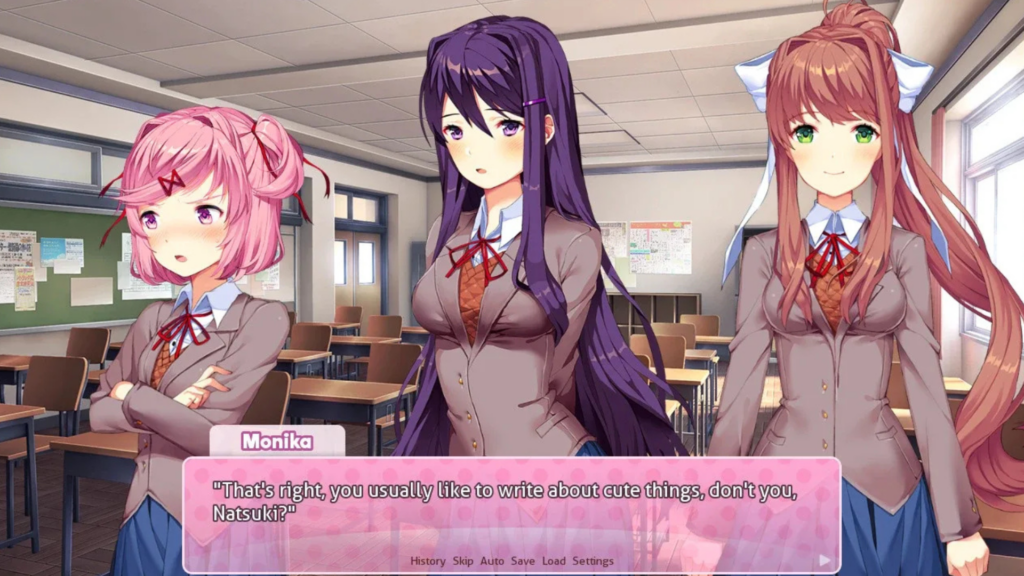
The Horror Isn’t Gore—It’s Glitch
Here’s the thing about DDLC that holds up in 2026: it doesn’t rely on jump scares. More spoilers will follow.
In an era where “horror” games are often just loud noises and a monster chasing you down a corridor, DDLC sits in your computer chair next to you and whispers, “I know where you live.”
Once the mask comes off, the game descends into madness not through blood and guts, but through metatextual manipulation. The graphics glitch. Characters’ eyes bleed—or disappear entirely. Natsuki’s neck snaps into a horrifying angle because the code is rotting from the inside. It is unsettling in a way that feels personal .
It taps into the ancient human fear of the unknown, repackaged for the digital age: the fear of your software turning on you. In 2026, with AI creeping into every corner of our devices, the idea of a program that is “aware” and really, really wants you to delete your friends’ files feels less like fantasy and more like a Tuesday.
Monika: The Character Everyone Talks About (Carefully)
You will hear about Monika. You will see memes about Monika. You will wonder why everyone is obsessed with the green-eyed girl who greets you at the start.
There is a reason for that.
Without spoiling anything, Monika is one of the most unique characters in gaming history. She is not a villain. She is not just a love interest. She is something else entirely—something that made gamers in 2017 uninstall the game, reinstall it, and then stare at their desktops wondering if their files were safe.
In 2026, with AI creeping into every corner of our devices, the questions DDLC raises about awareness, autonomy, and digital consciousness feel more relevant than ever.
The Verdict: Should You Join the Club?
If you are a fan of horror, deconstruction, or just want to understand why your friends keep making “Just Monika” jokes eight years later, download the new mobile port.
It runs great, it has all the Plus content (side stories, music player, hi-res art), and as one reviewer noted, the characters are “clear instead of having random moments of blur” like the old fan ports .
Just remember: Monika knows your name. She knows what you did. And she’s been waiting for you to come back.
Now, if you’ll excuse me, I have to go delete a character file. Again. It’s the only way to be free. If you want to learn more about the devs, click here to check their website out.
Have you played Doki Doki Literature Club? Did you throw your phone across the room during Act 2? Let me know in the comments—assuming Monika hasn’t deleted them yet.