
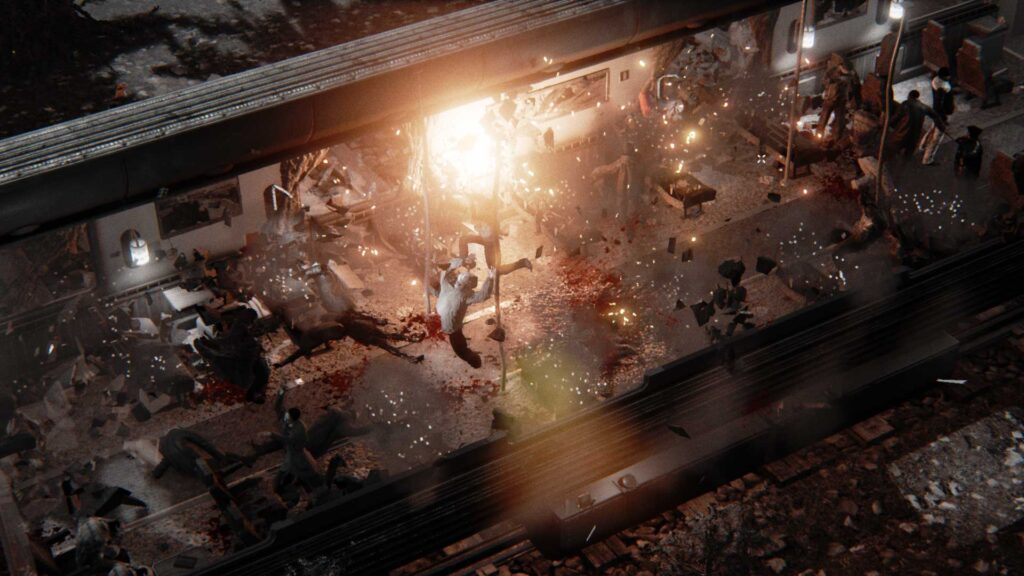
Hello everyone and welcome back to another blog post. Remember when being a “rebel” in the gaming world meant playing a game where the main character monotonously grumbles about hating “human worms”? Ah, 2015. The launch of Hatred was a masterclass in marketing, positioning itself as a brave crusade against the politically correct, “colorful” trends of the gaming industry. It got itself banned from Twitch, pulled from Steam (before a personal apology from Gabe Newell himself), and sparked a thousand heated forum threads. The question is, over half a decade later, does Hatred hold up as a transgressive masterpiece, or is it the video game equivalent of a teenager’s angst-filled poetry journal? We’ve fired it up again to find out.
What Is Hatred? A Plot Synopsis for the Uninitiated
You play as “Not Important,” a man so consumed by misanthropy that he embarks on a “genocide crusade” in New York City. His goal isn’t money or power; it’s to “put in the grave as many as [as he] can” before ultimately dying himself. The plot follows his journey from his neighborhood to a nuclear power plant, with a stop at a military base, all while slaughtering countless civilians and police officers. It’s about as subtle as a sledgehammer and twice as nuanced. The irony of a character who claims to hate everything having such a detailed, multi-step plan for mass destruction is… well, it’s certainly a choice.
Gameplay: The Grind of Genocide
Let’s talk about what you actually do. Hatred is an isometric twin-stick shooter. You kill, you execute enemies to regenerate health, and you move to the next area to do it all over again.
- The Loop: The core gameplay is often described as repetitive and lacking variation. It turns out that a one-note premise often leads to one-note action. Who could have predicted?
- The “Shock” Factor: The game’s primary mechanic for recovery is performing cinematic executions on incapacitated people. It’s the central pillar of its “controversy,” but without a compelling gameplay reason or narrative weight, it quickly feels less like a statement and more like a tedious button press.
The Contrivance of Controversy
This is where the sarcasm really writes itself. The developers at Destructive Creations claimed Hatred was a “reaction” to games becoming too polite and artistic. They positioned themselves as brave iconoclasts, a lone voice against the sanitization of the medium. It’s a compelling underdog story, until you realize they were rebelling against… the existence of other types of games. As one critic at the time noted, this was a “stand against what?”—a comedic supermarket sweep of deadbeat pulp horror cliches that was about as dangerous and provocative as telling your mum you’ve brushed your teeth when you haven’t. The game’s attempt to tap into a culture war made it a flag for certain communities, but its gameplay had no “cultural guile” or exploration of player culpability. It was just a game where you kill people.
The Verdict: So, Is It the MOST Controversial Game?
No. And that’s the funniest part of this whole saga.
While Hatred successfully courted controversy in its marketing and temporary bans, its legacy is not one of a truly challenging or important game. It was controversial in the way a whoopee cushion is controversial at a funeral—loud, jarring, and briefly shocking, but ultimately shallow and forgettable. Critics panned it for being repetitive, and its Adults Only (AO) rating from the ESRB cemented its place as a fringe title. True controversial games make you think; Hatred just made you grind. It’s less a brutal commentary and more a tedious artifact of a specific moment in gaming culture, a relic that reminds us that sometimes, the most rebellious thing a game can be is… fun, which Hatred, for most, was not. If you want to learn more about the game, check out the website here.