
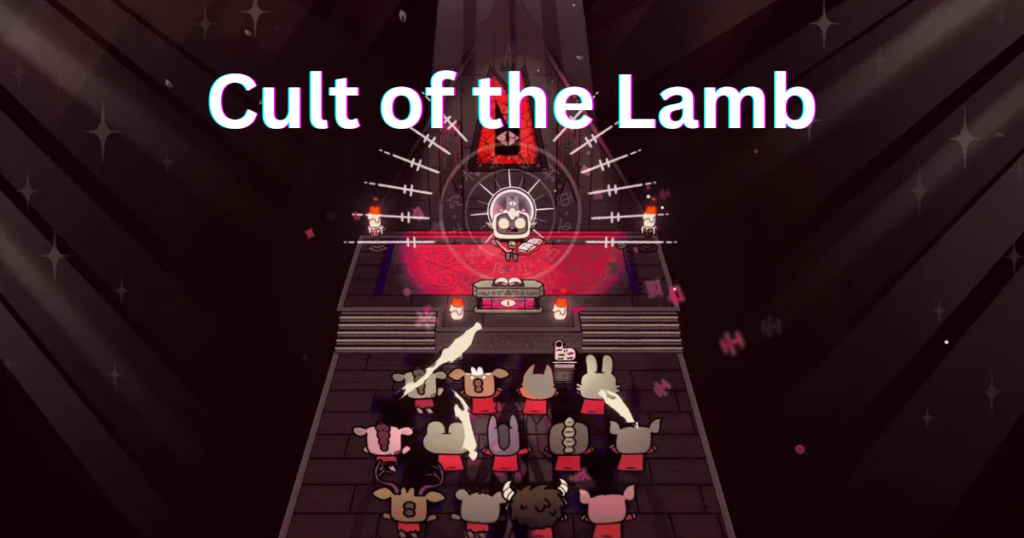
Hello everyone and welcome back to another blog post. You are a defenseless lamb, moments from ritual sacrifice at the hands of four sinister Bishops. As the blade falls, you find yourself not in oblivion, but striking a deal with a chained god. Your mission? Build a cult, exact revenge, and become the most adorable agent of chaos the gaming world has ever seen. This is Cult of the Lamb, the genre-bending hit from developer Massive Monster that has players gleefully balancing sermon-giving with skull-cracking.
Having led my own cult through triumphant crusades and catastrophic food shortages, I can confirm this game is a masterclass in darkly cute satire. But does its unique blend of cult management and roguelike dungeon crawling sustain its initial blasphemous charm, or does the grind eventually feel like a heretical slog? Let’s find out.
A Tale of Two Genres: Dungeon Crawling Meets Cult Sim
At its core, Cult of the Lamb is a brilliantly schizophrenic experience, seamlessly stitching together two distinct gameplay loops.
- The Crusader: One moment, you’re a vengeful spirit embarking on roguelike “crusades” into one of four beautifully grim regions of the Old Faith. Combat is fast, intuitive, and deeply satisfying. You’re given a random starting weapon—from swift daggers to lumbering hammers—and a magical “curse,” then set loose in a series of randomized rooms. The weapon randomness can be a double-edged sword: while finding a magical shotgun-like blunderbuss feels incredible, starting a tough run with a weak dagger can feel punishing.
- The Cult Leader: The other half of your existence is as a micro-managing deity. Returning to your camp after a crusade means facing the “joyful” duties of leadership: feeding followers, building shelters, resolving petty disputes, and giving sermons to maintain “faith”. This isn’t Stardew Valley; your followers will ask you to make another member eat poop, throw their rivals in prison, or fetch mushrooms just so they can look at them. Yes, really.
The genius is in the synergy. A successful cult grants you power-ups for dungeon crawling, and resources from crusades are vital for your cult’s survival. It creates a compelling push-pull: you’re anxious about your cult starving while you’re on a crusade, and eager for more power while you’re stuck babysitting.
The Doctrine of Choice: Be a Benevolent Leader or a Tyrannical Menace
This is where the game’s moral (or amoral) heart lies. You shape your cult through “Doctrines,” permanent beliefs you unlock that define your leadership style. Will you choose the path of “Good,” embracing communal feasts and afterlives? Or will you walk the path of “Evil,” instituting cannibalism, ritualistic fight pits, and sacrificing the elderly for faith boosts? The game doesn’t judge you. It simply gives you the tools and watches, with a cute, blinking smile, as you descend into tyranny.
The Not-So-Divine Grind: Where the Faith Wavers
For all its brilliance, the cult management can become repetitive. The accelerated day/night cycle is a frequent point of contention. Days blur by, and nights are “a ridiculously short quarter wedge,” forcing constant, frantic action. Followers age and die rapidly, turning your community into a revolving door that hampers long-term investment.
Some follower quests are hilarious bits of dark comedy, but others are tedious fetch tasks with punishing time limits. Failing a quest because a specific flower refuses to drop over multiple crusades, resulting in a faith penalty, feels less like a challenge and more like a punishment. It’s a stark reminder that even a god-king has to deal with soul-crushing micromanagement and bureaucratic nonsense.
A Masterclass in Tone: Cute, Cosmic, and Hilarious
The game’s greatest achievement is its tone. The art is deceptively cute and charming, a style the developers admit kept naturally bubbling up even when they tried to make it darker. This adorable aesthetic is the Trojan horse for some genuinely dark, cosmic horror and laugh-out-loud black comedy.
The world is packed with surreal, memorable moments:
- Using the “Holler Button” to make your vessel of eldritch power let out a pathetic “baaa” mid-battle.
- Witnessing the “Ascension” ritual, where a follower is lifted to the heavens by pious music only to splat back to earth if you haven’t chosen the right doctrine.
- Discovering that one of the powerful relics you seek is just a green Croc shoe belonging to a fortune-telling raccoon.
Verdict: A Uniquely Blasphemous Must-Play
Is Cult of the Lamb worth your time? Absolutely.
It is a bold, original, and unforgettable experience that confidently blends two deep genres into a cohesive and addictive whole. The 25-30 hour journey to confront the Bishops is packed with variety, strategic choice, and more laugh-out-loud moments than most dedicated comedy games.
Who Will Thrive in This Cult?
- Players who love strategic management with a dark, comedic twist.
- Fans of accessible roguelikes who enjoy tight, pattern-based combat.
- Anyone with a taste for stellar, subversive art direction and world-building.
Who Might Struggle to Convert?
- Gamers easily frustrated by management sim busywork and micromanagement.
- Those seeking a purely challenging, hardcore roguelike experience (the combat, while fun, is not the primary focus).
- Players sensitive to dark humor involving bodily functions and moral transgressions, even in a cartoonish wrapper.
In a landscape often afraid to be genuinely weird, Cult of the Lamb is a triumph. It’s a game that lets you be a cruel, caring, chaotic, and comedic god—often all within the same in-game day. Just remember to build an outhouse. Trust me on this.
What doctrine did you choose for your cult? Share your most heretical or benevolent leadership moments in the comments below.