
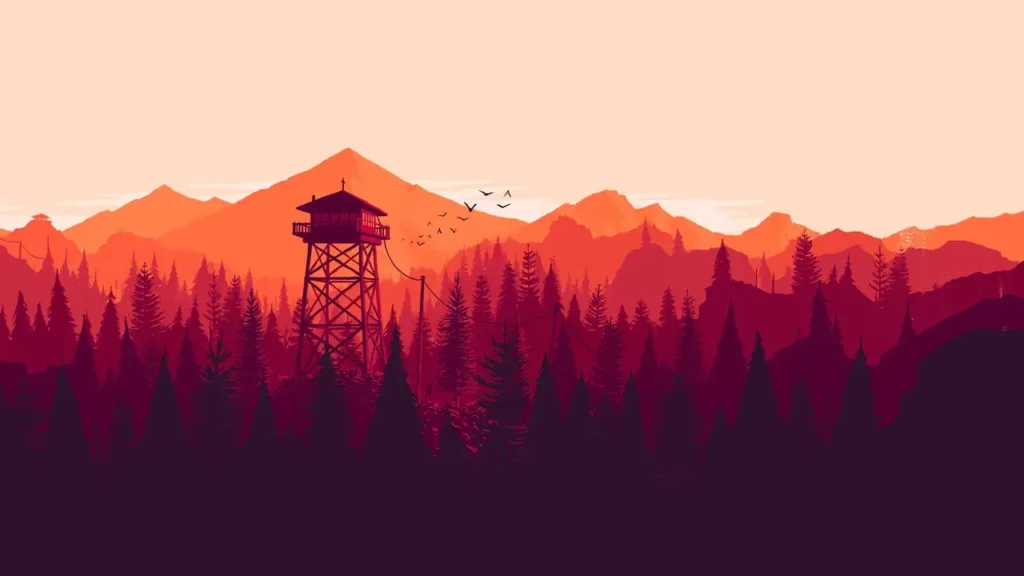
Hello everyone and welcome back to another blog post. It has been ten years since Campo Santo dropped Firewatch onto an unsuspecting public. A decade of hot takes, a decade of “walking simulator” arguments that make you want to delete your Twitter account, and a decade of people asking: “Wait, that’s it?”
But here we are, in 2026. The trees in Shoshone National Forest have probably grown a few inches, the paint on Henry’s lookout tower has definitely peeled a bit more, and yet, this game refuses to burn down and fade away. With the recent news that Campo Santo is basically a ghost crew scattered across Valve’s many projects—chasing the elusive In the Valley of Gods like a mirage—now feels like the right time to lace up our boots, grab a crappy map, and get hopelessly lost in the Wyoming wilderness again .
The Setup: Or, How to Run Away From Your Feelings
Let’s be real: Firewatch has the most depressing “meet-cute” in video game history. Before you even see a pixel of those gorgeous orange sunsets, you are forced to play a text-based adventure about your character Henry’s wife, Julia, developing early-onset dementia .
It is a gut punch delivered with the subtlety of a sledgehammer.
You don’t choose to be a hero. You don’t save the world. You choose to take a summer job in the middle of nowhere to avoid dealing with the fact that your life fell apart. Relatable, right? Who among us hasn’t considered becoming a forest-dwelling hermit when the rent is due or our spouse gets a job offer we don’t like?
Firewatch isn’t about fire. It’s about emotional avoidance. If you’re looking for a “power fantasy,” go play Call of Duty. If you want a game where the final boss is just sadness and poor communication, congratulations, you’ve found your match.
The “Walking Simulator” Dagger (That We’re All Sick Of)
Let’s address the elephant in the living room—or rather, the deer in the forest.
Critics love to slap the “walking simulator” label on Firewatch as if it’s an insult. Oh, I’m sorry, did you need a crafting menu? Do you need to build a base and grind for experience points to feel like your time is validated? Firewatch doesn’t care about your loot boxes.
The mechanics are sparse by design. You walk. You climb a rock. You pick up a turtle and put it down. Riveting stuff, I know .
But here is the part where the game actually flexes on the competition: the dialogue. The chemistry between Henry and your off-screen boss, Delilah, is the glue that holds this whole operation together. You spend the game staring at empty vistas and locked gates, but because her voice is in your ear, you don’t feel alone .
It’s like a long-distance relationship, but instead of Netflix Party, you’re looking at a burnt-out campsite and a pair of discarded underwear. Romance!
The Paranoia Pipeline: When Hiking Gets Spooky
Just when you start to settle into the rhythm of “check map, walk to objective, complain about the heat,” Firewatch pulls the rug out. Suddenly, you aren’t just a forest ranger; you’re a detective in a thriller.
Someone is watching you. There are notes. There are locked fences. There is a shadowy figure in the distance that definitely isn’t a bear .
The game uses horror techniques better than most actual horror games. You have no weapon. You have no combat skills. All you have is a walkie-talkie and a growing sense of dread. It turns out, the scariest thing in the woods isn’t a wendigo or a slasher—it’s the realization that you might be in over your head.
And then? Well, you get to the ending.
Oh, the ending.
The Ending: A Warning (No Spoilers, I Promise)
Look, you’re going to hear people complain about the ending of Firewatch. Some call it disappointing. Some call it genius. Almost nobody calls it “satisfying” in the way a Marvel movie is satisfying.
Here’s what I will tell you without ruining anything:
Firewatch sets up a mystery. It winds you tight. It makes you believe something huge and terrifying is happening. And then… it does something unexpected.
It chooses realism over spectacle.
Whether that feels brave or frustrating is entirely up to you. But whatever you do — don’t go in expecting The X-Files. Go in expecting a story about two lonely people in a forest who maybe wanted more than reality could give them.
The Verdict: Should You Play It in 2026?
Yes. But manage your expectations.
The art style still holds up better than most AAA games from 2016. The colors pop, the lighting is cozy, and the lack of a HUD makes it the ultimate screenshot generator .
Is it short? Yes (about 4 hours). Is it technically a “game”? If you define games by verbs, maybe not. But if you define games by vibes? Firewatch is the king of the mountain.
It is a masterclass in environmental storytelling and a harsh lesson in narrative restraint. In an era of bloated open-world maps covered in icons, Firewatch is a breath of fresh, smoky air.
Rating: 8/10 – Would get lost in the woods again.
Have you replayed Firewatch recently? Sound off in the comments—just don’t ask me for directions, I can’t read that map either.