
Hello everyone and welcome back to another blog post. Look, we all know history class was a scam. You spent four years memorizing dates you immediately forgot, while being actively lied to by a textbook that described Christopher Columbus as a “brave explorer” with the same energy as a Marvel origin story.
If you want to feel history—the mud, the political intrigue, the existential dread of realizing you’re just a peasant with a rusty spoon—you don’t need a classroom. You need a controller.
Welcome to the golden age of historical indie games. These aren’t the bloated, $200 million AAA titles that use World War II as a backdrop for explosions. These are passion projects made by history nerds who are more qualified to teach you about the past than your former coach-turned-history-teacher, “Coach McGuirk.”
Here are the top 10 historical indie games that deliver the goods.
1. Pentiment (Obsidian Entertainment)
Historical Era: 16th Century Bavaria
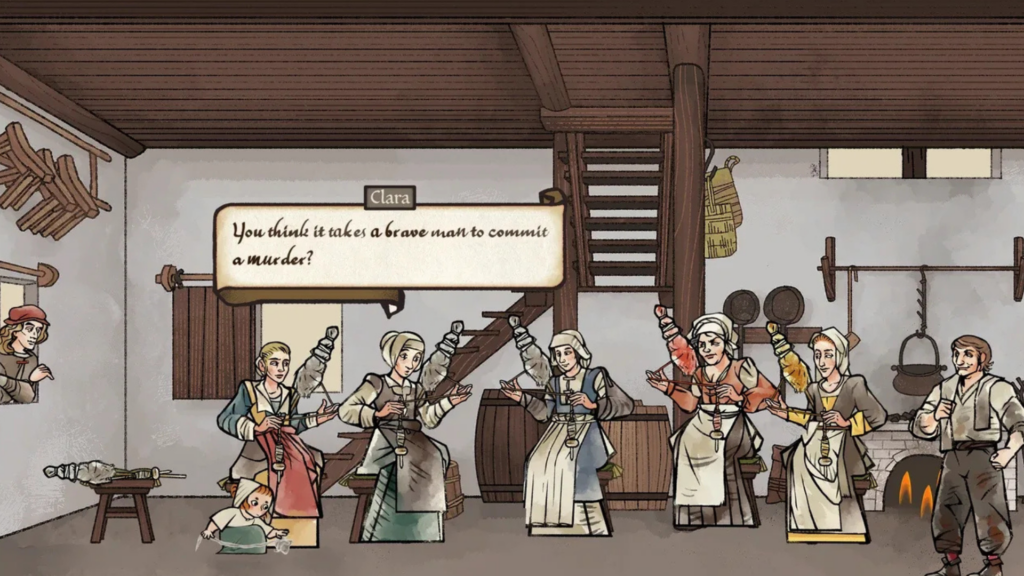
If you don’t agree with Pentiment being on this list, you are objectively wrong, and I will fight you in the comments. This game is the Citizen Kane of historical indie titles. You play as a master artist trapped in a murder mystery that spans decades.
Director Josh Sawyer has a degree in history. Not “I watched a YouTube documentary once” history—actual academic history. The game is a masterclass in manuscript illumination, theological schisms, and the brutal reality of early modern social hierarchy.
It’s a murder mystery where 90% of the gameplay is reading and eating bread. It sounds boring. It’s actually the most emotionally devastating game about font design you will ever play.
2. The Forgotten City
Historical Era: Ancient Roman Empire (with a twist)
Originally a Skyrim mod (which is the most indie origin story possible), this standalone game traps you in a time loop in a Roman underground city. It asks the philosophical question: “What if the gods were real, and they were really, really petty?”
The developers consulted with historians to reconstruct Roman engineering, philosophy, and the nuanced reality of slavery and class structure. It handles heavy themes with maturity rather than exploitation.
Finally, a game that lets you lecture ancient Stoics about their own philosophy while you’re stuck in a loop because some idiot stole some gold. It’s Groundhog Day for classics majors.
Venba (Visai Games)
Historical Era: 1980s–1990s Canada (Tamil Diaspora)
You play as a Tamil mother who immigrated to Canada with her family in the 1980s. The game unfolds through cooking—each recipe represents a memory, a conversation, a piece of culture slipping away or being stubbornly preserved. It’s short, it’s beautiful, and it will destroy you emotionally in under two hours.
Venba is a masterclass in using mechanics to tell history. You’re not just cooking; you’re reconstructing recipes from faded, damaged cookbooks, mirroring the experience of a family trying to hold onto traditions while raising a child who increasingly speaks English, adopts Canadian mannerisms, and doesn’t quite understand why his mother’s food matters. The game explores the Tamil diaspora experience, the aftermath of the Sri Lankan Civil War, and the quiet, daily labor of keeping a culture alive across generations. Developed by a small Canadian team led by Tamil creatives, this is history told from the inside.
It’s a cooking game where the hardest ingredient to measure is generational trauma. You’ll spend twenty minutes trying to figure out the correct amount of spice for a biryani while simultaneously grappling with your son’s identity crisis and your own place in a country that still looks at you like you’re a visitor. Bring tissues. Bring leftovers. Do not play this game if you have unresolved feelings about your own immigrant parents because you will be calling them afterward.
4. Norco
Historical Era: 2020s Louisiana (Yes, recent history counts)
Norco is a point-and-click adventure set in the industrial swamp of Louisiana. It’s historical in the sense that it documents the immediate aftermath of the petrochemical industry’s stranglehold on the American South. It’s cyberpunk, but the cyber is just rust, and the punk is just poverty.
Creator Geography of Robots is based in Louisiana. The game is a firsthand account of the region’s culture, environmental racism, and the collapse of the American industrial dream. It’s lived experience turned into narrative.
It’s a game where you explore a gas station, talk to a dying relative, and witness a cloned cult leader. It’s the most authentic Southern Gothic experience you can have without risking cancer from the local refinery runoff.
5. We. The Revolution (Klabater)
Historical Era: French Revolution
Ever wanted to know what it felt like to be the guy with the guillotine? No, not the fun Let Them Eat Cake version—the bureaucratic, morally ruinous version where you have to decide which terrified peasant gets executed based on flimsy evidence while your wife complains about your career choices.
This is a courtroom drama meets strategy game where you play as a judge during the Reign of Terror. The art style mimics the era’s judicial paintings, and the moral dilemmas are lifted directly from historical records of the Revolutionary Tribunal.
It’s Papers, Please but with powdered wigs and a much higher chance of being guillotined yourself if you make the wrong friends. You will learn the difference between a Girondin and a Jacobin purely out of self-preservation.
6. Attentat 1942
Historical Era: World War II (Czechoslovakia)
Most WWII games are about shooting Nazis. Attentat 1942 is about surviving the aftermath of shooting a Nazi. It’s an interactive documentary that uses real archival footage, survivor interviews, and hand-drawn art to explore the assassination of Reinhard Heydrich.
Developed by Czech academics and historians. This isn’t a game that was “consulted” by historians; it was made by them.
Prepare to click through family photo albums and cry. It’s the ultimate “um, actually” to people who think war is cool. It has the production value of a PBS documentary, which in this case, is a massive compliment.
7. The Legend of Tianding (CGCG)
Historical Era: Japanese Colonial Taiwan (1895–1945)
You’ve played a million games about cowboys and samurai. Now, finally, a game about a Taiwanese folk hero who robbed from the rich and gave to the poor while the Japanese Empire was breathing down everyone’s neck. It’s a sidescrolling brawler that doubles as a cultural preservation project.
The Sarcastic Pitch: It’s a side-scroller where you beat up colonial police with a straw hat and a sash. Finally, a historical game that isn’t about another generic white guy with a sword. You’ll feel like Robin Hood, except the sheriff is an occupying empire and the forest is Japanese-occupied Taipei.
Why It’s a Gem: The game is based on the real-life Liao Tianding, a legendary outlaw and folk hero in early 20th-century Taiwan. The developers meticulously researched period-accurate architecture, clothing, and the colonial tensions of the era, presenting it all through gorgeous hand-drawn art.
8. Return of the Obra Dinn
Historical Era: 1802 (East India Company)
Lucas Pope, the madman, created a game where you investigate a ghost ship using a pocket watch that lets you see the exact moment someone died. It is a masterpiece of deduction set against the backdrop of British naval imperialism.
Pope spent years researching period-accurate ship design, maritime law, and the socio-economic makeup of 19th-century crews. The attention to the 1-bit aesthetic is an expression of historical printing limitations.
It’s a puzzle game so hard that you’ll need to keep a physical notebook, making you look like a conspiracy theorist to your family. You will learn the difference between a topman and a seaman purely out of spite.
9. Lamentum
Historical Era: 19th Century New England
Lovecraftian horror meets historical accuracy. You play as a young aristocrat trapped in a decaying mansion filled with cultists, body horror, and enough existential dread to make you reconsider your life choices. It’s what would happen if Edgar Allan Poe decided to make a Resident Evil game—gothic, miserable, and full of things that should probably stay in the ground.
The game captures the aesthetic, architecture, and social anxieties of the Victorian era—class anxiety, the rise of industrialization, and the era’s obsession with spiritualism and eugenics (handled critically, not glorified). The pixel art is painstakingly detailed to reflect 1830s New England.
It’s a survival horror game where the scariest thing isn’t the monster chasing you—it’s the realization that your character is wealthy enough to own a mansion in the 1800s, meaning you’re probably the villain. Enjoy getting eaten by eldritch abominations. It’s still better than a dinner party with your in-laws.
10. A Plague Tale: Requiem
Historical Era: 14th Century France
While technically AA, A Plague Tale captures the indie spirit of narrative-first design. It’s a historical fiction about the Hundred Years’ War and the Black Death, except there are also… swarms of telepathic rats. Look, it’s not a documentary, but the vibe is immaculate.
The developers worked extensively with historians to reconstruct medieval French architecture, alchemy, and the military technology of the period. The supernatural elements serve the emotional truth of living through a pandemic.
You spend the entire game trying to keep your annoying little brother alive while being hunted by the Inquisition. It’s a fun family road trip if your family was traumatized, covered in leeches, and followed by a billion rats.
Conclusion: Why the Past Is Better When You’re Holding a Controller
Look, school textbooks will always be there to put you to sleep. Museums will always have that one security guard who follows you around like you’re about to pocket a Viking artifact. But historical indie games? They offer something neither of those can: the chance to inhabit history rather than just memorize it.
You don’t need to know the exact date of the Reign of Terror to understand what it felt like—the paranoia, the impossible moral choices, the way ideology curdles into survival. You don’t need to memorize the names of colonial Taiwan’s governors to appreciate why a folk hero like Liao Tianding mattered to the people on the ground.
The games on this list share a common thread: they trust you. They trust you to sit with discomfort, to engage with complexity, to understand that history isn’t a neat timeline of Great Men Doing Great Things. It’s messy. It’s human. It’s often deeply stupid. And occasionally, it involves a mute owl who carries his friends.
So do yourself a favor. Put down the dopamine-scrolling rectangle. Pick up one of these games. You’ll learn something. You’ll feel something. And at the very least, you’ll finally have a compelling answer for why you spent thirty hours judging French revolutionaries instead of responding to your emails.
TL;DR: Stop playing the same battle royale for the 5,000th time. Go play Pentiment. Learn about the Bavarian peasantry. Impress your friends at parties by knowing what a “scriptorium” is. You’ll look smarter, and honestly, it’s better than doom-scrolling.