
Hello everyone and welcome back to another blog post. Let’s get one thing straight: If you are here because you saw Transistor on sale for $3.99 and you’re wondering if it holds up in the era of A.I.-generated NPCs and games that require a 6,000-watt power supply to render individual sweat droplets—the answer is yes. Obviously.
In a gaming landscape currently dominated by live-service slop, procedurally generated dopamine vacuums, and sequels to remakes of prequels, Transistor (Supergiant Games, 2014) stands like a pristine, Art Deco middle finger to the concept of obsolescence.
The Aesthetics
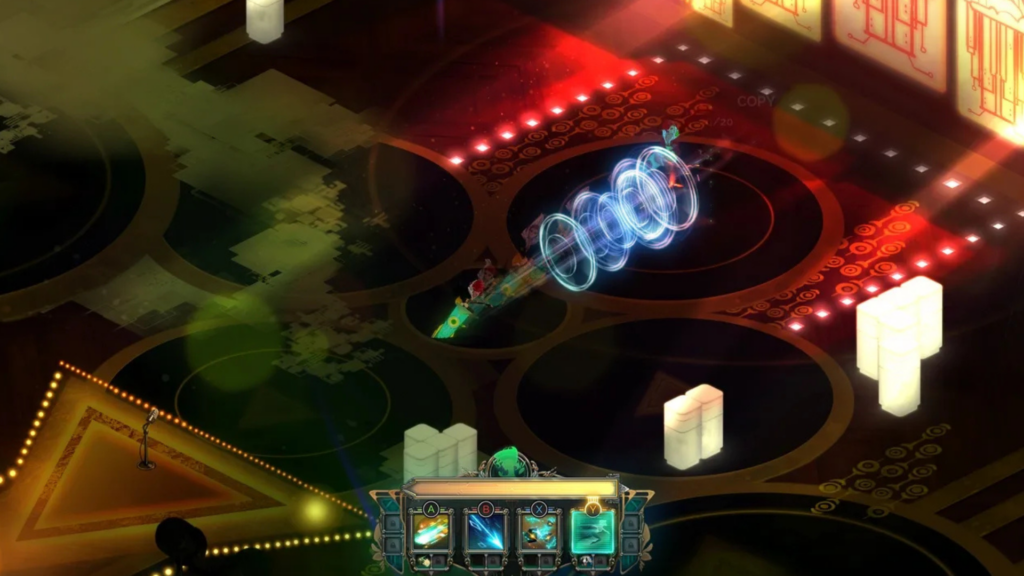
Let’s talk about the visual fidelity. In 2026, we’ve reached a point where graphics are technically “too real.” We have ray-traced lighting so complex it requires its own dedicated nuclear reactor. And yet, nothing released in the last two years holds a candle to the sheer, unadulterated swagger of Cloudbank.
The art direction—led by the legendary Jen Zee—is the kind of smug perfection that makes you want to throw your 8K monitor out a window. It’s a fusion of 1950s American optimism, Brutalist architecture, and a synthwave color palette that makes every single screenshot frame-worthy.
Transistor is why your current favorite “stylized” indie game looks like a cheap rental. Go to the Goldwalk district. Tell me I’m wrong. You’ll spend forty minutes just walking in a circle, listening to the hum of neon lights.
The Combat: Turn() or Get Wrecked
The combat system is where Transistor demonstrates its most sadistic form of genius. It’s part real-time action, part turn-based strategy via the “Turn()” function.
For the uninitiated: you freeze time, plot out a devastating series of movements and attacks (a “plan”), and then execute it in a blur of damage. Then, while your Turn() recharges, you have to survive in real-time like a normal action game.
In 2026, most AAA games have combat that plays itself. You hold a button, the character does a “finisher,” and a store page pops up asking if you want the “Execution+ Booster Pack.” Transistor expects you to use your brain.
I love that this game makes me feel like a tactical genius for approximately four seconds, only to immediately remind me that I’m an idiot who just planned a route that ends directly inside a giant, glowing, exploding “Jerky” enemy.
The Function system is absurdly deep. You equip Functions (your skills) to active slots, but you can also equip them as upgrades to other Functions, or as passive modifiers. If you didn’t spend at least 45 minutes in the menu staring at the absurd combinatorial possibilities of Jaunt() and Spark(), did you even play the game? This isn’t just a combat system; it’s a programming language for violence.
The Narrative
In the current year, we are inundated with companion characters who talk too much, usually to deliver quips about the latest microtransaction battle pass. Transistor features Red, a mute singer, and her companion, the Transistor—a sword containing the voice of her deceased lover, voiced by Logan Cunningham.
This should be annoying. A one-sided conversation between a woman who can’t speak and a sword who speaks for her? In the hands of a lesser studio, this would be a nightmare of exposition.
But it works. It works because the game trusts you to infer 90% of the emotional weight. Red’s body language, the way she touches the sword’s hilt, the way her humming weeps through the soundtrack—it’s storytelling through vibes.
Here’s a controversial opinion that is also correct: Transistor has a better story than Hades. Hades is a brilliant, endlessly replayable soap opera. Transistor is a tightly wound, tragic novel about grief, identity, and the commodification of art. It respects your intelligence. It doesn’t hold your hand; it holds your heart and then gently squeezes until you cry during the end credits.
The Soundtrack
Darren Korb, the composer, did something here that musicians in 2026 are still trying to replicate: he created a genre. “Old-school synthwave meets Argentinian tango” isn’t a real genre, but it should be.
If you are listening to this soundtrack while writing code or pretending to work, you are experiencing the audio equivalent of wearing a turtleneck in a café. It makes you feel smarter, sadder, and more sophisticated.
Go listen to “The Spine.” If your spine doesn’t tingle, please consult a medical professional and also delete my blog. We can’t be friends.
So, Why Play It in 2026?
We are in an era of “forever games.” Everything is trying to take up your entire hard drive and every waking moment. Transistor is the antidote.
It respects your time. It’s a six-to-eight-hour experience that offers a New Game Plus mode that fundamentally alters the difficulty and build-crafting, but it doesn’t beg you to stay. It tells its story, executes its vision with flawless precision, and ends.
Final Verdict
Rating: Masterpiece
Best For:
- Fans of tactical combat that requires a brain cell
- People who want to feel emotionally devastated by a video game sword
- Listeners who appreciate soundtracks that slap harder than they have any right to
- Gamers tired of open-world bloat
Worst For:
- People who skip cutscenes
- Those who believe a turn-based mechanic is a war crime
- The stray cat I named “The Camerata.” He knows what he did.
So, go buy it. Dust off your Steam Deck. Sink into a comfortable chair and let Jen Zee’s art wash over you. Just don’t blame me when you start wearing high-collared coats and dramatically staring at the horizon.
Have you played Transistor recently? Let me know in the comments.