
Hello everyone and welcome back to another blog post. Let’s be honest: most “strategy” games today aren’t strategy. They are vibes.
You know the ones. You click a button, a colorful animation plays, and a disembodied voice tells you that you’re a “brilliant tactician” for simply showing up. If you want to feel the warm, comforting hug of participation trophies, go play a mobile gacha game.
If, however, you want to feel the cold, unforgiving grip of existential dread as a single misplaced unit dooms your entire 14-hour campaign, welcome. You’ve come to the right place.
We’ve scoured the depths of Steam, Itch.io, and the dark alleys of gaming history—from genre-defining classics to recent brain-melters—to find the top 10 strategy indie games that actually respect your intelligence. Or, more accurately, that enjoy watching it crumble. Let’s dive in, shall we?
1. Manor Lords (2024)
Genre: Grand Strategy / City-Builder / Medieval Warfare
The Premise: The game that launched a thousand “finally, a realistic medieval game” comments. It’s a stunningly detailed simulation of feudal life, where you manage oxen, burgage plots, and supply chains—and yes, eventually raise armies to conquer your neighbors.
The Strategy: Forget your army for a second. Your biggest enemy in Manor Lords is the supply chain. If you forgot to assign a family to tanning, your army won’t have boots. If your army doesn’t have boots, they will die. If they die, your village burns. All because you thought leather was “boring.”
Why It Hurts So Good: It’s a game where you will genuinely celebrate because your population of peasants finally hit 50. Then a random baron will show up with 300 mercenaries because you forgot to pay your tithe. Back to the oxen mines, buddy.
2. Diplomacy is Not an Option (2022)
Genre: Real-Time Strategy / Survival / Base-Building
The Premise: The title is the tutorial. You are a feudal lord besieged by thousands of peasants who are very angry about taxes. You cannot talk to them. You must remove them.
The Strategy: It’s a classic RTS base-builder in the vein of Age of Empires but with a twist: you know the enemy is coming. You just don’t know from where, or how many. It turns into a frantic game of resource management where you’re constantly wondering if you spent too much on walls or not enough on archers.
Why It Hurts So Good: Your peasants complain about the rent, so they show up with battering rams to tear down your castle. Very reasonable escalation. The “strategy” here is to realize that diplomacy was, in fact, never an option, and you should have just raised taxes higher to afford more trebuchets.
3. They Are Billions (2019)
Genre: Real-Time Strategy / Survival / Base-Building
The Premise: It’s Age of Empires meets The Walking Dead. You build a steampunk colony while wave after wave of infected zombies tries to tear it down. One infected villager can doom your entire run.
The Strategy: Expansion is risk. Every new building you place extends your perimeter, and every extended perimeter needs defending. You will spend hours building the perfect, impenetrable fortress, only for a single zombie to slip through a gap you didn’t notice and infect your housing district before you can react.
Why It Hurts So Good: The game has a “pause and issue orders” mechanic, which is the game’s way of saying, “We know you can’t micro this fast, so here’s a lifeline. You’ll still lose.”
4. Northgard (2018)
Genre: Real-Time Strategy / City-Builder / Viking Simulator
The Premise: Age of Empires but with Vikings, territory control, and a winter that actively wants you dead. You lead a clan of Norse warriors trying to conquer, trade, or religiously convert a newly discovered continent.
The Strategy: Unlike traditional RTS games where you spam buildings everywhere, Northgard uses a territory system. You can only build on tiles you’ve claimed, and each tile costs resources to hold. Expansion is a deliberate choice, not a default behavior.
Why It Hurts So Good: Just when you think you’re winning, winter arrives. Your food production plummets. Your wood reserves vanish. Your army starts starving. You will learn to fear the snow more than any enemy clan.
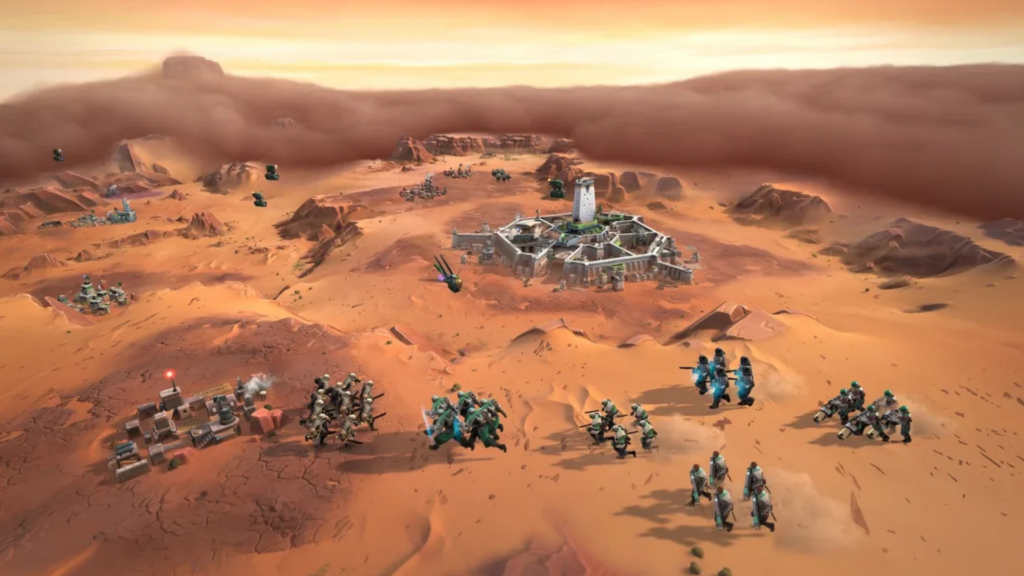
5. Dune: Spice Wars (2023)
Genre: Real-Time Strategy / 4X / Political Intrigue
The Premise: Civilization meets Command & Conquer on Arrakis. You control one of several factions vying for control of the spice—the most valuable resource in the universe. Also, there are giant sandworms.
The Strategy: This is a 4X game (explore, expand, exploit, exterminate) that plays in real-time. You manage economy, espionage, military, and politics simultaneously. Ignore any one of them, and you’ll lose—either to an enemy army or a political assassination.
Why It Hurts So Good: You’ll spend 30 minutes carefully building your economy, only to realize you forgot to pay the Landsraad (space parliament) any attention, and now you’ve been sanctioned into oblivion. Or worse: you ignored the desert, and a worm ate your harvesters.
6. Tooth and Tail (2017)
Genre: Real-Time Strategy / Arcade-Style / Animal Revolution
The Premise: It’s Red Alert 2 but with anthropomorphic animals having a violent revolution over food. It’s fast, brutal, and designed to be played with a controller (yes, really).
The Strategy: This is RTS stripped to its essentials. You control a single commander unit that builds structures wherever it stands. No base sprawling. No massive army micro. Just quick decisions, resource control, and knowing when to push and when to retreat.
Why It Hurts So Good: Matches last 10–15 minutes, which means you lose fast. One bad engagement, and your entire army is gone. You’ll lose, immediately queue up another match, and lose again. It’s a cycle of pain that feels suspiciously like addiction.
7. Rise to Ruins (2019)
Genre: Real-Time Strategy / God Sim / Base-Building
The Premise: You are a god protecting a village from monstrous corruption. It’s Age of Empires meets Black & White, with a heavy dose of tower defense.
The Strategy: You don’t directly control your units; you set tasks, build structures, and watch your villagers execute your orders with varying degrees of competence. The game is about planning infrastructure, managing resources, and desperately trying to keep your villagers from wandering into monster nests.
Why It Hurts So Good: Your villagers have survival instincts that range from “cautious” to “lemming.” They will happily walk into a burning forest to chop wood. You will scream at your monitor. They will not hear you.
8. Songs of Syx (2020 / Early Access)
Genre: City-Builder / Grand Strategy / Colony Sim
The Premise: Imagine Dwarf Fortress crossed with Civilization and a dash of Total War. You build a city that can scale to 50,000+ citizens, then manage diplomacy, trade, and warfare with neighboring empires.
The Strategy: This is a game about scale. Early on, you’re managing individual citizens. Late game, you’re managing armies, ethnic tensions, supply lines, and rebellions. It starts as a colony sim and ends as a grand strategy empire.
Why It Hurts So Good: Your city will collapse not because of a single bad decision, but because of a cascade of them. You forgot to build enough housing, so immigrants stopped coming. Without immigrants, your army starved. Without an army, your neighbor invaded. You lose in slow motion over 40 hours.
9. Kingdom Two Crowns (2018)
Genre: Real-Time Strategy / Base-Building / Minimalist
The Premise: Age of Empires if it were a 2D side-scroller and also a metaphor for monarchical fragility. You ride left and right, dropping coins to build walls, recruit archers, and expand your kingdom.
The Strategy: The strategy is deceptively simple: expand too fast, and you can’t defend. Expand too slow, and the Greed (the game’s enemy) will overwhelm you. Every decision comes down to coin management and risk tolerance.
Why It Hurts So Good: There is no micro-management. You can’t tell your archers where to stand. You can’t command your knights who to attack. You just build, hope, and watch as a single night attack wipes out months of progress because you forgot to upgrade your walls.
10. Industries of Titan (2023)
Genre: Real-Time Strategy / City-Builder / Corporate Dystopia
The Premise: Command & Conquer meets SimCity on Saturn’s moon. You are a corporate executive tasked with building a futuristic metropolis while fending off rival corporations and rebels.
The Strategy: You build factories, manage supply chains, and design warships in a modular ship-builder. Combat happens on a separate tactical layer, but your economy determines how many ships you can field and how well they’re equipped.
Why It Hurts So Good: The game’s humor is bleakly corporate. You’re not a heroic commander; you’re a middle manager optimizing profit margins. Lose a battle? That’s a budget shortfall. Get your citizens killed? That’s a labor shortage. You’ll win, but you’ll feel like you need a shower afterward.
Conclusion: Go Fail Better
So, there you have it. Ten strategy indie games that will either sharpen your mind into a diamond-hard tactical weapon or make you throw your controller through your monitor.
The indie strategy scene thrives because these developers actually play games. They know that strategy isn’t about flashy graphics or cinematic trailers; it’s about systems that interact in ways you didn’t expect, forcing you to adapt, learn, and occasionally cry.
Now, stop reading and go lose. You’ve got supply chains to manage, zombies to breach, and democracy to dismantle before the world turns into an apocalypse.