
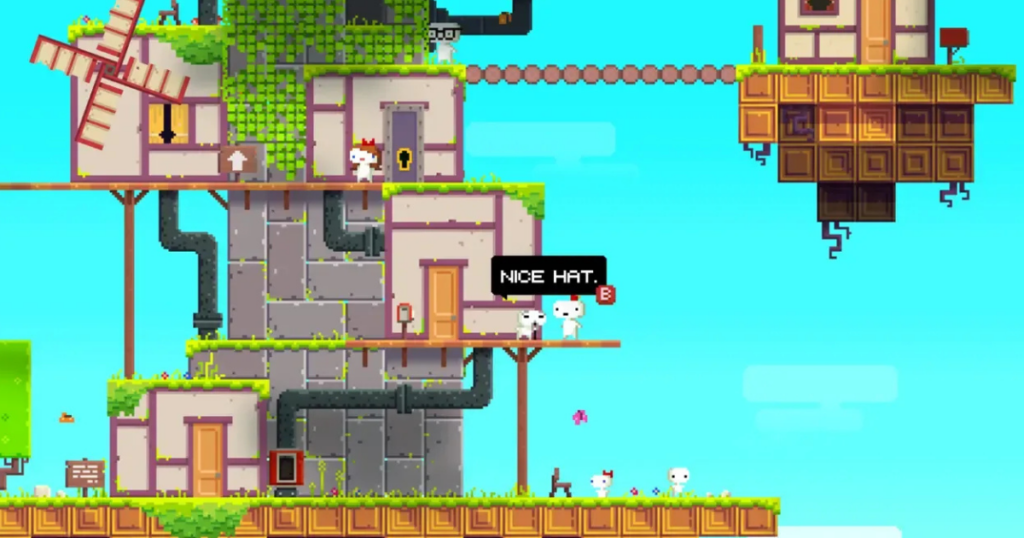
Hello everyone and welcome back to another blog post. Let’s be honest—you’ve heard of FEZ. It’s that indie game from over a decade ago that your coolest gamer friend won’t shut up about. The one with the “mind-blowing perspective shift” and the “controversial developer” and that adorable little character bouncing through a pixelated universe. Playing it for the first time in 2026 feels a bit like finally watching a classic film everyone says changed cinema. You approach it with respect, but also with a healthy dose of modern skepticism: does the magic actually hold up, or has time rendered its innovations quaint?
Having just completed my first journey through its isometric puzzles, I can report that FEZ’s particular brand of sorcery remains potent. As a newcomer, I was completely disarmed by its creativity. The core platforming feels like rediscovering a fundamental truth about video games, and the visual presentation—a lush, living diorama of pixel art—manages to feel both nostalgically retro and timelessly fresh.
The Rotation Revelation: Where 2D Meets the Third Dimension
The central mechanic that defines FEZ is deceptively simple yet endlessly clever. You guide the perpetually bewildered Gomez through what initially appears to be a strictly 2D, side-scrolling world. Then, with the press of a shoulder button, the entire universe groans and rotates 90 degrees, revealing that what was once a flat wall is now a walkable platform, and a distant, unreachable ledge is now right in front of you.
This “gimmick” is actually the game’s entire language. The genius lies in how intuitively it teaches you to think in four different perspectives of the same space. You stop seeing levels as linear paths and start seeing them as three-dimensional structures you’re merely viewing from one side at a time. The satisfaction is profound and constant; a path forward is rarely about a perfectly timed jump, but about finding the correct angle to make the jump possible. It turns navigation into a quiet, cerebral “aha!” moment factory.
This philosophy extends to the game’s overall tone. There are no enemies to kill, no lives to lose. The primary antagonist is your own perception, and the primary reward is the sheer joy of seeing the world click into place. It’s a shockingly peaceful experience, perfectly underscored by Disasterpeace’s legendary soundtrack—a melodic, chiptune masterpiece that evokes contemplative isolation and wonder in equal measure.
A Modern Player’s First Impressions
From my vantage point, this approach felt refreshingly countercultural. In an era of battle passes, grinding loops, and constant notifications, FEZ confidently presents itself as a quiet space for contemplation. Its puzzles are environmental and logical. You’re not following a quest marker; you’re following your own curiosity, rewarded by the game’s willingness to let its world be genuinely mysterious. The pixel art isn’t a cheap retro affectation—it’s meticulously crafted, with layers of parallax scrolling, subtle animations, and a cohesive, dreamlike color palette that makes every screen feel like a place you could pause and just live in for a while.
When the Charm Wears Thin: Hitting the Glyph Wall
However, to believe FEZ is only this serene, intuitive exploration is to be lulled into a false sense of security. After collecting a certain number of the game’s central collectibles (the golden cubes and cube fragments), the façade cracks. The game undergoes a metamorphosis, shedding its skin as a gentle platformer to reveal the skeletal structure of what its creator, Phil Fish, once termed a “Mystroidvania.”
This is where FEZ transitions from a puzzle game to a puzzle box. It introduces a fully developed Fezian alphabet and numeral system that you must decode. It scatters cryptic glyphs, obscure treasure maps, and even in-game QR codes that, in a delightfully meta twist, require a physical smartphone to scan. The open-ended, non-linear world map, often criticized in reviews of its later ports, becomes a source of frustration as you backtrack through similar-looking areas searching for that one symbol you half-remember.
This late-game shift is where modern players might feel the age gap most acutely. The game’s design assumes a level of patience and manual notetaking that feels almost archival today. As one long-term player meticulously documented in a detailed critique, many of these meta-puzzles abandon the elegant rotation mechanic entirely. The challenge stops being about spatial reasoning and starts being about cryptography, pattern recognition, and communal guesswork. You’re no longer a platforming hero; you’re an amateur archaeologist, and the tomb is confusingly laid out.
The Enduring Legacy: Why FEZ Still Deserves Your Attention in 2026
So, with its sometimes-obtuse second act, does FEZ still earn a place on your hard drive? Unequivocally, yes.
Its strengths are foundational, not cosmetic. The initial ten hours—the process of learning its language and falling in love with its world—constitute one of the most uniquely rewarding experiences in gaming. It’s a masterclass in teaching through mechanics rather than tutorials, in rewarding observation over reaction.
The key for a contemporary player is to manage expectations. Embrace FEZ for what it does peerlessly: providing a calm, visually stunning, and intellectually stimulating playground. Savor the act of exploration itself. When you inevitably encounter the dreaded first glyph you can’t decipher, don’t view it as a failure. See it as a crossroads. You have three authentic choices:
- The Purist Path: Clear off your desk, open a notebook, and embrace the role of cartographer-linguist. The game was built for this.
- The Community Path: Consult the still-thriving online forums and guides. FEZ’s puzzles were designed to be solved collectively, and that community spirit is part of its history.
- The Tourist Path: Decide you’ve seen enough, that the joy was in the journey of discovery, not in compiling a complete lexicon. There is no shame in this.
FEZ is more than a game. It’s a time capsule from a specific, passionate moment in indie development, a piece of interactive art that asks you to literally change your point of view. It can be frustrating, bewildering, and slow. It can also be transcendent, beautiful, and quietly profound. That tension is what makes it a classic. Its pixels aren’t just displaying a world; they’re asking you a question: Are you willing to look at things differently?
What was your FEZ breaking point? The first time you had to draw a map, or the moment you finally translated a whole sentence? Share your stories of triumph or surrender below.