
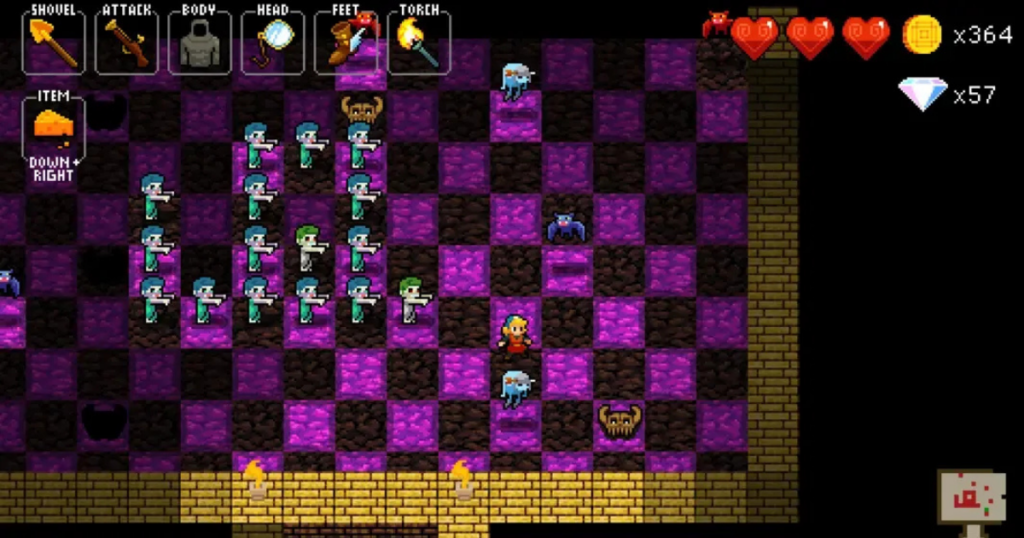
Hello everyone and welcome back to another blog post. So you’ve decided to descend into the Crypt of the Necrodancer, a place where your typical rogue-like “careful planning” is thrown out in favor of “dancing like your Wi-Fi depends on it.” Imagine, if you will, a game that looks at the precise, turn-based strategy of classic dungeon crawlers and says, “That’s cute, but what if we added a relentless drum track?” This is that game. You don’t just fight skeletons; you boogie with them to the beat. Miss a step, and you’re not just dead—you’re rhythmically dead, which is somehow more embarrassing.
Here, the dreaded permadeath system is a public shaming set to a killer soundtrack. You’ll die. A lot. But each time, you’ll hopefully learn that the green blob has a two-beat shuffle or that trying to face-tank an armored skeleton is a one-way ticket back to the title screen. It’s a game of patterns, pressure, and perpetual motion, and it has absolutely no respect for your two left feet.
The Core Concept: When a Metronome Attacks
The premise is deceptively simple. Your character—be it the standard hero Cadence or one of the many, many unlockable characters designed to break your spirit—can only act on the beat. Moving, attacking, even buying a overpriced potion from a singing shopkeeper: everything is a dance move.
This creates a frantic, almost zen-like state of panic. You’re not just navigating a dungeon; you’re solving a spatial puzzle in 4/4 time. That red dragon isn’t just a threat; it’s a fire-breathing metronome waiting for you to miss your cue. The genius of the game is how it transforms simple enemy patterns into complex rhythmic challenges. Learning that a monster moves every other beat becomes as crucial as finding a better sword.
Your Dance Partners (The Monsters)
Let’s meet the residents of this rhythmic ruin, shall we? They’re not just here to kill you; they’re here to critique your timing.
- The Green Blob: The tutorial enemy you’ll still somehow manage to die to in Zone 3. It bounces back and forth with predictable, plodding grace. It’s the rhythm game equivalent of a warm-up stretch, until six of them box you into a corner.
- The Armored Skeleton: The game’s way of teaching you that sometimes, you have to hit things from the side. A frontal assault results in a sad clang and a feeling of profound foolishness. It’s the dungeon’s way of saying, “Nice try, but maybe think for a beat.”
- The Red Dragon: Ah, the panic inducer. It breathes fire in a long line, forcing you to either move perpendicular with perfect timing or become extra-crispy dungeon fodder. The key, as some have wisely noted, is simply to “hold your nerve for a few seconds.” Obviously. Why didn’t I think of that while pixelated flames licked at my heels?
The Tools of the Trade (Your Arsenal)
Your weapon doesn’t just change your damage; it changes your entire dance style.
- The Dagger: Your default. It’s short, it’s stabby, and it forces you to get intimately close with every horror in the crypt. Using it feels like trying to win a boxing match with a toothpick.
- The Broadsword: For when you want to swing wide and pretend you’re a whirlwind of death. Excellent for crowds, terrible in tight hallways where you’ll spend more time clanging off walls than enemies.
- The Rapier: The fencer’s choice. It lets you lunge forward and, crucially, retreat on the same beat. It feels elegant, sophisticated, and is usually how I die while trying to look cool.
- The Crossbow: The “I don’t want to dance with you people” option. Allows for ranged attacks but must be reloaded on the beat. Nothing says “rhythmic failure” like standing there helplessly clicking at a skeleton while your character slowly nocks another bolt.
The Zones: A Tour of Musical Mayhem
The crypt is divided into distinct zones, each with a new soundtrack and a fresh way to ruin your day.
Zone 1 – The Funky Foundations: The relatively gentle introduction. The music is upbeat, the enemies are basic, and it lulls you into a false sense of “Hey, I’ve got this!” This is a lie.
Zone 2 – The Jungle Boogie: Welcome to the land of explosive mushrooms and creeping vines. Here, the environment is as much your enemy as the monsters. One misstep onto a fungal landmine and your beautiful coin multiplier goes up in a poof of spores.
Zone 3 – The Ice & Fire Concert Hall: A masterpiece of integration. The level is split between ice and fire tiles, and the music itself dynamically shifts from a metal riff to a synthwave track as you move between them. It’s a stunning audio-visual trick that you’ll barely appreciate as you scramble to not freeze or burn.
Zone 4 – The Finale of Frustration: Where the rules change, enemies parry, and everything wants to explode. By this point, you’re either a rhythm god or a broken person muttering about beats in their sleep.
Beyond Cadence: The Cast of Misfits
Beating the game with the main character is just the opening act. The real madness begins with the unlockable crew, each of whom fundamentally breaks the game’s rules for a new flavor of pain.
Bard: For those who thought, “This is great, but what if we removed the music?” He lets you move freely without the beat. He’s the training wheels character, and using him feels like cheating in the most satisfying way possible.
Monk: The ultimate test of greed. This pacifist can’t kill, only push enemies. But if he so much as touches a piece of gold, he dies instantly. The game becomes a tense, coin-dodging ballet of avoidance.
Dove: True pacifism. Can’t attack, can’t hurt anyone. You just have to outmaneuver every enemy in the dungeon to escape. It’s the most frustrating puzzle game ever created, hidden inside a rhythm rogue-like.
The Verdict: To Dance or Not to Dance?
Crypt of the Necrodancer is a brilliant, punishing, and endlessly creative gem. It’s the kind of game that could only come from a team with a fiercely specific and weird vision. It takes time to learn its rhythm, and even longer to master its steps, but the moment you clear a difficult room without missing a beat is a feeling of pure, unadulterated triumph.
Play it if: You have a sense of rhythm (or a stubborn desire to develop one), you love games that reward deep mastery, and you don’t mind laughing at your own repeated, musical failures.
Avoid it if: You get easily frustrated, your toes are incapable of tapping, or you believe video game shopping should be a quiet, contemplative experience free of disco ball lights and a singing merchant.
In the end, it’s a cult classic for a reason. It’s hard, it’s fair, and it’s packed with more personality than most games ten times its size. Now, if you’ll excuse me, I have to go try not to pick up gold as the Monk for the hundredth time. The struggle, as they say, is real. And perfectly synced to a 120 BPM track.