
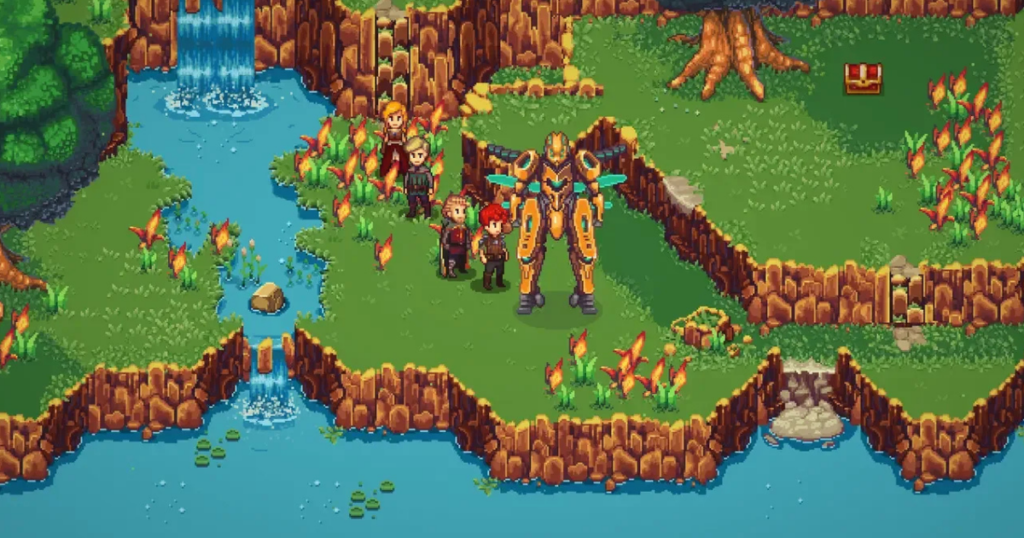
Hello everyone and welcome back to another blog post. In a gaming era obsessed with 4K realism and sprawling open worlds, a pixel-art JRPG developed primarily by one person became a critical darling and a beacon for the genre. Chained Echoes didn’t just pay homage to the SNES classics of the 1990s; it audaciously refined them, asking a provocative question: What if the golden age of JRPGs wasn’t behind us, but happening right now? This is a love letter written not with nostalgia, but with a scalpel—surgically improving on the formulas of Chrono Trigger, Xenogears, and Final Fantasy VI while telling a fiercely original, mature story. (Because, let’s be honest, sometimes you want a plot with more philosophical heft than “spiky-haired teenager saves the world.”)
From Solo Vision to Genre Triumph: The Making of a Modern Classic
The story of Chained Echoes is the ultimate “hold my beer” moment in game development. It is the magnum opus of Matthias Linda, who, in a move that should embarrass entire studios, decided to craft nearly every pixel, line of dialogue, and game system himself. This glorious act of creative defiance landed on every modern platform in December 2022, published by Deck13 Spotlight.
Gameplay Genius: Fixing What Wasn’t “Broken” (It Was Broken)
At its core, Chained Echoes is a turn-based JRPG where you guide heroes across a war-torn continent. But then it quickly informs you that it has politely filed all the genre’s annoying traditions in the nearest incinerator.
The Overdrive System: A Meter That Actually Matters
The star of combat is the Overdrive system. Forget mindless “Attack/Heal” loops. Here, a meter tracks your party’s “heat.” Land in the green zone, and you’re good. Let it hit red, and you’re a wet noodle in a sword fight. The trick? You can’t just spam your best move. You have to strategically use weaker or defensive abilities to cool the engine. It transforms every trash mob fight into a tactical skirmish, punishing the kind of brain-off grinding we’ve all done while listening to a podcast. (You know you have.)
The Sacred Cow Slaughter: No Grind, No Random Encounters
Chained Echoes looks at two JRPG pillars—random encounters and level grinding—and says, “Why?” Enemies are visible. You choose your fights. And in a move so revolutionary it should be illegal, characters don’t gain traditional EXP. Instead, you earn permanent upgrades at set story points. You can’t overlevel. The game fully heals you after every single fight. It’s the gaming equivalent of a concierge handing you a chilled towel after a workout. It respects you so much it almost feels insulting to other games. (Looking at you, titles that made me fight 37 slimes to afford a new hat.)
Mechs, Because Walking is for Peasants
Just when you think you’ve mastered combat, the game hands you the keys to Sky Armor—giant, piloted mechs with their own combat system. Because why have one perfectly balanced battle system when you can have two? It’s an absurd, glorious power trip that makes the regular combat—which is already fantastic—feel like the tutorial. The world is packed with secrets, all set to a stunning original soundtrack that somehow makes 16-bit soundfonts evoke a full orchestra.
A Story with More Betrayals Than a Family Reunion
Set on the continent of Valandis, the plot kicks off with a “whoops”: mercenary Glenn accidentally nukes thousands with a magical superweapon called the “Grand Grimoire.” So begins a 30-40 hour epic where the politics are as thick as the plot twists, and everyone has a secret, a tragic past, or a shocking lineage. You know, JRPG stuff—but written for people who’ve graduated high school.
The cast is a delightful band of misfits:
- Glenn: Haunted by guilt and past lives, basically a therapist’s dream client.
- Lenne: A princess who’d rather steal sky-armors than sit on a throne. Relatable.
- Sienna: A thief with a heart of gold and a better fashion sense than your entire party.
- Victor: A centuries-old bard who’s seen it all and is profoundly tired of your nonsense.
The story confidently swings from courtly intrigue to world-ending mech battles, asking questions about fate and free will without ever making you cringe. It proves that “mature” storytelling doesn’t mean just adding more blood and swears; it means trusting your audience to handle complexity.
The Ultimate Takeaway: A Benchmark in Fun
Chained Echoes is a monument to the idea that good design is timeless, and player respect is the best feature. It proves that you can love a genre’s soul while mercilessly modernizing its clunky bones. It’s the game you finish, then immediately want to reboot to experience the sheer audacity of its polish all over again. In a world cluttered with endless live-service looter-shooters and open-world checklists, it’s a brilliant, self-contained reminder of why we fell in love with games in the first place: pure, unadulterated fun, served without filler. If you want to check it out, get on Steam here, or gog.com here.