
Hello everyone and welcome back to another blog post. Let’s be honest—when a major game publisher says “innovative,” they usually mean a battle pass for a zombie open-world survival-crafting-live-service title that’s already three months behind on its roadmap. The word has been hollowed out faster than a loot box full of disappointment.
True innovation, especially in the indie scene, isn’t about the biggest budget or flashiest tech. It’s about creative audacity. It’s about a single, brilliant mechanic that rewires your brain, a narrative trick that changes how you feel about agency, or a simple tool that transforms your relationship with a digital world. These games didn’t just play by the rules; they built a new game board entirely.
In Part 2 of our definitive Top 10 Most Innovative Indie Games of All Time: The Future Isn’t Made by Corporate Committee list, we move beyond the foundational classics to explore the titles that pushed the envelope even further. These are the games that prove the most exciting ideas in gaming are still born from singular, stubborn, and brilliant visions, not from corporate committee reports wondering how to monetize a grapple hook. So buckle up, and let’s count down ten games that actually earned the “I” word.
1: Outer Wilds (2019) – The Knowledge-Based Progression System
The Innovation: A Universe Where Your Brain is the Only Upgrade
Forget skill trees, experience points, or unlocking new areas with a shiny key. Outer Wilds drops you into a miniature, handcrafted solar system doomed to explode in a 22-minute time loop. Your only real tool is the ship’s log. The game’s monumental innovation is that all progression is based on the knowledge you, the player, personally acquire and remember.
The first time you clumsily crash on a planet is a disaster. The tenth time, you’re executing a perfect landing because you’ve learned its quirks. You don’t level up your character; you level up your understanding of alien language, orbital mechanics, and quantum entanglement. Solving the galaxy’s greatest mystery feels less like following quest markers and more like a genuine “Eureka!” moment that unfolds in your own mind.
Outer Wilds is the ultimate rebuttal to every game with glowing trails and objective checklists. It’s proof that the most satisfying reward isn’t a +5 Sword of Stats, but the moment a cosmic puzzle clicks into place inside your own head. Just try explaining to a friend where to go without spoiling it. You’ll sound like a conspiracy theorist mapping out the Kennedy assassination with red string.
2: Braid (2008) – The Game That Made Us All Feel Simultaneously Smart and Dumb
Long before every other indie game was a “thought-provoking puzzle-platformer,” there was Braid. At first glance, it looked like a charming, painterly love letter to Super Mario Bros. But then you tried to rescue the princess and realized the universe itself was working against you—not with goombas, but with the fabric of time.
The true innovation here wasn’t just “you can rewind time.” That’s a parlor trick. The genius was building entire worlds where time behaved differently. In one world, time moved forward when you moved right, and backward when you moved left. In another, certain objects were immune to your temporal meddling. It created puzzles that felt less like “find the key” and more like unraveling a philosophical knot.
Braid is the reason we now have a thousand indie puzzle games where the core mechanic is also the central metaphor. It taught a generation of developers that you could make a game about something—regret, obsession, the futility of one’s actions—without needing a single line of heavy-handed dialogue. It also taught players that it’s perfectly acceptable to spend 45 minutes staring at a single screen, muttering obscenities at a mischievous cloud.
3: Tunic (2022) – The Instruction Manual as a Sacred, In-Game Artefact
The Innovation: A Meta-Layer of Discovery That Recaptures Childhood Wonder
Tunic presents itself as a charming, isometric love letter to classic Zelda. Then, you start finding crumpled, fox-language pages of the game’s own instruction manual scattered through the world. This isn’t a collectible; it’s the core mechanic.
The manual contains maps, hints for environmental puzzles, combat tips, and lore. It simulates the childhood experience of poring over a game’s manual on the school bus, scouring every pixel for secrets. Progression becomes about literally translating a lost language and connecting clues across pages. The game world and its “paratext” become one intertwined mystery.
Tunic is a powerful argument against modern games that treat you like you have the memory of a goldfish. It proves that discovery is infinitely more satisfying than chasing a glowing icon. It also single-handedly revived the phrase “Did you check the manual?” as a genuine, helpful piece of advice.
4: Citizen Sleeper 2: Starward Vector (2025) – The Dice-Driven, DnD-Inspired Space Epic
The Innovation: TTRPG Mechanics as an Engine for Humanist, Cyberpunk Storytelling
This sequel from solo developer Gareth Damian-Martin exemplifies modern indie innovation. You are a “Sleeper,” a digitized human consciousness in a failing synthetic body, trying to survive on a scrappy spaceship at the edge of a corporate galaxy. Your daily actions are governed by a dice roll—a direct, brilliant translation of tabletop RPG tension.
A low roll can trigger a desperate, dramatic chain of events. The genius is in how this systemic randomness fuses with a deeply humane, choice-driven narrative about community and interdependence. It’s a game about finding your people in a universe designed to chew you up and spit you out, and every dice roll heightens the emotional stakes.
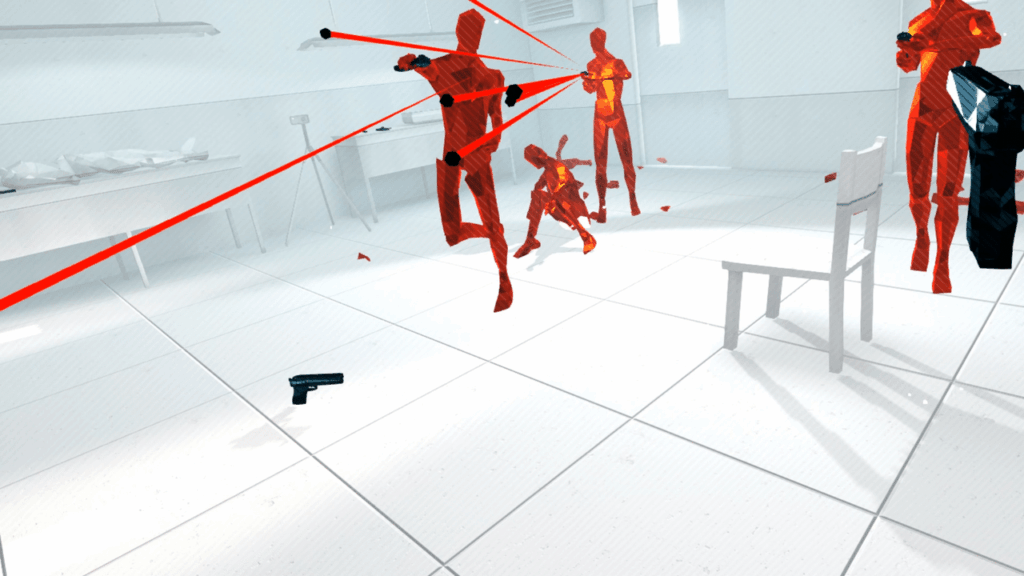
5: Superhot (2016) – “Time Moves Only When You Move”
The Innovation: A Shooter That Turned Inaction Into Its Core Strategy
The pitch is simple: a first-person shooter where time stands still until you move. What sounds like a neat gimmick becomes a revolutionary gameplay loop. Superhot innovates by redefining the core verb of an entire genre. Running and gunning gets you killed. Success is about stillness, observation, and planning your next second of motion like a lethal ballet.
It turns every encounter into a cascading puzzle of bullets, enemies, and environmental awareness. You’ll dodge a hail of gunfire, snatch a weapon from mid-air, and shatter a foe, all in a single, fluid motion you choreographed in frozen time. It makes you feel like the protagonist in a John Woo film directed by a physicist.
Superhot is the game you use to prove that a killer idea is worth more than a $200 million graphics budget. It also gave us all a power fantasy far more unique than “man with big gun”: the fantasy of being a hyper-intelligent statue. Also, Superhot is what girls call me 😉 (in my dreams).
6: What Remains of Edith Finch (2017) – The Anthology of Interactive Vignettes
The Innovation: Weaponizing Gameplay Variety to Explore Grief
Labeled a “walking simulator”, Edith Finch is better described as a series of playable short stories. Each tale of a family member’s death is told through a unique, genre-bending interactive vignette.
You’ll become a shape-shifting monster in a comic book, swing through the trees in a first-person daydream, and even chop fish in a cannery while your mind soars elsewhere. The innovation is using wildly different mechanics not as minigames, but as direct emotional translators for each character’s inner world. It proves games can make you feel a spectrum of emotions by constantly changing how you play.
This game is the reason the phrase “it’s more of an experience” is now a valid and respected descriptor, instead of just a euphemism for “there’s no gameplay.” It turns family trauma into the most creatively diverse theme park you’ll ever visit.
7: Viewfinder (2023) – Reality-Bending Photography Mechanics
The Innovation: Making a Photograph a Literal Building Tool
What if you could take a picture of a bridge, then hold that photo up and place it into the world to become a real, traversable bridge? That’s the simple, brain-melting premise of Viewfinder. Its innovation is taking a familiar mechanic (photography) and making it a literal world-sculpting tool.
The puzzles start clever and quickly become mind-breaking feats of spatial reasoning. You’ll create impossible loops, duplicate keys by photographing them, and build entire structures from a collage of snapshots. It’s a constant, delightful assault on your perception that makes you question every surface and angle.
This is the kind of idea so obviously brilliant you’ll slap your forehead wondering why no one did it before. It takes the “portal” mechanic and democratizes it, letting you create your own solutions from the very fabric of the environment. Pure, unadulterated video game magic.
8: Chicory: A Colorful Tale (2021) – Painting as a Core Gameplay and Narrative Tool
The Innovation: A Brush That’s Your Weapon, Tool, and Therapy
In a world left blank and colorless, you wield the brush of a god-like artist. Chicory‘s innovation is making the act of painting the solution to every type of challenge. You paint to solve environmental puzzles, you paint to battle “pollution,” and you paint to literally fill in the world and bring joy back to its inhabitants.
But the brush is also a tool for emotional expression and connection with characters. The game tackles themes of imposter syndrome, anxiety, and creative burnout with a surprising deftness, all while you’re doodling flowers on a hillside. It turns an artistic action into a holistic mechanic for gameplay, storytelling, and healing.
Chicory is the anti-“brutal difficult indie.” It’s proof that a game can be profoundly innovative while also being overwhelmingly kind. It also makes every other game’s world feel lazy by comparison—why wouldn’t you want to leave your own colorful graffiti everywhere?
9: Fez (2012) – 2D Meets 3D in a Literal Rotation
The Innovation: A Perspective Shift as a Core, Genre-Defining Mechanic
Before indie was a booming industry, Fez dropped a bombshell. In its 2D world, Gomez receives a fez that reveals the third dimension. Rotating the world 90 degrees at a time, you realign platforms and uncover hidden paths. The innovation was building an entire puzzle-platformer universe around a single, perfect perspective shift.
It was more than a gimmick; it was a new language for seeing video game spaces. Secrets weren’t just hidden behind walls; they existed in the spaces between the 2D planes you traditionally viewed. It inspired a generation of designers to think about space and perception as puzzles in themselves.
Fez is the grandfather of the “mind-blowing indie.” It’s also a cautionary tale about the intense pressure and scrutiny that follows a sudden, massive success. It taught us that a game could be a perfect, self-contained artifact, even if the universe around it got messy.
10: and Roger (2025) – Short-Form, High-Impact Interactive Storytelling
The Innovation: Proving Profound Emotional Impact Doesn’t Require Length
In an era of 100-hour open worlds, and Roger is a masterfully crafted visual novel you can complete in under two hours. Its innovation is in ultra-efficient, intimate storytelling. Using hand-drawn art, subtle interactivity, and a focused narrative, it delivers a gut-punch of emotion that many bloated AAA titles spend dozens of hours failing to achieve.
The game demonstrates that innovation isn’t always about a new mechanic; sometimes, it’s about perfecting the execution of an existing form and respecting the player’s time. It’s a powerful reminder that a game’s impact is measured in moments, not minutes logged.
In the coming flood of AI-assisted “content,” games like and Roger will be the gold standard. Its emotional resonance is un-copyable because it’s born from specific, human experience and artistic intention—something no large AIs can genuinely replicate. It’s a short, sharp lesson in the power of authorship.
Conclusion: The Future is Independent (And Probably a Little Weird)
The most exciting ideas in gaming aren’t coming from boardrooms obsessed with quarterly reports and “live-service engagement metrics.” They’re bubbling up from developers who have a unique vision and the courage to see it through, jank and all. These ten games, from the time-looped curiosity of Outer Wilds to the brief, beautiful punch of and Roger, didn’t just entertain us—they expanded our idea of what a game could be.
As tools become more accessible and the lines between genres continue to blur, the stage is set for the next wave of indie revolution. The next game to break all our brains is likely being coded right now by one person who doesn’t know the “rules” they’re supposed to follow. And frankly, that’s the most exciting prospect of all.
So, what’s the most innovative indie game you’ve ever played? Did we blasphemously leave your favorite off the list? Let the passionate, slightly unhinged debate begin and tell us your Top 10 Most Innovative Indie Games. Just try to be more innovative with your insults than the average internet troll.