
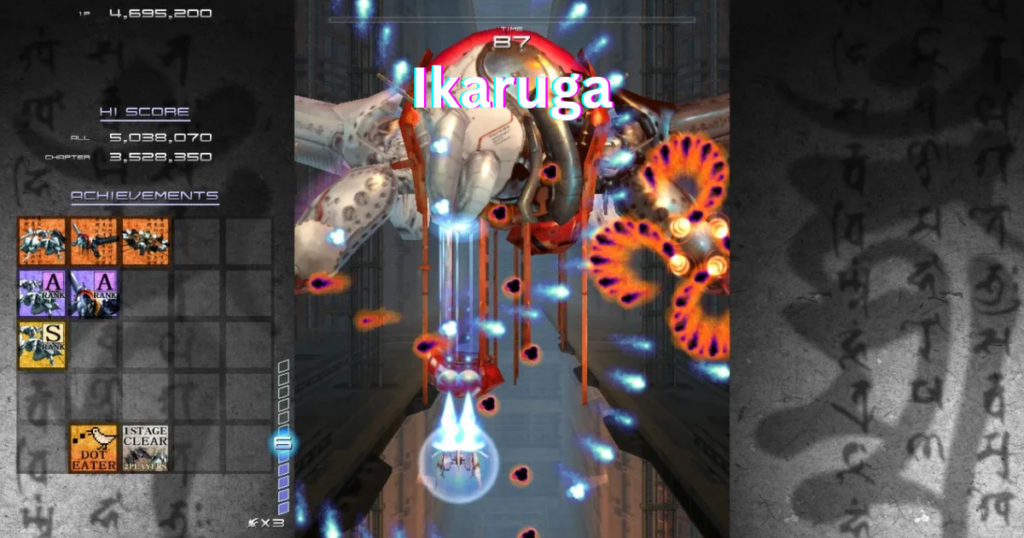
Hello everyone and welcome back to another blog post. Let’s get this out of the way: you are not good enough for Ikaruga. Neither am I. In an era where games gently pat your head for remembering to breathe, this 2001 shoot-em-up remains a glorious, beautiful, and utterly merciless monument to a simple idea: maybe video games should make you feel like a complete idiot.
Ikaruga isn’t just “that really hard Japanese shooter.” That’s like calling a shark “a somewhat bitey fish.” It is a high-speed logic puzzle disguised as chaos, a game so perfectly engineered that your failure is always, unequivocally, your own fault. And we keep coming back for more punishment. Why?
The One Mechanic That Broke Everyone’s Brain
Forget everything you know about shoot-em-ups. The standard “dodge everything, shoot everything” playbook is useless here. Ikaruga introduces a polarity system so elegantly simple it will break your mind.
Your ship—a sleek thing called the Ikaruga—can switch between black and white. Enemy bullets of the matching color heal you (well, they charge your world-annihilating super laser). Bullets of the opposite color? They send you back to the start of the section. You deal double damage to enemies of the opposite color. This turns every millisecond into a tactical decision.
You’re not just dodging a rainbow of death. You’re navigating it, consciously surfing on the white bullets while the black ones harmlessly pass through you, then flipping at the precise moment to do it all over again. It transforms the screen from a terrifying mess into a solvable circuit board. Or, at least, that’s what the experts claim. To the rest of us, it still looks like a printer explosion in a tar factory.
The Real Game Isn’t Shooting—It’s… Color-Coded Accounting?
Here’s where Ikaruga reveals its true, diabolical nature. If you just want to survive, you can. But if you want to score? To climb the leaderboards and have the game’s hauntingly beautiful soundtrack whisper, “You are worthy?”
You must master “chaining.”
Destroy three enemies of the same color in a row, and you start a chain. Break the sequence—say, by vaporizing a white enemy when you were on a black streak—and the chain resets. The entire game is designed around these meticulously planned chains. To score big, you must memorize the exact order and color of every enemy spawn across five grueling stages.
So, you’re not really playing a reflex test. You’re executing a pre-memorized, color-coded ballet at mach speed. You’re a concert pianist who must also dodge landmines. It’s the most stressful sudoku puzzle ever conceived.
How to (Try to) Play It in 2026 Without Rage-Quitting Forever
The good news is that this masterpiece is more accessible than ever. The definitive way to play is, without a doubt, on the Nintendo Switch. Why? One word: Tate mode.
You can rotate the screen 90 degrees, turning your Switch (preferably in a Flip Grip or similar accessory) into a miniature arcade cabinet. This is how the game was meant to be seen—tall, glorious, and filling your entire field of vision with patterned hell. It also makes the bullet patterns slightly easier to read. Slightly.
The PC version is a close second, especially for score addicts who live for the global leaderboards. The original GameCube and Dreamcast releases? They’re for collectors and masochists who enjoy the “authentic” experience of having their dreams crushed on period-accurate hardware.
A tip from someone who has seen the “Game Over” screen more than their own home: Use the unlimited continues. The game offers them. It wants you to see its later levels. Anyone who tells you this is “cheating” is a person who has never experienced the soul-crushing, brick-wall difficulty spike of Chapter 3. Your goal for the first ten hours is not to win. It is to bear witness.
Why This Relic Still Feels Fresher Than 90% of Modern Games
In 2026, we’re drowning in live-service games that demand our time, open worlds that beg to be checked off, and algorithmically generated content designed to be “engaging.” Ikaruga is the antithesis of all that.
It is a complete, authored, and closed system. Every single bullet is placed with purpose. Every enemy spawns at a precise millisecond. There is no randomness, no grinding, no loot box that will make you better. There is only you, the machine, and your own painfully acquired skill.
Its longevity is a testament to perfect design. There’s no fluff, no filler, no lengthy dialogues about the emotional weight of being a spaceship. It is pure, uncut game—a test of focus, memory, and nerve. Beating a level you’ve struggled with for weeks delivers a high no battle pass reward can ever match.
The Final, Unasked-For Opinion
Should you play Ikaruga?
If you view games as a relaxing escape, a way to turn your brain off after a long day, then run. Run far away. This is not that. This is coming home after a long day and deciding to do theoretical physics in a hurricane.
But if you’re tired of being handheld, if you crave the satisfaction of conquering something that once seemed impossible, if you want to engage with one of the most brilliantly designed video games ever crafted… then yes.
It will frustrate you. It will humiliate you. You will curse its name. And then, one day, you’ll flawlessly weave through a storm of black and white, your chain counter climbing, the music swelling, and for a few glorious seconds, you’ll feel like a god.
Then you’ll immediately die on the next screen. Some things never change.