
Hello everyone and welcome back to another blog post. As a gamer who has spent more time staring at “Game Over” screens than actual game worlds, and as someone who writes professionally about video game design, let me assure you: challenge in games is subjective. But some indie games go beyond “tough” into the territory of life-consuming, controller-chucking, existential despair—and we love them for it.
Why do indie developers seem to specialize in crafting such uniquely punishing experiences? Indie developers have the freedom to pursue a singular, often brutal, creative vision. They target players who crave not just a game, but a trial by fire—a grueling test of skill where victory is earned, not given. According to industry data, 34% of dedicated indie game buyers cite “innovation and uniqueness” as a top priority, compared to just 28% of traditional game buyers. These are the 10 Hardest Indie Games.
The Selection Gauntlet: How We Picked These Tormentors
This isn’t just a list of games that made me cry (though there was some of that). To ensure we’re talking about quality suffering, not just cheap frustration, we applied some ruthless criteria:
Legitimate Skill Tests: We focused on games where the primary challenge stems from demanding combat, unforgiving platforming, or deep strategic play, not from obscure puzzles or tedious grinding (though some grinding is inevitable).
Default Difficulty as a Benchmark: The base game experience had to be hard. Games that only become challenging with optional, self-imposed rules didn’t make the cut.
Critical & Community Acclaim: Each title here is notorious within gaming circles for its difficulty and has generally high review scores. This is about respected, skill-based torment.
Now, steel your nerves. We’re counting down from tough to absolute soul-crushing.
10. Salt and Sanctuary
The Gist: 2D Dark Souls. Period.
Why It’s Brutal: This game transplants the oppressive atmosphere, weighty combat, and “drop your currency on death” mechanic of Dark Souls into a sprawling Metroidvania world. The world is dreary, enemy placement is cruel, and the bosses are eldritch monstrosities designed to flatten you for the slightest mistake. It’s a masterclass in adapting a famously difficult formula into a new dimension.
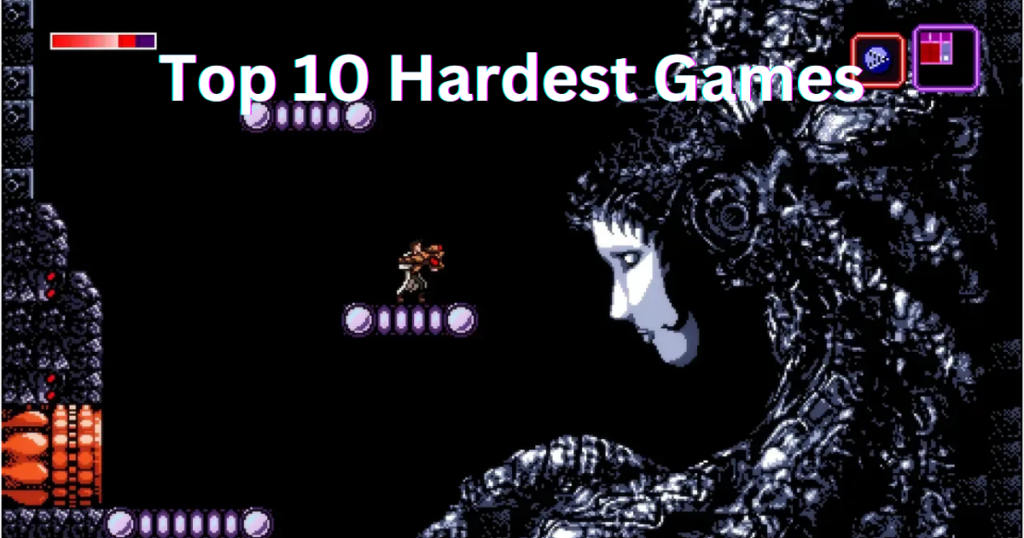
9. Axiom Verge
The Gist: A Metroid homage that’s meaner than its inspiration.
Why It’s Brutal: While it follows the exploration blueprint of classics like Super Metroid, Axiom Verge sets you loose in a more hostile and confusing alien world with fewer safety nets. Its genius “Hard Mode” doesn’t just tweak numbers; it fundamentally transforms the experience with reduced health and higher damage, demanding perfect play and thorough exploration from the first screen.
8. Crypt of the NecroDancer
The Gist: A dungeon crawler where if you miss the beat, you’re dead meat.
Why It’s Brutal: This roguelike forces you to move and attack to the pulse-pounding soundtrack. Dying sends you back to the start. 100% completion requires mastering this rhythm-based combat across all characters, including the infamous “Coda,” who has half a heart, double speed, and dies if you miss a single beat. It’s a unique, nerve-shredding fusion of skill sets.
7. Dead Cells
The Gist: A “roguevania” with breakneck combat and zero forgiveness.
Why It’s Brutal: This game is brutally fair. Its hack-and-slash combat is fluid and responsive, which makes every death feel like your fault. The challenge ramps up mercilessly as you unlock higher “Boss Cell” difficulty levels, spawning tougher enemies earlier and removing healing sources.
6. Celeste
The Gist: A beautiful, heartfelt story about anxiety… wrapped around one of the hardest platformers ever.
Why It’s Brutal: The main story is challenging but manageable. The true hell begins with the B-Sides, C-Sides, and the monumental Farewell chapter. To 100% this game, you must collect golden strawberries, which require completing entire chapters without dying a single time. What starts as a tough platformer evolves into a pixel-perfect puzzle of air dashes and wall jumps that will push your patience to its limit.
5. Terraria
The Gist: A deceptively cute sandbox that transforms into a boss-rushing nightmare.
Why It’s Brutal: On “Journey” mode, it’s a peaceful building game. Switch to “Master Mode” and it becomes a ruthless survival RPG. Bosses like the Wall of Flesh or the Empress of Light (especially in daylight) demand perfect arena preparation, gear optimization, and twitch reflexes.
4. Slay the Spire
The Gist: A deck-building roguelike where RNG is your frenemy.
Why It’s Brutal: True mastery here isn’t about getting a lucky card draw; it’s about building a synergistic deck from random offerings and managing resources across an entire run with no full heals. The “Ascension” levels, which permanently increase the difficulty up to level 20, require an encyclopedic knowledge of enemy patterns, card synergies, and relic interactions. One wrong card pick can doom a run an hour later.
3. The Binding of Isaac: Rebirth
The Gist: A bullet-hell roguelike with thousands of hours of abominable content.
Why It’s Brutal: With over 600 achievements and a completion mark system that requires beating the game multiple times with different characters on increasingly harder paths, this is a commitment of biblical proportions. Characters like The Lost die in two hits, and true 100% completion (involving “Dead God” saves) is a task so herculean that only a fraction of a percent of players ever achieve it. It’s the Everest of indie completionism.
2. Hollow Knight: Silksong
The Gist: The highly anticipated sequel that took the original’s beautiful, melancholic challenge and decided to weaponize it from minute one.
Why It’s the New Hardest: If Hollow Knight was a tough but fair dance, Silksong is a chaotic mosh pit. It begins where the original’s difficulty peaked. Early-game bosses have the complex, screen-filling attack patterns of the original’s endgame, and enemy attacks regularly deal double damage, instantly putting you on the back foot. The new protagonist, Hornet, is wildly acrobatic, but her moves—like the angular Silk-Roll or dive-bomb Pogo Dive—demand a complete un-learning of Hollow Knight muscle memory, penalizing old habits brutally. Long, punishing platforming gauntlets leading to bosses are the new standard, making every death a significant setback. It’s the logical, ruthless evolution of Team Cherry’s design philosophy, crafted specifically for those who thought the Pantheon of Hallownest was a warm-up.
1. Super Meat Boy
The Gist: The pure, uncut essence of precision platforming.
Why It’s the Hardest: While newer games have more content, no game on this list matches the raw, undiluted difficulty per second of Super Meat Boy. Levels last mere seconds, but demand a sequence of perfect jumps, slides, and wall-jumps. To 100% it, you must A+ every level, including the pitch-dark “Dark World” versions. The margin for error is zero. It’s the foundational text for modern hardcore platforming, and it remains arguably the most technically demanding game ever made.
A Final Word of “Encouragement”
So there you have it, our list of the 10 Hardest Indie Games. A curated selection of digital self-flagellation. Remember, these games aren’t just hard; they’re elegantly hard. They replace frustration with a strange, compelling rhythm of failure, learning, and incremental improvement. When you finally beat that pantheon or snag that golden strawberry, the victory isn’t just on the screen—it’s a real, chemical high of success.
These indie devs, with their smaller teams and bigger creative freedom, have mastered the art of making you love the punishment. Now, if you’ll excuse me, I have to go try (and fail) to survive the opening biome of Silksong for the 50th time. It’s fine. Everything is fine. If you want to check some of these titles out, click here to see the Steam store, or here for gog.com.