
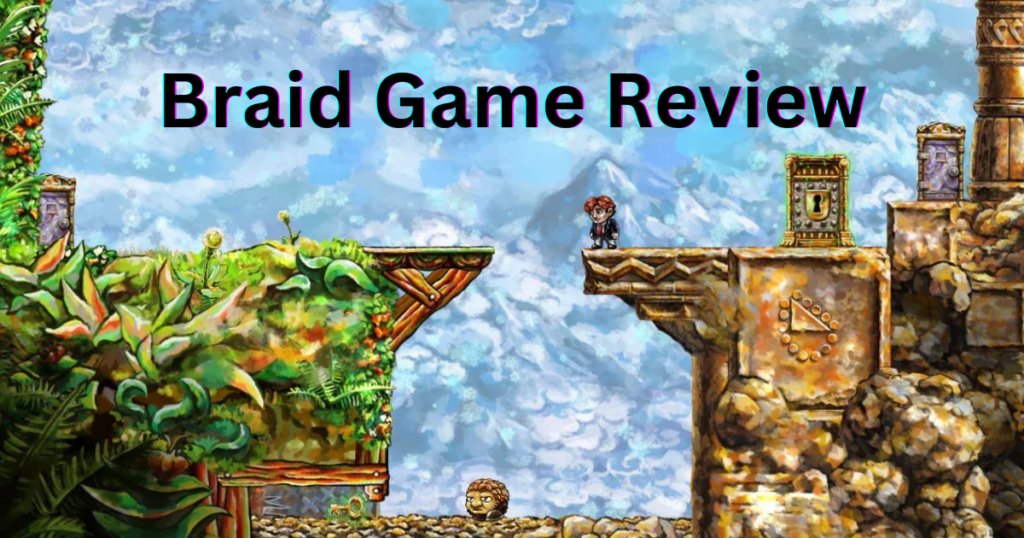
Hello everyone and welcome back to another blog post. In August 2008, a quiet revolution arrived on Xbox Live Arcade. Braid, a modest-looking puzzle-platformer, challenged players not just with tricky jumps but with philosophical concepts wrapped in time-manipulation mechanics. This wasn’t another Mario clone—it was a game about regret, obsession, and the scientific process disguised as a princess rescue mission. Remarkably for its time, the game encouraged failure as part of its design philosophy, which ironically made it one of the most rewarding experiences in gaming history.
The DNA of a Masterpiece: More Than a Princess Rescue
Braid begins with what appears to be a straightforward premise: Tim, our protagonist in a sharp blue suit and red tie, seeks to rescue a princess from “a horrible and evil monster”. But as players progress through six distinct worlds, this simple narrative unravels into something far more complex and personal. The game’s structure is anything but linear—you move between levels representing different rooms of Tim’s house, each with its own temporal rules.
The genius lies in how these time mechanics become the game’s language. In World 2, you can freely rewind any mistake, a surprisingly forgiving mechanic for a platformer. By World 3, certain objects glow with green immunity to your time manipulations, forcing you to think in paradoxes. World 4 ties time’s flow to horizontal movement, while World 5 introduces shadow clones that execute past actions in parallel realities. Each mechanic functions like a scientific principle to be observed, tested, and mastered.
The visuals provide subtle storytelling cues too. What initially appears as a setting sun behind Tim is actually a constant fixture—a visual representation of the game’s non-linear relationship with time. Even your failures become data points rather than setbacks; after all, you can’t die in the traditional sense, only learn through temporal experimentation.
When Time Rewrites the Rules: The Philosophy in the Puzzles
Jonathan Blow, the game’s designer, invested $200,000 of his own money over three years of development—a considerable gamble that paid off spectacularly. His motivation wasn’t to create just another game but a critique of contemporary game design trends, where time manipulation mechanics rarely had meaningful consequences.
What sets Braid apart is how its mechanics embody philosophical concepts:
- The Price of Perfection: The rewind ability initially feels like a gift—who wouldn’t want to undo mistakes? But World 3’s text reveals the dark side of this power: Tim’s obsession with creating “the perfect relationship” through constant revision leads to a feeling of imprisonment. The princess, if always pleased perfectly, becomes a cage of expectations.
- The Irreversible Nature of Certain Choices: Despite the game’s emphasis on rewinding, certain puzzles like “Irreversible” present moments that cannot be undone—a sobering counterpoint to the fantasy of total control.
- Multiple Perspectives: The final revelation—that Tim might be the monster the princess flees from—forces players to reconsider everything they thought they knew about their mission. That trusty rewind button suddenly becomes a mechanism for examining one’s own culpability.
A Cultural Artifact That Shaped Indie Gaming
Braid arrived at a pivotal moment for independent game development. As the first major title featured in the documentary Indie Game: The Movie, it demonstrated that small teams with big ideas could achieve critical and commercial success. The game went on to generate nearly $6 million in revenue, which Blow used to fund his subsequent project, The Witness—a testament to how artistic games could be financially sustainable.
The game’s 2024 “Anniversary Edition” added new levels and developer commentary, introducing the classic to a new generation while affirming its lasting relevance. Steam reviews continue to describe it as “beautiful, entertaining, and inspiring,” with a “Very Positive” rating maintained years after its original release.
But what truly sets Braid apart is its refusal to provide easy answers. Is Tim truly a monster? Is the princess a person, an ideal, or a metaphor for the atomic bomb (as some interpretations suggest)? The game invites multiple readings without endorsing any single one—a rare quality in any medium, let alone video games.
Timeless Design in a Time-Bending Game
Braid remains essential playing because it represents what games can be when they trust players with complexity. It respects intelligence over reflexes, curiosity over completionism. The game’s puzzles don’t just challenge your timing—they challenge your perception of cause and effect, your understanding of narrative, and even your moral compass.
In an industry increasingly focused on cinematic spectacles and multiplayer services, Braid stands as a reminder that sometimes the most profound journeys happen not across vast digital landscapes but within the shifting possibilities of a few beautifully crafted puzzles. You might enter thinking you’re playing a game about rescuing a princess, but you’ll leave contemplating much more—the nature of regret, the illusion of control, and the stories we tell ourselves to make our mistakes bearable.
And really, what could be more horrifying—or illuminating—than discovering that the monster you’ve been chasing all along is your own reflection in the temporal mirror?
Nicee
Thank you for reading!
🤩
😁