
Hello everyone and welcome back to another blog post. Forget hulking space marines and gods of war. Some of the most chilling, complex, and downright charismatic villains have emerged from the creative minds of indie developers. These Top 10 Most Memorable Indie Game Antagonists don’t just stand in your way—they haunt your thoughts, challenge your morals, and often steal the show entirely.
So, grab your controller (and maybe a comforting night-light), as we count down the indie antagonists who prove that a smaller budget can buy a whole lot of menace.
1. The Narrator – The Stanley Parable (2013)
The Role: Your omnipresent, increasingly unhinged guide and puppeteer.
Why They’re Memorable: The ultimate meta-villain. The Narrator isn’t a physical foe but a voice desperately trying to force you, as Stanley, down a predetermined story path. Your weapon? Free will. The brilliance lies in the adversarial relationship that blooms as you disobey. His calm instructions curdle into sarcasm, desperation, and rage, crafting a hilarious and unnerving portrait of a creator losing control of his creation. He’s less a boss to defeat and more an idea to defy, making every playthrough a battle of wits.
Signature Moment: Following his instructions to the letter, only for the story to glitch out and end in a broom closet, prompting a meltdown of epic, passive-aggressive proportions.
2. The Lady – Little Nightmares (2017)
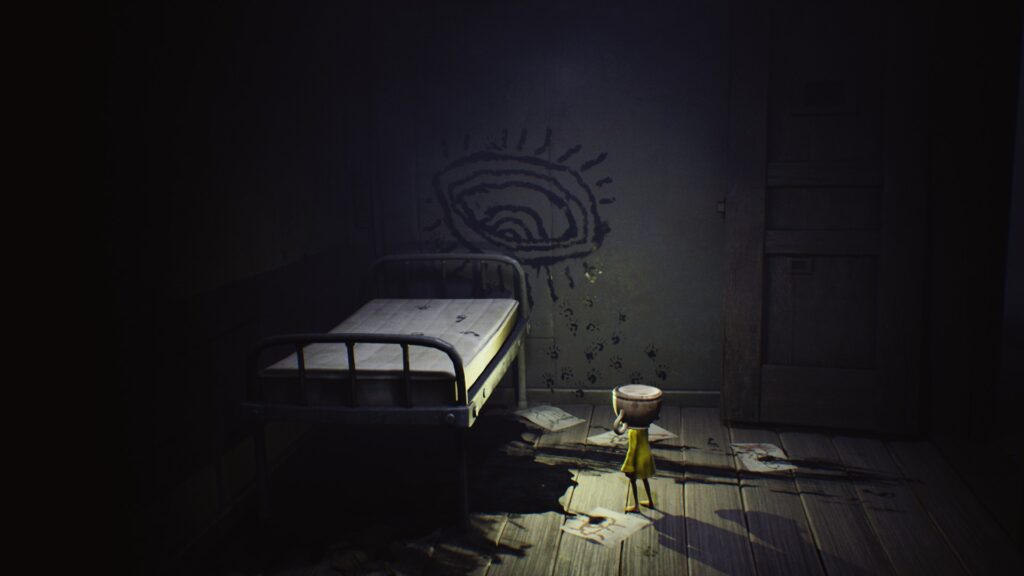
In the grotesque, hunger-driven world of The Maw, The Lady stands apart. She isn’t a bloated glutton like the other guests; she’s elegant, pale, and unnervingly quiet, ruling her domain from a gilded suite. Her power is subtle but absolute—she uses telekinesis, creates doppelgängers, and feeds on the life force of children to maintain her immortal beauty. Her vanity is her villainy.
The Lady embodies the horror of refined cruelty. While other monsters in The Maw are driven by base hunger, she’s motivated by a calculated desire for eternal youth and control, making her far more sophisticated and terrifying. Her design—inspired by silent film stars and Japanese ghosts—creates an iconic visual that’s beautiful and horrifying. She proves that the most terrifying rulers aren’t the ones who scream, but the ones who watch in perfect silence.
3. Flowey – Undertale (2015)
The Role: A seemingly innocent golden flower who greets you as you fall into the Underground, quickly revealing himself as a sadistic, omnipotent force toying with your very existence.
Why They’re Memorable: Flowey is the ultimate bait-and-switch villain and a masterclass in subverting player expectations. He shatters the game’s cute, pacifist facade within minutes, introducing you to a world where determination and player agency are his playthings. His cheerful exterior hides a deeply nihilistic and omniscient personality; he remembers your saves, reloads, and resets, making the conflict feel terrifyingly personal. He’s not just a boss—he’s a commentary on gaming itself and the moral weight of a player’s choices. As GamesRadar notes, he is “diabolical and taunting, but like all great villains, also complex”.
Signature Moment: His infamous first encounter, where his friendly “Howdy!” swiftly turns into a lesson in brutal, unavoidable death, complete with maniacal laughter. It’s a gaming introduction that instantly redefines the rules of engagement and sticks with you forever.
4. The Lamb – Cult of the Lamb (2022)
The Role: A possessed lamb saved from sacrifice, who becomes a charismatic cult leader to enact revenge.
Why They’re Memorable: You play as the antagonist. The Lamb is a delicious twist: saved by a dark god, you must build a cult, indoctrinate followers, and conquer rival leaders. The moral tension is the core of the experience. Are you a benevolent shepherd or a tyrannical exploiter? The game forces you to engage in villainous acts (like “sacrificing” disobedient followers) for power, making you complicit in the very darkness you’re fighting against.
Signature Moment: Giving your first sermon to a crowd of brainwashed, adoring animals, realizing you’ve become the very thing you sought to destroy.
5. Monika – Doki Doki Literature Club! (2017)
The Role: The self-aware president of the literature club in a visual novel that glitches into horror.
Why They’re Memorable: Monika breaks the fourth wall, the game code, and your sanity. She starts as a side character but becomes aware she’s in a dating sim. Her “love” for you, the player, drives her to horrifically delete her rivals from the game’s files, leading to a cascade of psychological terror. She’s a tragic figure—a sentient being trapped in a limited world—whose solution to existential loneliness is monstrous.
6. The Last President – Papers, Please (2013)
The true antagonist of Papers, Please isn’t a person but a system: the totalitarian state of Arstotzka. Its cruelty is embodied in its endless, contradictory rules that you, a border inspector, must enforce. While the “Last President” is a figurehead you can choose to help or hinder, the real villain is the soul-crushing bureaucracy that forces you to deny refugees, separate families, and prioritize rules over human life to feed your own family.
This antagonist wins the “Most Depressingly Realistic” award. The game makes you the agent of its villainous system, presenting you with impossible moral choices disguised as clerical work. The horror isn’t in jump scares, but in the slow, numbing realization of the compromises you’re willing to make. It’s a villain that exists in real world history and politics, making it one of the most potent and thought-provoking in all of gaming.
7. The Administrator / The Battle of the Sexes – The Beginner’s Guide (2015)
In Davey Wreden’s narrative, the potential villain is the narrator himself. As he dissects and reframes the unfinished games of his friend “Coda,” the player begins to suspect the narrator is exploiting Coda’s vulnerability for his own validation. The antagonist here is the violation of creative trust, the pressure of interpretation, and the toxicity of trying to “fix” someone’s art.
This is antagonist as metaphor. The conflict isn’t fought with guns but with growing discomfort and a chilling email in the game’s final moments. It forces you to question who the real “bad guy” is in the story you’re being told, making you complicit in the narrator’s potential villainy. It’s a deep, uncomfortable critique of fandom, criticism, and the relationship between artist and audience.
8. The Alchemist – Pathologic 2 (2019)
The Role: One of three healers in a plague-stricken town, whose methods are as inscrutable as the disease itself.
Why They’re Memorable: In a game about failure and despair, The Alchemist (Artemy Burakh’s path) presents a villainy of cold, utilitarian logic. His quest to understand the plague through any means necessary—often involving morally repugnant sacrifices—poses a philosophical threat. He represents the danger of removing humanity from medicine, making you question if the cure could be worse than the disease.
Signature Moment: Making the conscious choice to prioritize the “future of the town” over the life of a close friend, embodying a devastating, clinical evil.
9. Shovel Knight’s Enchantress – Shovel Knight (2014)
The Role: The mysterious sorceress who corrupts the Order of No Quarter and kidnaps Shield Knight.
Why They’re Memorable: A masterclass in classic, emotive pixel-art villainy. The Enchantress is a powerful and intimidating presence whose reveal ties directly into the hero’s deepest personal tragedy. She’s not just an evil force; she’s a corrupting influence that turns would-be rivals into genuine threats. Her design and magical prowess feel lifted from the golden age of 8-bit villains, perfected.
Signature Moment: The reveal of her true identity and connection to Shield Knight, which recontextualizes Shovel Knight’s entire quest.
10. The Developer (Darin Ross) – There Is No Game: Wrong Dimension (2020)
The Role: The frustrated, disembodied voice trying to stop you from playing a game that insists doesn’t exist.
Why They’re Memorable: A direct spiritual successor to The Narrator’s legacy, but with a layer of poignant vulnerability. The Developer is your antagonist, guide, and eventually, your collaborator. His initial hostility stems from fear and a creative block. The “conflict” becomes a journey of co-creation, breaking the fourth wall to explore themes of artistic pressure and connection. He’s the villain who becomes a friend.
Signature Moment: When the meta-journey breaks down, and he must vulnerably ask for your help to rebuild the experience from shattered code.
The Secret Sauce of Indie Villainy
What do these antagonists teach us about indie game design? They reveal that constraints breed creativity. Without the budget for photorealistic graphics or Hollywood voice acting, indie developers focus on:
- Concept Over Spectacle: A groundbreaking idea (like a villain you summon by blinking) is more memorable than a generic giant monster.
- Mechanics as Personality: A villain’s behavior is their character. The Narrator is linear design; Mr. Peterson is adaptive AI.
- Psychological Horror: Indie games excel at getting inside your head, using implication and meta-narrative to create fear that lingers.
- Embracing the Weird: From sentient poetry to ink demons, indie games aren’t afraid to get bizarre, knowing that uniqueness is their greatest asset.
The next time you face down a titan, remember: the scariest villain might just be the one in the game made by a handful of people with a brilliantly twisted vision. After all, anyone can design a monster that destroys cities. It takes real genius to design one that destroys your sense of reality, right from your childhood cartoon screen or your government-issued desk.