
Hello everyone and welcome back to another blog post. Welcome to the Ministry of Admission, where your family’s survival depends on your ability to deny others theirs. Papers, Please, Lucas Pope’s iconic “dystopian document thriller,” remains as brutally relevant in 2025 as it was at its 2013 debut. This is a paperwork purgatory that masterfully blends bureaucratic puzzle-solving with gut-wrenching ethical dilemmas. Let’s dive in the Papers Please Review
An Introduction to a Bleak, Pixelated World
Developed by former Naughty Dog engineer Lucas Pope, Papers, Please casts you as an immigration inspector for the fictional, Soviet-styled nation of Arstotzka in 1982. You’ve just been assigned via a labor lottery to manage a border checkpoint in the grimy town of Grestin, recently reopened after a six-year war with the neighboring Kolechia. Your job is simple, repetitive, and soul-crushingly difficult: inspect the documents of the endless line of hopeful entrants.
The genius of the setup is its inversion of typical video game roles. You are not a hero. You are a cog in a cold, unforgiving state machine, and the game makes you feel every bit of the crushing pressure that comes with it.
Gameplay: The Bureaucratic Puzzle
The Core Loop
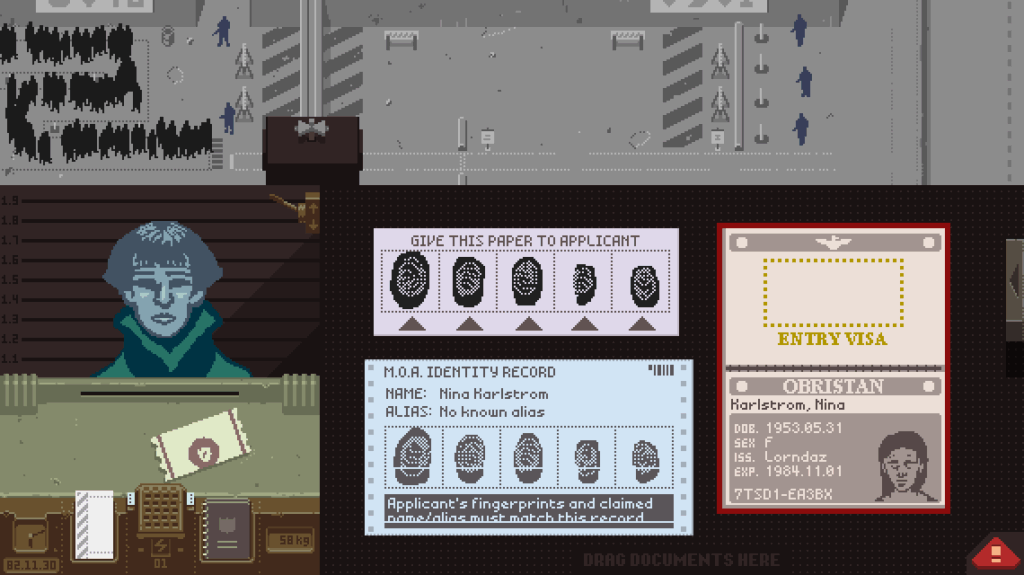
At its heart, Papers, Please is a puzzle game disguised as a simulation. Each day, you are given a new set of ever-changing rules from the Ministry. Your task is to check passports, entry permits, work passes, and other documents against these rules, looking for any discrepancies.
- Discrepancy Detection: You must cross-reference details like names, dates, passport numbers, and issuing cities. A mismatch means a denial. As days pass, the rules become more complex, requiring you to check vaccination certificates, identity supplements, and even conduct full-body scanners.
- Speed vs. Accuracy: You are paid based on the number of entrants you correctly process. Make a mistake—approve someone with faulty papers or deny a valid entrant—and you’re fined. This creates a constant, stressful tug-of-war between the desire to be thorough and the need to earn enough money to keep your family alive.
The Weight of Moral Choices
The gameplay loop alone is engaging, but where Papers, Please becomes a masterpiece is in its integration of narrative and moral choice. The game forces you to confront your own capacity for cruelty, all while justifying it as essential to “winning”.
You will encounter situations that test your humanity:
- A woman secretly passes you a note saying she’s being trafficked.
- A husband and wife are separated because one lacks proper documentation.
- A man begs to be let through to see his dying child.
Approving them might mean a financial penalty that causes your own family to go without food or medicine. Denying them preserves your income but forever stains your conscience. There are no morality meters here—just you, your decisions, and the consequences.
Characters & Storytelling: Life in the Lines
Despite its minimalist presentation, Papers, Please tells a deeply human story. The narrative unfolds through the people who stand in your booth and the events that happen between days.
- Your Family: Between shifts, you must manage your budget for heat, food, and medicine. Your family can—and will—get sick and starve if you fail. This isn’t a abstract game over screen; it’s a slow, painful failure state that makes your day-job desperation feel terrifyingly real.
- Recurring Characters: The line of entrants isn’t just random. You’ll meet memorable characters, most notably Jorji Costava, an adorable smuggler from a non-existent country called Cobrastan who keeps returning with increasingly ridiculous forged papers, including one drawn in crayon and marked “Pre-Approved”. His cheerful demeanor in the face of repeated detainment provides much-needed comic relief, even as he casually admits to strapping drugs to his leg.
- Larger Conspiracies: As the game progresses, you can get involved with a shadowy anti-government organization called EZIC, forcing you to choose between upholding the state that feeds your family or helping to overthrow it. With 20 different endings, your choices have a profound impact on how the story concludes.
Visuals, Audio, and Overall Experience
Aesthetics of Oppression
The game’s 8-bit, pixel-art style is a deliberate and effective choice. It mirrors the technological limitations of the early 80s setting and uses abstraction to powerful effect. The crude, lumpy character sprites make everyone look equally miserable, and the drab, grey color palette perfectly captures the bleakness of life under an authoritarian regime.
Sound of Dread
The sound design is equally masterful. The stomping Eastern Bloc soundtrack is a mix of “ominous parps and sinister trills”. The main theme you hear while walking to your booth each morning is ironically triumphant, making you feel like you’re high-stepping your way to your own personal hell—a fantastic touch of dark humor. Garbled tannoy announcements and the satisfying thunk of your approval stamp complete an audio landscape that is both immersive and deeply unsettling.
A Note on “Fun”
Is Papers, Please fun? In the traditional, lighthearted sense, no. It’s stressful, emotionally draining, and at times, deeply sad. However, it is compelling, thought-provoking, and unforgettable. It’s the kind of game that leaves a scar and changes your perspective on power, morality, and the human cost of bureaucracy.
The Final Stamp: Approval or Denial?
Pros & Cons at a Glance
The Verdict
APPROVED. Papers, Please is not just a game; it is a landmark piece of interactive art. Over a decade after its release, its commentary on authority, compassion, and survival remains powerfully resonant. While its deliberate pacing and nerve-shredding tension won’t be for everyone, those who appreciate being challenged—both intellectually and ethically—will find an experience that sticks with them long after the final stamp is pressed.
It’s a punishing, brilliant, and utterly essential play. Glory to Arstotzka, and may your family stay warm tonight. I hope you liked our Papers Please Review, and if you want to learn more, check out the game’s website here.